
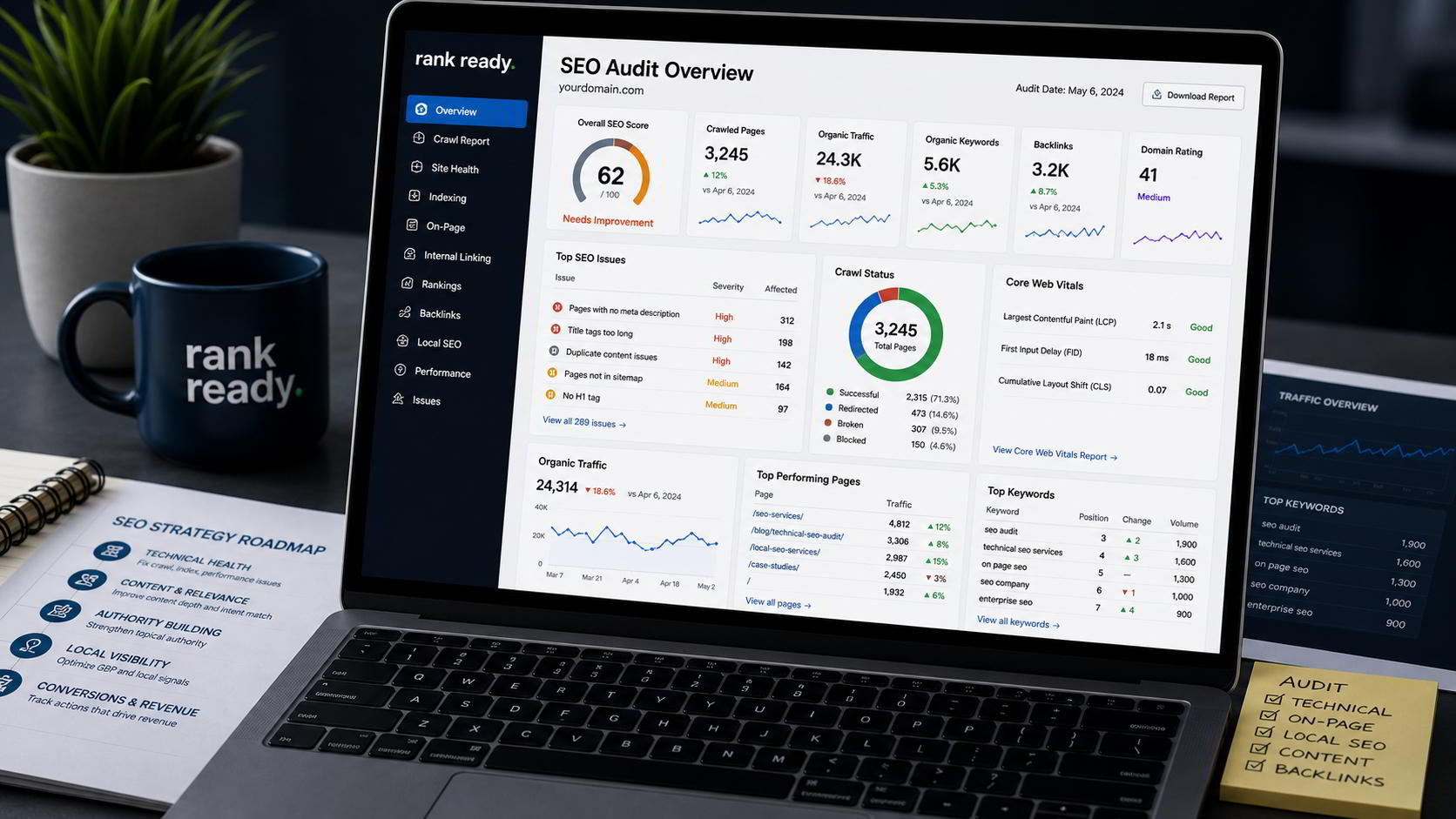
SEO bottlenecks are usually the real reason websites fail to rank — not missing meta tags, not publishing frequency, and not another 50 blog posts.
After auditing a few hundred sites in the last 18 months, a pattern keeps emerging — 80% of ranking problems trace to 2-3 root causes, not 200 small issues.
That’s the part most SEO agencies miss.
They hand clients a 70-page PDF full of warnings, color-coded scores, and technical trivia. Meanwhile, the actual ranking bottleneck sits untouched for another six months.
We’ve seen this across legal, healthcare, home services, real estate, and SaaS. One law firm increased organic traffic +312% in 6 months after fixing cannibalization and internal linking issues. A multi-location dental group eliminated duplicate-content clustering across 120 location pages by rebuilding location architecture properly.
Most SEO problems are not volume problems. They’re structural problems.
This post breaks down the seven SEO bottlenecks we repeatedly find in audits — including the one quietly costing businesses the most rankings, leads, and revenue.
Why Most “SEO Problems” Come Down to 2-3 Root Causes
More SEO activity does not mean more SEO progress
Most businesses assume poor rankings mean they need:
- More blog posts
- More backlinks
- More keywords
- More pages
Usually wrong.
The real issue is that one broken system suppresses everything else.
Most businesses think SEO bottlenecks are caused by dozens of small technical issues. In reality, a few structural SEO bottlenecks usually suppress everything else.
We regularly audit sites with strong backlinks, hundreds of indexed pages, and decent content quality — and still weak rankings.
Because one structural bottleneck is blocking authority flow, relevance clarity, or local trust signals.
These SEO bottlenecks often remain hidden because businesses focus on surface-level SEO activity instead of structural constraints.
“Most SEO audits don’t fail because they miss issues. They fail because they can’t identify which issue is actually suppressing growth.”
That’s the difference between checklist SEO and diagnostic SEO.
Our SEO audit process prioritizes revenue-impact bottlenecks first — not vanity warnings that look dramatic inside audit software.
Bottleneck #1: Wrong Primary GBP Category (The Highest-Leverage Fix)
One dropdown can destroy local visibility
This is still one of the highest-ROI fixes in local SEO.
A business selects:
- “Consultant” instead of “Marketing Agency”
- “Attorney” instead of “Personal Injury Attorney”
- “Dentist” instead of “Cosmetic Dentist”
Then wonders why competitors dominate the local pack.
Your primary Google Business Profile category heavily influences:
- Local pack eligibility
- Query relevance
- Competitor association
- Map visibility
We’ve seen category corrections increase:
- Local impressions by 40-70%
- Calls by 2-5× within 60 days
Elite Home Services increased inbound call volume 5× in 60 days after fixing GBP positioning and local relevance alignment.
Most agencies spend months tweaking websites while ignoring the profile generating the majority of local leads.
Some of the highest-impact SEO bottlenecks we uncover during local audits involve incorrect GBP categorization.
Our GMB management service exists because this single issue quietly suppresses local SEO performance more often than technical errors do.
Bottleneck #2: Cannibalization Between Service Pages
Your own pages competing against each other
Most service businesses accidentally create overlapping pages targeting the same intent.
Examples:
- Multiple “SEO services” pages
- Several near-identical city pages
- Blog posts competing with money pages
Google does not reward redundancy.
It splits relevance signals across multiple URLs and struggles to identify the primary authority page.
The result:
- Ranking volatility
- Weak topical authority
- Diluted link equity
We recently audited a legal site with 11 pages targeting variations of “personal injury lawyer.” After consolidation and restructuring, organic traffic increased +312% in 6 months.
Cannibalization is one of the most common SEO bottlenecks affecting service-based websites.
Cannibalization is rarely a content quality problem. It’s usually an architecture problem disguised as one.
Bottleneck #3: Schema Gaps Making Content Invisible to AI Engines
Most schema implementations are incomplete
Adding Organization schema once and forgetting about it is not a semantic SEO strategy.
AI-driven search systems increasingly rely on structured understanding:
- Entity relationships
- Geographic relevance
- Service categorization
- Content hierarchy
Without those signals, your site becomes harder for AI engines to interpret correctly — even if the content itself is strong.
NorthPeak SaaS increased AI engine citation visibility from 0% to 74% in 90 days after implementing structured entity optimization and semantic schema improvements.
The most common schema gaps we see:
- Missing Service schema
- Weak LocalBusiness markup
- No FAQ structure
- Missing geographic associations
Weak schema architecture is becoming one of the fastest-growing SEO bottlenecks as AI search evolves.
“Google stopped matching strings in 2013. Every agency still obsessing over keyword density is fighting the last war.”
Our semantic SEO methodology focuses heavily on entity architecture because AI visibility increasingly depends on structured understanding, not just keywords.
For schema implementation standards, Google’s own Search Central documentation remains the benchmark.
Bottleneck #4: Internal Linking That Passes Nowhere
Most internal links are decorative
A footer link is not an internal linking strategy.
Neither is:
- Generic “learn more” anchors
- Random blog cross-links
- Navigation-only structures
Strong internal linking distributes authority intentionally.
Weak internal linking traps authority inside disconnected sections of the site.
We regularly audit sites with:
- 300+ indexed pages
- Orphaned service URLs
- Minimal contextual links
One B2B SaaS company improved indexed page discovery by 38% and commercial keyword visibility by 29% without building a single backlink.
Poor internal authority flow remains one of the most overlooked SEO bottlenecks in large websites.
The fix was structural — not promotional.
Bottleneck #5: Thin Location Pages Triggering Canonical Clustering
The most expensive SEO mistake we see repeatedly
Most agencies build location pages by changing city names inside templates.
Google sees through this immediately.
Example:
- “HVAC Repair Dallas”
- “HVAC Repair Fort Worth”
- “HVAC Repair Arlington”
Same copy. Same structure. Same intent.
The result:
- Canonical clustering
- Weak indexing
- Duplicate-content suppression
- Local relevance dilution
We’ve audited franchises with:
- 200+ location pages
- Fewer than 15% properly indexed
MetroDental Group had 120 location pages triggering duplicate-content risk before restructuring local entity differentiation properly.
Thin local pages are easily among the costliest SEO bottlenecks for multi-location businesses.
“Most local landing pages aren’t failing because they’re too short. They’re failing because they say nothing unique.”
Our local landing page strategy focuses on building geographically distinct entity signals — not spinning city-name templates at scale.
Why this bottleneck costs the most
One weak page hurts one market.
One hundred weak pages suppress an entire regional growth strategy.
This is where businesses burn six figures on SEO campaigns that were structurally incapable of scaling.
Bottleneck #6: Title Tags That Match the H1 Instead of Search Intent
Relevance is not the same as alignment
A surprisingly common setup:
- H1: “Personal Injury Lawyer”
- Title tag: “Personal Injury Lawyer | Brand Name”
Technically relevant. Strategically weak.
Search intent matters more than exact-match repetition.
Better examples:
- “Injured in a Truck Accident? Speak With a Dallas Personal Injury Lawyer”
- “Emergency AC Repair in Phoenix — Same-Day Service Available”
We regularly see title rewrites improve CTR by 18-42% without ranking increases.
Intent misalignment creates SEO bottlenecks even when rankings appear technically stable.
The goal is not matching keywords mechanically. The goal is matching motivation.
Google’s own SEO fundamentals documentation reinforces this — titles should help users understand relevance instantly.
Bottleneck #7: No Tracking on the Actions That Actually Drive Revenue
Rankings are not business outcomes
Many businesses still measure:
- Traffic
- Rankings
- Impressions
…but not:
- Qualified calls
- Closed revenue
- Lead quality
That creates dangerous reporting blindness.
Mid-Atlantic Realty attributed $1.2M in organic revenue within 12 months because they tracked landing-page attribution and revenue by market.
Most analytics setups still miss:
- Call tracking
- CRM integration
- GBP conversion attribution
Missing attribution systems create SEO bottlenecks that distort decision-making and campaign priorities.
If you cannot connect SEO performance to revenue, you are measuring activity instead of impact.
Which One Costs the Most? Usually #5 — Thin Location Page Architecture
Scale multiplies the damage
Thin location page systems create compounding problems:
- Weak indexing
- Authority dilution
- Cannibalization
- Duplicate clustering
A 50-location rollout with weak differentiation does not create 50 ranking opportunities.
It creates 50 competing URLs suppressing each other.
That’s why local SEO architecture matters more now than ever — especially as Google and AI engines become more aggressive about filtering redundant content.
How to Find Your Version of These in 30 Minutes
Start with the highest-leverage checks first
You do not need enterprise software to identify most bottlenecks.
Check your GBP category
- Search your primary service keyword in Maps
- Check whether competitors use a different category
- Verify category alignment with commercial intent
Audit service page overlap
site:yourdomain.com "primary keyword"
If multiple pages target the same intent, you likely have cannibalization.
Review schema coverage
- Use Google Rich Results Test
- Use Schema Markup Validator
Analyze internal linking
- Count contextual internal links
- Check anchor relevance
- Identify orphan pages
Compare location pages side-by-side
If only the city name changes, Google already knows.
Check conversion tracking
- Can you track booked calls?
- Can you connect SEO to revenue?
- Can you identify top-converting pages?
If not, your SEO reporting is incomplete.
Most SEO campaigns do not fail because the competition was unbeatable. They fail because one structural bottleneck quietly suppressed everything else.
Wrong GBP categories. Thin location pages. Weak schema architecture. Cannibalized service pages. Broken internal authority flow. These are not “small technical issues.” They directly affect rankings, indexing, local visibility, AI citations, and revenue generation.
The good news: most of them are fixable faster than businesses expect — when you identify the right bottleneck first instead of chasing 200 low-impact tasks.
Finding the right SEO bottlenecks early is often the difference between slow growth and compounding organic revenue.
If your site has any of these — and odds are at least three of them — our free SEO + GEO audit identifies the specific 1-2 bottlenecks costing you the most rankings, along with a practical 30/60/90-day fix plan built around revenue impact, not vanity metrics.

0 Comments