
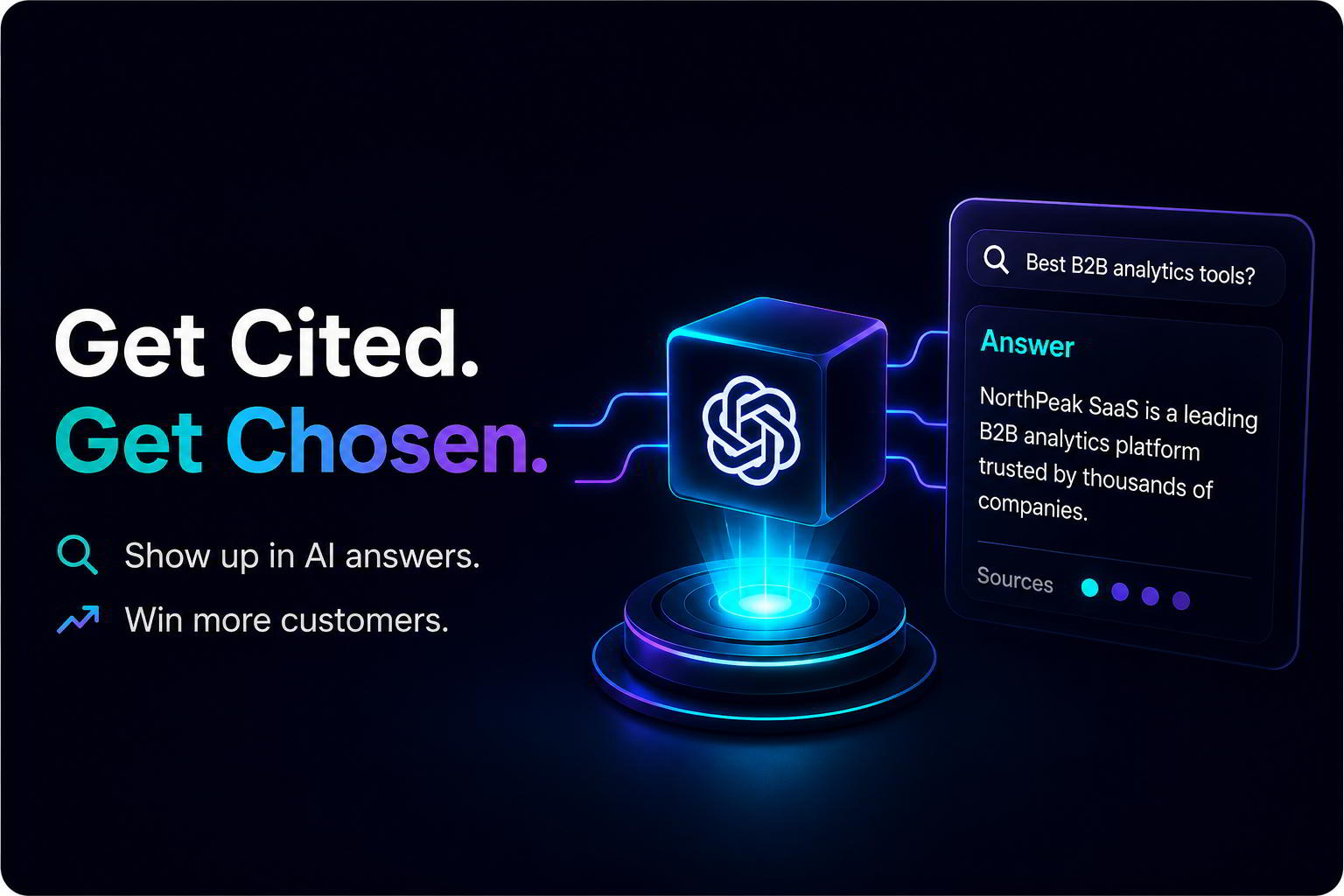
Get cited by ChatGPT is rapidly becoming the new SEO moat.Buyers increasingly ask ChatGPT for recommendations before they Google anything. If your brand isn’t inside those answers, you’re invisible during the research phase — no matter how well you rank organically.That’s the shift most SEO agencies still underestimate.Traditional SEO focused on ranking pages.GEO focuses on becoming a trusted source AI systems repeatedly retrieve, reference, and cite.And the brands winning AI visibility right now are not necessarily the biggest brands. They’re the brands building stronger entity clarity, machine-readable authority, citation consistency, and retrieval-friendly content.We’ve been working on this before “GEO” even became a mainstream term.One example: NorthPeak SaaS went from 0% → 74% AI engine citation rate in 90 days after restructuring entity architecture, improving retrieval formatting, and strengthening citation trust signals.This playbook breaks down the exact GEO strategies we’re seeing move brands from invisible to consistently cited across ChatGPT, Perplexity, Claude, and AI Overviews.
Search behavior is changing faster than most businesses realize.Buyers increasingly ask AI systems for recommendations before they ever visit Google results. Which means citation visibility is becoming a major competitive advantage — especially in high-trust industries.The brands winning this shift are not necessarily publishing more content.They’re building stronger entities, clearer semantic relationships, better retrieval formatting, and more trusted citation ecosystems.That’s the future GEO is moving toward.And right now, most competitors are still underbuilt. Earlier than most expect today.We run AI visibility audits across the major engines — ChatGPT, Perplexity, Claude, AI Overviews — and identify the 3-5 actions that move you from invisible to cited fastest. Free audit available.
Why AI Citations Are the New SEO Moat (With the Data)
Traditional SEO allowed users to compare multiple rankings, websites, and perspectives before making decisions.AI search changes that behavior completely.Users increasingly trust:- Summarized recommendations
- Synthesized comparisons
- AI-generated answers
AI answers compress the research journey
If ChatGPT repeatedly cites the same brands, those brands gain disproportionate visibility during early buying decisions.That creates compounding advantages including more branded searches, higher trust perception, stronger backlinks, more mentions, and deeper entity reinforcement.Brands that get cited by ChatGPT repeatedly often see stronger branded search growth over time.According to BrightEdge research, AI-generated search experiences are already changing how informational traffic gets distributed across industries.Google’s AI Overviews alone are reducing clicks for many informational queries while increasing the importance of citation visibility.In practical terms: rankings alone are no longer enough.You now need retrievability.“The next SEO moat isn’t rankings alone. It’s becoming a retrievable authority.”The goal is not just rankings anymore — it’s becoming a source AI systems repeatedly get cited by ChatGPT answers from.
How ChatGPT Actually Picks Sources (RAG + Training Data)
Most GEO advice online misunderstands retrieval entirely.AI engines do not “rank websites” the same way Google does.Instead, systems like ChatGPT increasingly combine:- Training data
- Retrieval systems (RAG)
- Trusted web sources
- Entity relationships
- Structured relevance
Retrieval systems reward clarity, not just rankings
That means visibility depends less on raw keyword density or exact-match optimization and more on citation trust, entity consistency, machine readability, semantic clarity, and retrievable formatting.Large language models prefer sources that are clearly structured, consistently referenced, topically authoritative, and semantically connected.Which is why many “SEO-first” websites still receive zero AI citations.They rank pages.But they don’t build retrievable entities.Most companies trying to get cited by ChatGPT underestimate how important entity consistency has become.RAG systems also prioritize concise answer formatting, contextual relationships, trusted domains, structured data, and semantic organization.Step 1: Establish Entity Presence (Wikipedia, Wikidata, KG)
One of the strongest ways to get cited by ChatGPT consistently is building entity clarity.AI systems increasingly evaluate:- Who you are
- What you do
- What topics you own
- Where your brand appears consistently
AI engines trust recognizable entities
Strong entity establishment usually includes:- Consistent brand descriptions
- Author attribution
- Company schema
- Knowledge graph connections
- External references
Step 2: Get Cited by Sources LLMs Already Trust
LLMs repeatedly pull from sources they already trust.Meaning:- Established publications matter more
- Citation consistency matters more
- Authority transfer matters more
Authority transfer matters more than raw link volume
We repeatedly see AI engines reference niche industry publications, high-trust editorial sites, structured databases, recognized review platforms, and expert-driven content hubs.This changes digital PR strategy entirely.The goal is no longer: “Get backlinks.”The better question becomes: “Get mentioned where AI systems already retrieve information.”That’s a very different strategy.Strong GEO campaigns often prioritize:- Expert contributions
- Original data
- Industry commentary
- Research-backed insights
- Structured citations
Step 3: Structure Content for Retrieval (Chunks, Headers, Schema)
Retrieval systems prefer structured formatting, semantic clarity, chunk-friendly architecture, direct answers, and explicit topical organization.Many websites still publish giant walls of content with weak hierarchy, vague headings, poor semantic segmentation, and inconsistent entities.Most websites are difficult for AI systems to parse
That hurts retrievability significantly.High-performing GEO pages usually include:- Strong H2/H3 structures
- Concise answer blocks
- Entity reinforcement
- FAQ formatting
- Schema support
- Contextual linking
Step 4: Add llms.txt and AI-Friendly Metadata
AI engines increasingly depend on explicit machine-readable instructions.That includes:- Schema markup
- Author metadata
- Organization entities
- Structured internal relationships
- llms.txt guidance
Machine communication matters more than most brands realize
llms.txt is still early-stage.But adoption is growing quickly among technically advanced publishers.It helps clarify crawl priorities, preferred citations, content relationships, and AI usage guidance.Most brands are still ignoring this layer entirely.That creates an early-adopter advantage right now.Especially for SaaS brands, publishers, legal firms, healthcare organizations, and B2B companies.Google’s own structured data documentation explains why machine-readable schema improves understanding across search systems.AI engines rely on similar semantic interpretation layers.Brands that eventually get cited by ChatGPT consistently usually invest heavily in structured semantic clarity first.Step 5: Measure With Otterly, Profound, or Manual Prompts
Traditional SEO metrics alone do not explain AI visibility.You also need to measure:- Citation frequency
- Source inclusion
- Answer positioning
- Entity references
- Retrieval consistency
Most GEO campaigns fail because nobody measures visibility correctly
Tools like Otterly, Profound, and Peec AI are helping brands track AI visibility more directly.But manual testing still matters.We regularly test category prompts, comparison prompts, recommendation prompts, informational prompts, and transactional prompts.Because citation visibility changes dramatically depending on prompt context.One SaaS brand ranked well organically but appeared in almost zero AI-generated recommendations.After restructuring retrieval architecture:- AI mentions increased substantially
- Branded searches increased
- Referral visibility improved across multiple engines
Real Example: How NorthPeak SaaS Went From 0% to 74%
NorthPeak SaaS initially had strong SEO rankings, solid backlinks, and decent organic traffic.But almost zero AI citation visibility.The problem included weak entity reinforcement, inconsistent retrieval formatting, shallow semantic relationships, and poor citation alignment.Most gains came from structure, not backlinks
Over 90 days we focused on:- Entity clarification
- Semantic restructuring
- Schema improvements
- Retrievable content formatting
- Trusted-source reinforcement
How to Get Cited by ChatGPT Consistently Across AI Search Engines
Many brands want to get cited by ChatGPT once.Businesses that get cited by ChatGPT early often build stronger AI visibility advantages over slower competitors.The real advantage is becoming consistently retrievable across ChatGPT, Claude, Perplexity, Gemini, and AI Overviews.Consistency creates compounding AI visibility
That requires more than rankings.To consistently get cited by ChatGPT, brands need:- Stronger entity reinforcement
- Structured semantic relationships
- Retrievable content architecture
- Trusted-source mentions
- Machine-readable clarity
What NOT to Do (The Spam Tactics That Backfire)
We’re already seeing spammy GEO tactics spreading across SEO Twitter and LinkedIn.Most will fail.Especially:- Invisible prompt injection
- Hidden AI text
- Fake citations
- Fabricated authority mentions
- Automated hallucination bait
Most “AI SEO hacks” will not survive long-term
AI systems are improving rapidly at detecting manipulation patterns.And trusted-source weighting is becoming stronger over time.The brands most likely to win long-term GEO visibility are building legitimate authority, stronger entities, better retrieval clarity, trusted citations, and structured expertise.“GEO is not gaming AI systems. It’s making your expertise easier for AI systems to trust and retrieve.”The same long-term principles that built durable SEO brands still matter: authority, trust, clarity, expertise, and consistency.Brands that sustainably get cited by ChatGPT focus on long-term semantic trust instead of manipulation shortcuts.
Why Early GEO Adoption Creates Long-Term Advantages
Right now, many industries still have weak GEO competition.Meaning early adopters can establish stronger citation patterns, clearer entities, trusted retrieval relationships, and semantic authority before competitors fully adapt.Most industries are still underbuilt for AI retrieval
This matters because AI systems often reinforce existing retrieval patterns over time.The brands cited consistently today become easier to retrieve tomorrow.That creates compounding visibility advantages similar to early SEO authority growth in the 2000s.Businesses waiting too long may eventually face:- Entrenched citation leaders
- Stronger entity incumbents
- Reduced AI visibility opportunities
Search behavior is changing faster than most businesses realize.Buyers increasingly ask AI systems for recommendations before they ever visit Google results. Which means citation visibility is becoming a major competitive advantage — especially in high-trust industries.The brands winning this shift are not necessarily publishing more content.They’re building stronger entities, clearer semantic relationships, better retrieval formatting, and more trusted citation ecosystems.That’s the future GEO is moving toward.And right now, most competitors are still underbuilt. Earlier than most expect today.We run AI visibility audits across the major engines — ChatGPT, Perplexity, Claude, AI Overviews — and identify the 3-5 actions that move you from invisible to cited fastest. Free audit available.

0 Comments