
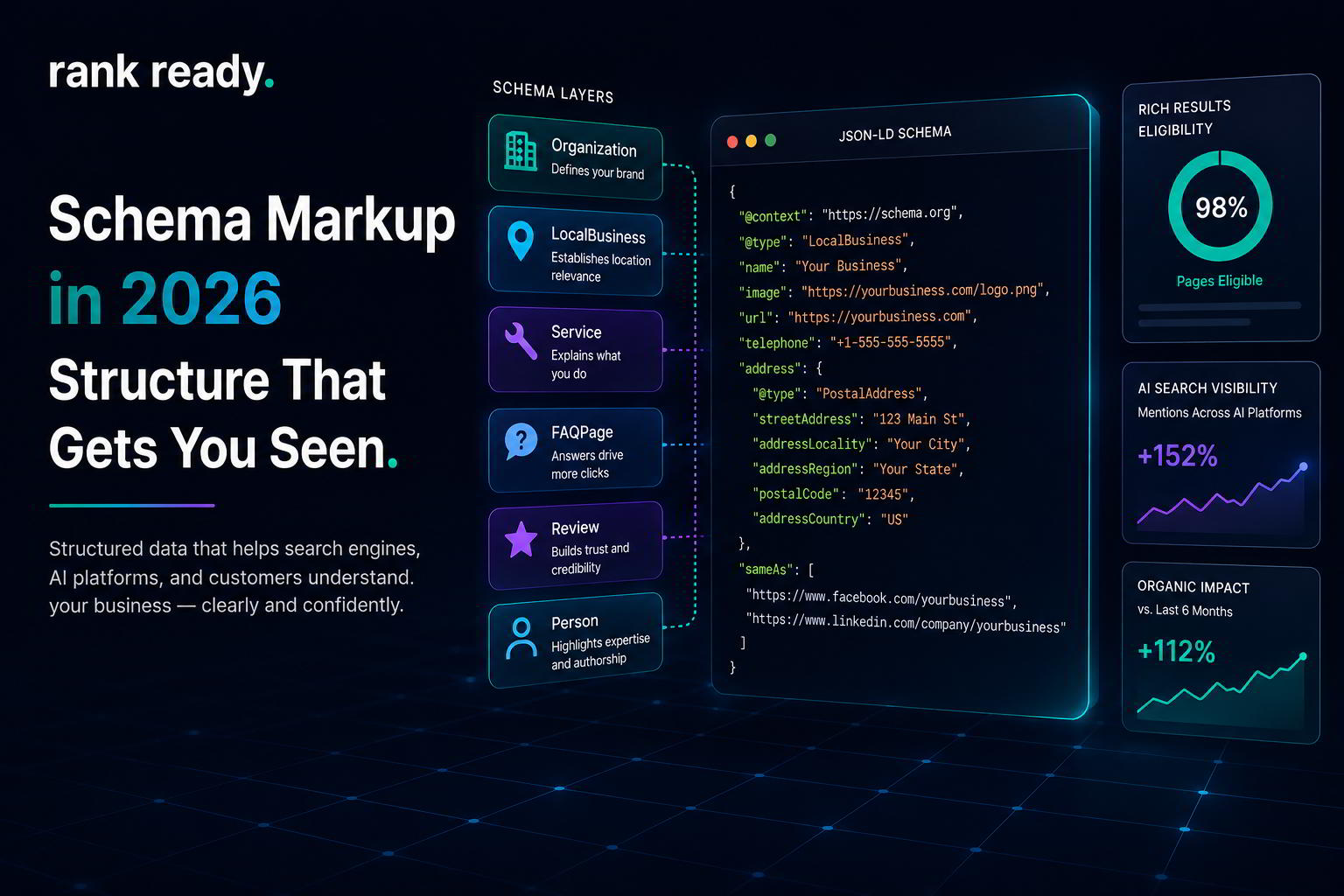
Why Schema Markup Types Matter More in 2026 Than Ever
Google’s search systems increasingly rely on structured understanding instead of keyword matching.AI engines work the same way.ChatGPT, Gemini, Perplexity, and Google’s AI Overviews all depend heavily on entity clarity, structured relationships, and machine-readable content.That is exactly what JSON-LD schema provides.Google’s own structured data documentation explains that schema helps search engines interpret page meaning and qualify pages for rich results.The gap between sites with advanced structured data and sites without it is widening fast.Most service businesses still underuse schema markup types across their highest-value pages. They may implement Organization schema once and assume the work is finished. Meanwhile, competitors using layered structured data, advanced JSON-LD schema, and service-specific entity relationships are building stronger eligibility for AI retrieval, richer search visibility, and more consistent indexing. We increasingly see service businesses gain measurable improvements in crawl clarity, branded visibility, and rich-result stability within 60–90 days after repairing incomplete schema ecosystems.
Another overlooked issue is inconsistency between visible content and rich results schema. Search engines compare structured data against on-page content continuously. If reviews, FAQs, services, or business details inside the schema do not align with visible page elements, trust weakens. That is why modern schema markup types implementation is not just technical formatting anymore — it is operational SEO infrastructure tied directly to entity trust and AI search understanding.
Google stopped matching strings in 2013. Every agency still obsessing over keyword density is fighting the last war.Schema is no longer optional technical cleanup. It is search infrastructure.
1. Organization Schema: The Spine of Structured Data
Every serious service-business website needs Organization schema.This becomes the central entity connecting:- Brand name
- Logo
- Social profiles
- Founders
- Locations
- Services
- Website
Why this schema matters
Without Organization markup, Google has weaker confidence about who owns the site and how the business connects across the web.That becomes especially important for branded searches and AI citations.Most websites still leave Organization schema incomplete:- No sameAs profiles
- No entity relationships
- No founder data
- No service associations
2. LocalBusiness Schema & Industry Subtypes
Generic LocalBusiness schema is not enough anymore.Google supports dozens of more specific schema variants:- Dentist
- Attorney
- HVACBusiness
- MedicalClinic
- RealEstateAgent
- AccountingService
Specificity improves entity understanding
A dental practice using generic LocalBusiness markup gives Google less contextual understanding than a practice using Dentist schema with provider relationships and treatment associations.That difference matters in competitive local markets.We saw this directly during the MetroDental rollout:- 120 location pages
- Zero duplicate-content flags
- Stronger local entity clarity across every office
3. Service Schema: Explain What You Actually Do
Most service pages still rely on headings alone to explain services.That is weak structured communication.Service schema explicitly defines:- The service offered
- The provider
- The service area
- Related entities
- Associated categories
Why this matters for GEO
AI search systems need structured clarity.Pages that clearly define service relationships are easier for AI engines to summarize, cite, and retrieve.This becomes even more important for multi-service businesses where:- One location offers implants
- Another focuses on Invisalign
- Another specializes in emergency care
4. FAQPage Schema: The Underused CTR Booster
FAQ schema remains one of the highest-leverage schema markup types for service businesses.Not because it magically improves rankings.Because it improves search visibility and click-through behavior.FAQ schema works best when answers are specific
Weak FAQ:“Do you offer free consultations?”Better FAQ:“How long does a dental implant consultation take at your Phoenix office?”Specific questions create stronger topical relevance and better long-tail search alignment.We regularly see FAQ-enhanced pages increase SERP real estate significantly compared to plain service pages.The mistake most websites make is adding generic filler FAQs with no semantic depth.5. Article & BlogPosting Schema for Content Authority
Every serious content strategy should use Article or BlogPosting schema.Yet many websites either skip it completely or apply identical schema sitewide.Why Article schema matters
Article schema helps search engines understand:- Publication date
- Author
- Publisher
- Headline
- Featured image
- Content relationships
- Legal
- Healthcare
- B2B SaaS
- Finance
6. Person Schema for Author Trust
Google increasingly evaluates who created content — not just the content itself.That is especially true in YMYL industries.Most author bios are structurally invisible
Many websites add author boxes visually but never structure them properly.Person schema can connect:- Credentials
- Experience
- Employer relationships
- Social profiles
- Published content
Authority is no longer just backlinks. It is identifiable expertise tied to real entities.
7. Review & AggregateRating Schema — Compliantly
Review schema is powerful. Abused review schema is dangerous.Google tightened review rich-result rules years ago, yet many sites still violate them.Common review-schema mistakes
- Self-serving review markup
- Fake aggregate ratings
- Hidden review content
- Ratings unrelated to visible content
- Visible reviews
- Real rating averages
- Legitimate reviewer associations
- Relevant services or products
8. BreadcrumbList Schema: Don’t Skip It
Breadcrumb schema looks small. It is not.BreadcrumbList markup helps Google understand page hierarchy and contextual relationships.Why hierarchy matters
A page living inside:/services/seo-audits/carries stronger contextual meaning when breadcrumb relationships reinforce that hierarchy structurally.This matters for:- Site architecture clarity
- Crawl efficiency
- Internal relevance
- AI understanding
9. WebSite & SiteNavigationElement Schema
Search engines need help understanding how your site is organized.WebSite schema defines the overall digital entity.SiteNavigationElement helps clarify primary navigational structure.Most enterprise websites leave this incomplete
That creates weaker contextual understanding across:- Core services
- Industry hubs
- Location structures
- Content clusters
10. HowTo & ItemList Schema for Tactical Content
HowTo schema remains underused outside DIY industries.That is a mistake.Service businesses publishing tactical educational content can structure:- Processes
- Workflows
- Step-by-step explanations
- Implementation sequences
ItemList schema improves list interpretation
Google can interpret ranked or ordered lists more effectively when ItemList schema is applied correctly.This matters for:- Best-practice lists
- Tool roundups
- Procedure sequences
- Service comparisons
11. SpeakableSpecification Schema for Voice & AI Search
Voice search never replaced traditional search the way marketers predicted.But AI retrieval changed the importance of speakable content dramatically.Why Speakable schema matters now
SpeakableSpecification helps identify content sections optimized for spoken playback and AI summarization.That matters because:- AI assistants summarize content
- Voice systems retrieve concise answers
- Conversational search keeps growing
12. ProfessionalService Schema Variants for Legal, Medical & Specialized Industries
Generic schema becomes weaker in regulated industries.Specificity matters more.Examples of stronger professional schema
- Attorney
- MedicalClinic
- Dentist
- FinancialService
- AccountingService
Common Schema Mistakes That Break Rich Results
Most schema problems are not missing schema.They are broken implementations.The most common schema failures
- Invalid JSON formatting
- Missing required fields
- Fake review markup
- Duplicate schema conflicts
- Plugin overlap issues
- Schema disconnected from visible content
How to Validate Structured Data Properly
Schema implementation without validation is guesswork.Every implementation should be tested using:- Google Rich Results Test
- Schema.org Validator
Validation should happen after deployment — not before
Many websites validate staging environments but never test live rendered pages.Rendered HTML can behave differently because of:- JavaScript conflicts
- CMS rendering issues
- Plugin duplication
- Deferred loading
The Sites Winning in 2026 Are Structurally Understandable
The businesses dominating modern search are not just publishing more content.They are building machine-readable ecosystems.Better schema. Better entity structure. Better semantic clarity. Better AI retrievability.Most websites still treat structured data like technical decoration.The ones pulling ahead treat it like infrastructure.That difference compounds over time.Schema is one of the highest-leverage technical fixes in modern SEO. We audit it across all 12 types and ship a complete implementation in 2–3 weeks for most sites.Most service businesses already have enough authority to earn stronger visibility — they just are not communicating their entities clearly enough for search engines and AI systems to interpret confidently. Our SEO audit service identifies missing schema opportunities, implementation conflicts, weak entity relationships, and rich-result blockers across your entire site. Schema is one of the fastest technical wins available right now. Get a schema audit on us.

0 Comments