
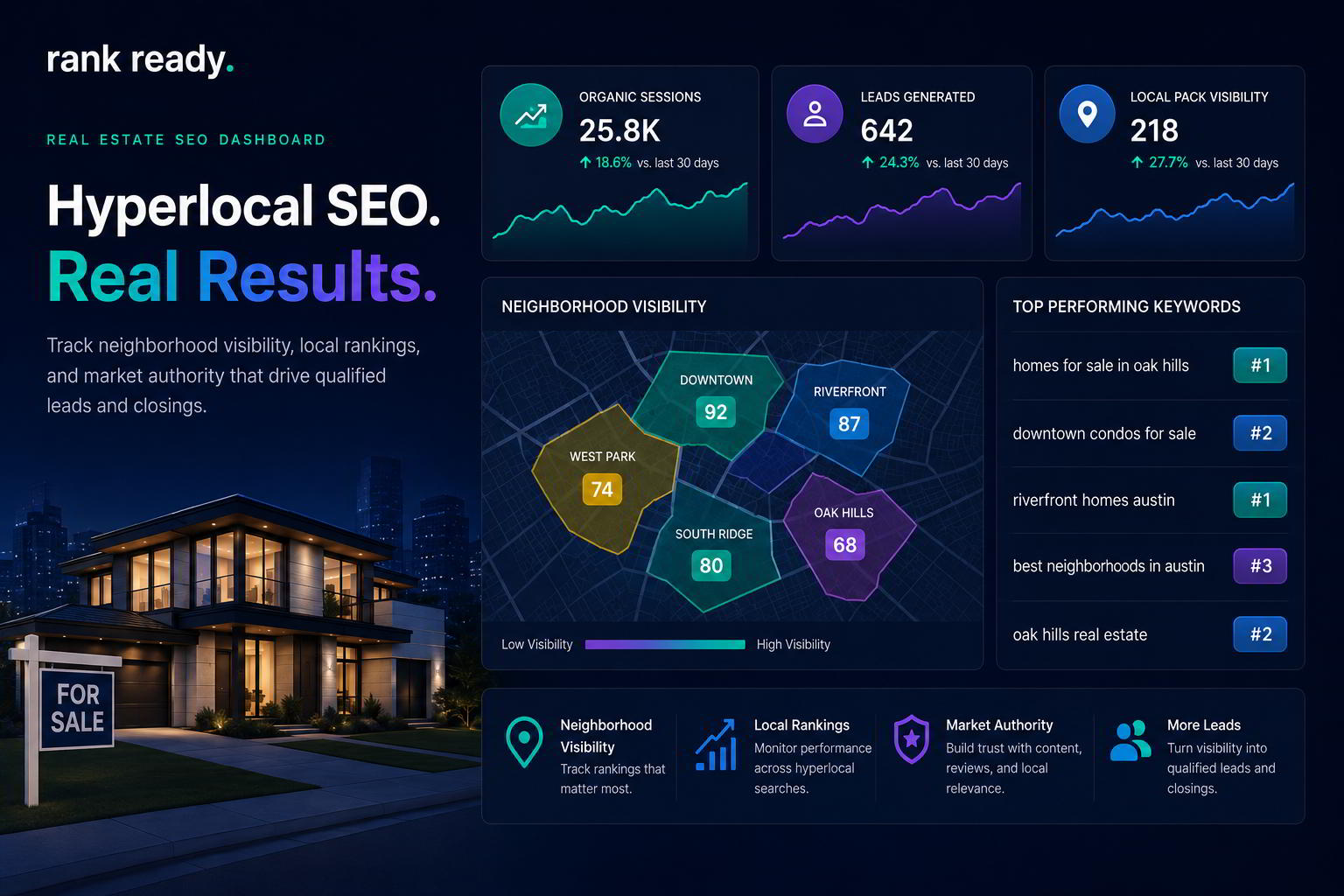
Trying to beat Zillow at “homes for sale in Austin” is a losing fight. But there’s a whole layer of high-intent queries Zillow can’t dominate — and that’s exactly where smart brokerages are winning.
Most real estate websites are fighting the wrong SEO war.
They chase massive head terms, publish generic blog posts, and wonder why Zillow, Redfin, Realtor.com, and Homes.com absorb nearly all the traffic.
Meanwhile, smaller brokerages quietly build local authority around neighborhoods, schools, relocation searches, market trends, and agent expertise — and generate leads Zillow struggles to convert with the same trust.
That is where modern real estate SEO gets interesting.
The brokerages winning in 2026 are not trying to out-Zillow Zillow. They are building hyperlocal authority ecosystems around intent Zillow cannot scale authentically.
Neighborhood expertise. Agent entities. Local market intelligence. Community-level trust.
That is the playbook.
Why Zillow Wins Certain Real Estate SEO Queries
Zillow dominates broad real estate search because its scale is almost impossible to replicate.
Millions of indexed pages. Massive backlink authority. Constant inventory updates. Strong behavioral signals.
For broad transactional searches like:
- homes for sale in Austin
- condos for sale in Miami
- houses for sale near me
Google already understands Zillow as an authoritative listing aggregator.
Trying to outrank them directly for those terms usually becomes an expensive distraction.Most modern real estate SEO campaigns fail because they target broad inventory terms instead of building neighborhood-level authority where local trust and expertise actually influence conversions.
Why aggregator authority compounds
Zillow benefits from:
- Constantly refreshed inventory
- Huge crawl frequency
- Massive backlink acquisition
- National brand trust
- Behavioral engagement signals
Most brokerages cannot compete at that scale.
And honestly, they should not try.
The brokerages winning organic search are not competing on scale. They are competing on specificity.
Another overlooked factor is user behavior. Large portals generate enormous click-through and engagement data because users repeatedly browse listings, save properties, compare homes, and return multiple times during the buying journey. Those engagement patterns reinforce authority signals continuously.
Independent brokerages rarely generate that volume. But they do not need to. They only need to dominate the right layer of intent.
The Real Estate SEO Queries Zillow Can’t Dominate
This is where opportunity starts.
Zillow struggles with searches requiring authentic local context, nuanced expertise, or community-level trust.
Examples:
- best neighborhoods in Austin for young families
- moving from California to Nashville guide
- East Austin vs Mueller property taxes
- walkable neighborhoods near downtown Tampa
- living in Scottsdale pros and cons
These searches require interpretation — not inventory aggregation.
Why neighborhood intent converts better
Hyperlocal queries usually signal stronger buying intent.
Someone searching:
“best gated communities in North Dallas for retirees”
is often far closer to conversion than someone casually browsing “homes for sale in Texas.”
This is where neighborhood SEO becomes a major competitive advantage.
The best-performing brokerage websites build authority around local understanding Zillow cannot mass-produce.
We regularly see brokerages generate stronger lead quality from neighborhood-focused traffic because users arriving through hyperlocal searches already trust the site as a local authority source instead of just another listing database.
Neighborhood-Level Content Is the Right Geographic Unit
Most brokerage websites organize content too broadly.
City pages alone are not enough anymore.
Google increasingly rewards granular geographic expertise.
Neighborhood pages outperform generic city pages
Strong neighborhood SEO pages typically include:
- School insights
- Walkability details
- Commute patterns
- Property tax information
- Lifestyle positioning
- Price trend analysis
- Inventory commentary
That creates semantic depth Zillow often lacks.
The same framework powers our local landing pages service, where neighborhood-level entity relevance matters more than generic geographic targeting.
Specificity builds trust
Weak page:
“Homes for sale in Austin.”
Better page:
“Best neighborhoods in Austin for remote tech workers relocating from California.”
Specificity attracts intent-rich traffic.
Strong neighborhood pages also age well because they continue earning relevance as local authority assets over time. Generic listing pages expire quickly. Evergreen local expertise compounds.
That is why many brokerages now structure entire content systems around neighborhood clusters instead of city-level landing pages alone.
Market Reports Become Authority Assets When Published Monthly
Most brokerage market reports are forgettable PDFs nobody reads.
That is wasted authority potential.
Modern market reports should function as recurring search assets.
Monthly cadence matters
Publishing market reports monthly creates:
- Fresh indexing signals
- Recurring local relevance
- Topical authority growth
- AI citation opportunities
- Natural backlink acquisition
Strong reports include:
- Median price shifts
- Days-on-market trends
- Inventory changes
- Migration patterns
- Neighborhood comparisons
Most real estate websites publish generic commentary without structured interpretation.
That is why our semantic SEO service focuses heavily on entity relationships, recurring content structures, and topical authority systems instead of isolated blog posts.
Schema strengthens report visibility
Market reports should include:
- Article schema
- BlogPosting schema
- Person schema
- Place schema
Structured data improves machine-readable context across AI systems and search engines.
Google’s structured data documentation explains how schema helps search systems interpret page meaning more accurately.
Brokerages publishing detailed local-market analysis consistently can eventually dominate informational real estate queries within specific neighborhoods. That authority often spills into transactional visibility later.
Agent SEO: Every Agent Should Operate Like a Sub-Brand
Most brokerages bury agents inside weak directory pages.
Huge mistake.
Every serious agent should function as an indexed entity with their own authority footprint.
Strong agent SEO pages include
- Specialization focus
- Neighborhood expertise
- Transaction history
- Client testimonials
- Market insights
- Video content
- FAQ sections
This improves both search visibility and trust.
Especially for searches like:
- best luxury realtor in Scottsdale
- top buyer agent downtown Nashville
- Miami waterfront condo specialist
Those are intent-heavy searches Zillow cannot localize authentically.
Agent entities improve AI visibility too
AI systems increasingly evaluate identifiable experts instead of anonymous content.
That means agent pages should include:
- Person schema
- Review associations
- Neighborhood associations
- Social entity links
Authority today is identifiable expertise tied to real entities.
Some brokerages now generate meaningful inbound leads directly through agent-level pages because searchers connect more strongly with recognizable specialists than with generic brokerage brands.
Brokerage Architecture: Structuring a 50-Agent Website Correctly
Most real estate websites collapse under scale because their architecture was never designed properly.
Fifty agents. Hundreds of neighborhoods. Thousands of listings.
Without structure, authority fragments quickly.
The architecture that scales
Strong brokerage SEO structures typically include:
- Neighborhood hubs
- Agent hubs
- Market-report hubs
- Property-type clusters
- Relocation content clusters
That creates cleaner topical grouping and stronger internal relevance.
Weak brokerage structures usually rely on:
- Thin city pages
- Duplicate location content
- Disconnected agent pages
- Poor internal linking
That weakens crawl clarity and topical authority.
Internal linking becomes infrastructure
A brokerage with 50 agents should not operate like a five-page brochure site.
Large real estate SEO systems require:
- structured hierarchy
- clear entity relationships
- crawl prioritization
- semantic clustering
Senior-led, not junior-dumped.
One brokerage we audited had more than 1,800 orphaned pages disconnected from the primary navigation and neighborhood hierarchy. Google indexed many of them inconsistently, causing major ranking volatility across local searches.
Architecture problems scale quietly — until traffic growth stalls completely.
Schema for Real Estate SEO: RealEstateListing, Place & Person
Most real estate websites barely implement schema correctly.
Homepage Organization schema alone is not enough.
The schema types that matter most
- RealEstateListing
- Place
- Person
- Article
- BreadcrumbList
- Review
- FAQPage
Real estate SEO increasingly depends on machine-readable relationships.
Search engines want to understand:
- Who the agent is
- What neighborhood they specialize in
- Which listings connect to which places
- How market reports relate geographically
This is exactly why structured entity systems matter more in 2026 than they did even two years ago.
AI engines need clarity.
Local Pack Visibility for Brokerages & Individual Agents
Google’s local pack still drives enormous lead volume in real estate.
Especially for mobile users.
Brokerages and agents need separate local strategies
Strong local visibility often includes:
- Brokerage-level GBP optimization
- Agent-level review systems
- Consistent NAP management
- Local landing pages
- Neighborhood authority content
Most brokerages centralize everything too aggressively.
That removes local relevance.
The highest-performing firms balance centralized brand standards with localized authority building.
Review velocity matters more than review totals
An agent consistently generating fresh reviews monthly often outranks competitors sitting on older review profiles.
Fresh trust signals matter.
Brokerages also underestimate the impact of localized photography and office-specific engagement. Authentic office imagery and active local participation strengthen trust far more effectively than stock branding assets.
The Mid-Atlantic Realty Case: $1.2M Attributed in 12 Months
Mid-Atlantic Realty did not grow by chasing broad Zillow-style keywords.
They grew by building hyperlocal authority systems.
What the campaign focused on
- Neighborhood-level content clusters
- Structured relocation guides
- Market-report publishing cadence
- Agent entity optimization
- Internal semantic architecture
The result:
- $1.2M attributed organic revenue
- Significant growth in non-branded leads
- Stronger local-market visibility
- Higher conversion quality
More examples are available on our case studies page.
The brokerages winning search are not publishing more content. They are publishing more useful local understanding.
What to Skip: Real Estate SEO Tactics That Waste Time
The real estate SEO industry still repeats outdated advice constantly.
Most of it no longer works.
Tactics that usually waste resources
- Thin city pages
- Generic “top 10 tips” blogs
- Mass AI-generated neighborhood pages
- Keyword-stuffed listing descriptions
- Duplicate relocation content
- Purchased backlink spam
Google increasingly rewards authentic expertise and structured authority.
Not volume for the sake of volume.
The brokerages growing consistently today are building semantic depth around real local knowledge.
That is a completely different strategy than chasing vanity traffic.
We increasingly see AI-generated neighborhood content fail because it lacks lived-in specificity. Search systems are getting much better at detecting generic geographic filler.
The Future of Real Estate SEO Is Hyperlocal Authority
Zillow will continue dominating broad inventory searches.
That is not changing.
But hyperlocal intent is still fragmented — and that creates opportunity for brokerages willing to build real authority around neighborhoods, agents, relocation patterns, and local market expertise.
Modern real estate SEO strategy is not about beating Zillow everywhere.
It is about winning the searches where trust, interpretation, and local expertise matter more than inventory scale.
That is where independent brokerages still have leverage.The brokerages gaining long-term visibility through real estate SEO are usually the ones investing in semantic neighborhood depth instead of chasing short-term listing traffic spikes.
If your brokerage wants to compete effectively in modern search, our real estate SEO framework breaks down how we structure scalable neighborhood authority systems for growth-stage firms.
Real estate SEO is a structural problem before it is a content problem. Most brokerages already have enough market expertise to rank — the issue is that their architecture, entity structure, and local relevance systems are not communicating clearly enough to search engines. Our SEO audit service evaluates the five structural decisions that determine whether your brokerage can realistically compete against Zillow at the queries that actually drive transactions.

0 Comments