
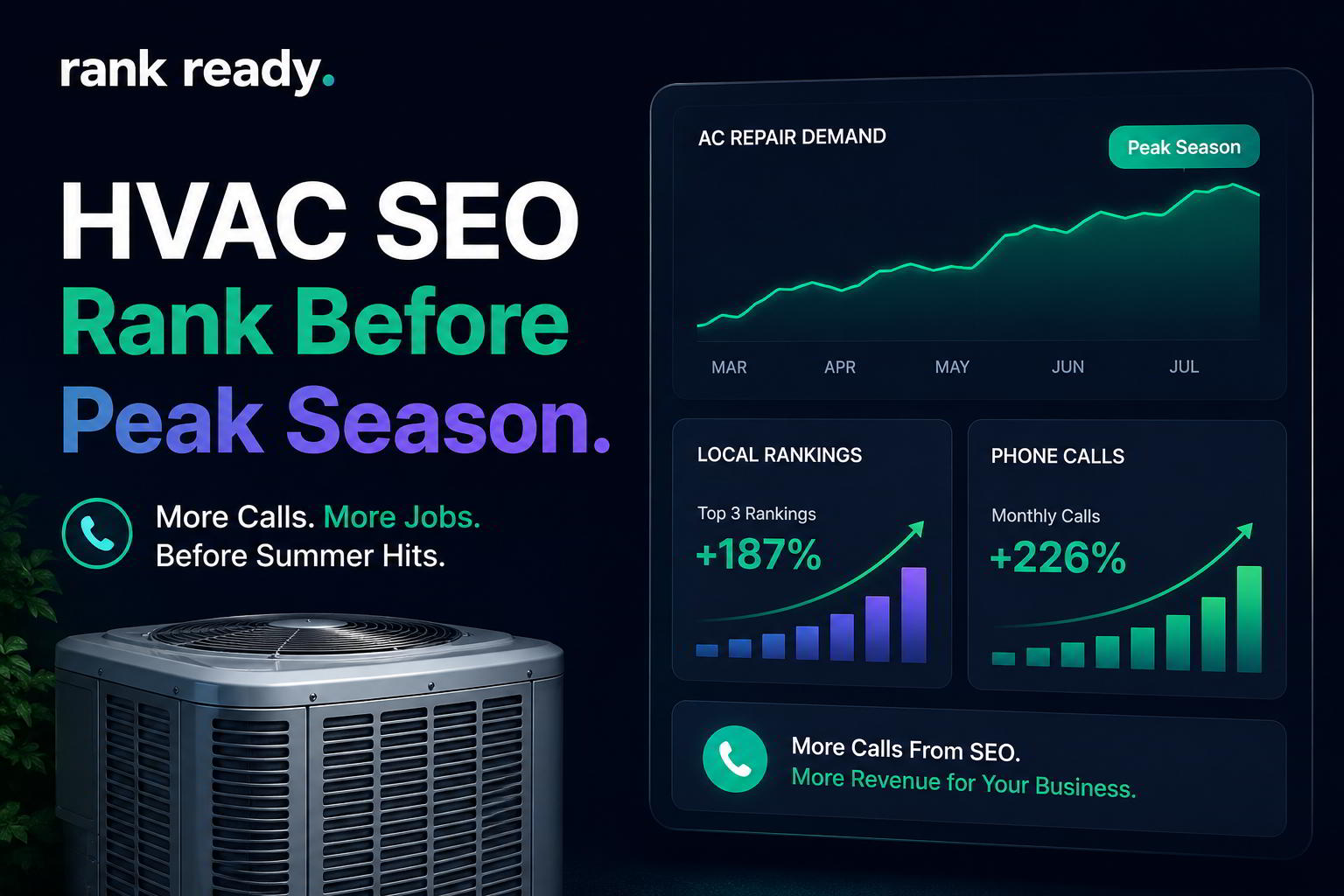
By the time AC season hits, it’s too late to start ranking for it. The HVAC companies that win July were already ranking in March. Here’s how the math actually works.Emergency HVAC demand moves fast. A heat wave hits. Systems fail. Homeowners search “AC repair near me” and call whoever looks trusted, local, and available. Not whoever published their first summer blog yesterday.That is the real game behind SEO for HVAC. You are not just ranking pages. You are banking authority before demand spikes. Google needs enough local relevance, service coverage, review proof, and engagement signals before peak season arrives. AI search systems work the same way.This guide breaks down the HVAC search calendar, emergency-service authority, local landing pages, GBP optimization, schema, reviews, seasonal content, and the KPI that matters most: calls.Strong SEO for HVAC companies starts months before peak demand arrives.
If summer is coming and your HVAC site is not ranking yet, you probably have about 60 days to fix the pieces that matter most. Our free HVAC SEO audit identifies the 3-5 changes most likely to move calls in that window — service gaps, local visibility issues, GBP weaknesses, and conversion leaks.
The HVAC search calendar: plant 90 days before demand, harvest during peak season
HVAC search is seasonal, but rankings are not instant. A page published in June is usually too late for July demand. In competitive service areas, HVAC companies should begin building authority at least 60-90 days before peak season.Most HVAC companies start SEO after demand spikes. By then, competitors already own the rankings.The HVAC companies that dominate peak season started compounding visibility months earlier.Seasonality changes search intent fast. Spring searches focus on tune-ups and maintenance. Summer shifts toward emergency AC repair. Fall pushes heating repair and furnace installation. Strong HVAC SEO campaigns build these assets before demand appears.That is why our home services SEO framework is structured around service timing, not generic yearly SEO checklists.
Building emergency-service authority before peak season
Emergency HVAC searches convert because the customer already has pain. No cold air. No patience. No interest in reading a long guide before calling.For emergency intent, your website needs to prove three things immediately:- You handle the exact HVAC problem.
- You serve the customer’s area.
- You can respond quickly.
Emergency pages need problem-first structure
Strong emergency AC repair pages focus on specific failures, fast response expectations, local service areas, and clear call actions above the fold.This is where AC repair SEO differs from broad HVAC marketing. “HVAC contractor” is a business category. “AC stopped cooling in [city]” is a panic search with immediate buying intent.You need both — but they should not live on the same page.Service-area pages: the right granularity for HVAC
Most HVAC companies either under-build local pages or spam city pages with duplicate content. Both approaches fail.The right local strategy depends on search demand, technician coverage, competition, and operational reality. If your crews regularly service 15 cities, those cities deserve dedicated landing pages. If you occasionally drive 60 miles for a one-off install, that does not require SEO coverage.Build pages around real service areas
A useful HVAC service-area page should include:- The city name naturally integrated into headings and copy.
- Specific HVAC problems common in that market.
- Relevant services like AC repair, heat pump repair, or furnace installation.
- Trust signals such as reviews, neighborhoods served, or local references.
- Strong call-to-action placement.
GBP plays specific to HVAC: categories, services, and attributes
Your Google Business Profile is often the first conversion point for HVAC searches.For many contractors, local SEO for HVAC success depends heavily on GBP visibility.The map pack appears before the organic result. The phone button is immediate. The review count is visible before users ever visit your website.Many HVAC profiles lose visibility because categories and services are incomplete or misaligned.GBP optimization should include more than categories
Strong HVAC GBP optimization includes:- Accurate primary and secondary categories.
- Complete service listings.
- Updated emergency and holiday hours.
- Service-area accuracy.
- Fresh photos of trucks, technicians, installs, and completed jobs.
Review velocity strategy: when storms hit, you’re ready
Review count matters. Review quality matters. But for HVAC companies, review velocity matters because demand spikes happen suddenly.When extreme weather hits, homeowners scan the map pack quickly. Companies with fresh reviews often look more active and trustworthy than businesses with older review histories.The mistake most HVAC businesses make: asking for reviews only after peak season begins.Build momentum before demand spikes
The best HVAC companies ask consistently, respond quickly, and keep review activity steady before peak season starts.That consistency helps both rankings and conversions. Recent review activity tells Google the business is active. It also reassures customers who need emergency help immediately.Do not buy reviews. Do not filter only positive customers. Long-term authority beats short-term manipulation.Schema for HVAC: LocalBusiness, Service, and FAQPage stack
Most HVAC schema implementations stop at one generic LocalBusiness block. Better than nothing — still incomplete.For HVAC websites, schema should clarify the business entity, services, locations, and common questions tied to those services.The HVAC schema stack
- LocalBusiness or HVACBusiness schema: business details, hours, phone, geo information.
- Service schema: AC repair, emergency HVAC, furnace repair, heat pump services.
- FAQPage schema: applied only when real FAQs exist on-page.
- Organization schema: stronger brand/entity understanding.
- Breadcrumb schema: clearer site hierarchy.
Content cadence: monthly seasonal content plus evergreen pillars
Random blog publishing creates random rankings.Strong HVAC content strategies usually operate in two layers:- Evergreen service pillars: AC repair, furnace repair, HVAC installation, maintenance, heat pumps.
- Seasonal content: storm response, tune-ups, energy bills, summer breakdowns, winter emergencies.
Strong HVAC SEO works best when HVAC marketing aligns with seasonal search demand and local intent.
Local SEO for HVAC companies compounds faster when seasonal content and GBP signals work together.Tracking what matters: calls, not clicks
Traffic matters. Rankings matter. But HVAC companies cannot deposit impressions into the bank.The KPI that matters most is qualified calls.Effective HVAC SEO should always connect rankings to booked jobs and revenue.Every HVAC SEO campaign should track:- Organic calls from service pages.
- Calls generated through GBP.
- Emergency repair inquiries versus maintenance requests.
- Form submissions from estimate pages.
- Booked revenue where possible.
Measure the actual conversion path
Many SEO dashboards focus heavily on rankings while ignoring booked jobs. That creates reporting that looks impressive but produces weak business outcomes.A page generating 100 targeted visitors and 15 booked calls is more valuable than a page generating 2,000 visits and almost no leads.For HVAC companies, call tracking should connect landing pages, service intent, city-level demand, and actual revenue whenever possible.Real client: Elite Home Services 5× call volume in 60 days
Elite Home Services came to Rank Ready with a common HVAC problem: demand existed, but local visibility was fragmented.Their service pages lacked structure. Local signals were inconsistent. Calls were not scaling in the markets that mattered most.We rebuilt the campaign around the revenue path:- High-intent service pages.
- Location-focused landing pages.
- GBP optimization and service alignment.
- Review velocity improvements.
- Call-focused conversion tracking.
Common questions about SEO for HVAC
How early should HVAC companies start SEO before summer?
At least 60-90 days before peak demand. Competitive HVAC markets often require even more lead time because Google needs enough authority and engagement data before rankings stabilize.Do HVAC companies need separate city pages?
Yes — when those cities represent real service areas with meaningful search demand. Thin duplicate pages usually fail. Strong local pages include unique service context, trust signals, and localized content.What is the best content strategy for HVAC SEO?
Build evergreen service pages first, then support them with seasonal content tied to weather events, repairs, maintenance, and homeowner concerns.The HVAC companies ranking in July are already moving in March
Storm-season visibility is not luck. It is preparation.Build the service pages early. Optimize the GBP before demand spikes. Generate reviews consistently. Add schema that clarifies the business entity. Publish seasonal content before homeowners start searching.That is how SEO for HVAC turns into booked calls instead of vanity traffic charts.Most agencies react after demand arrives. Rank Ready builds authority before the season breaks. Senior-led, not junior-dumped.SEO for HVAC , works best when authority is built before seasonal competition spikes.Most agencies react after demand arrives. Rank Ready builds authority before the season breaks. Senior-led, not junior-dumped.If summer is coming and your HVAC site is not ranking yet, you probably have about 60 days to fix the pieces that matter most. Our free HVAC SEO audit identifies the 3-5 changes most likely to move calls in that window — service gaps, local visibility issues, GBP weaknesses, and conversion leaks.

0 Comments