
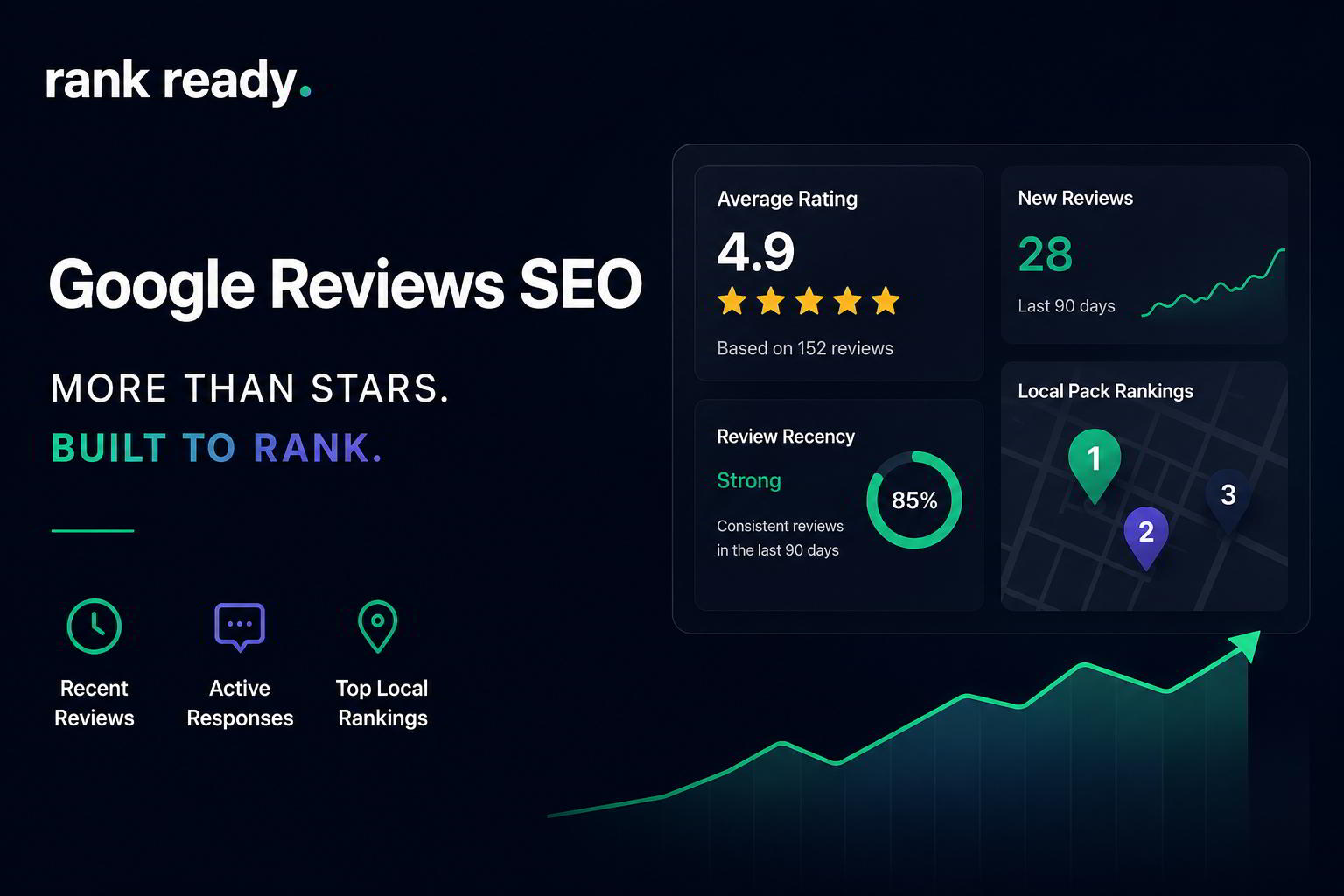
200 5-star reviews and you’re still ranking 4th. Volume isn’t the only thing that matters — recency, keyword content, and response patterns all factor in. Here’s the fix.Most businesses still think reviews work like a scoreboard. More stars. More reviews. Better rankings.That logic used to work better than it does now.Today, Google reviews SEO depends on much deeper signals: freshness, engagement behavior, service relevance, and review activity patterns.That is why smaller competitors sometimes outrank businesses sitting on hundreds of older reviews.Google increasingly wants evidence that the business is:
If reviews are your weakest signal, our managed GBP service rebuilds the system from acquisition through response. The free audit identifies what’s actually broken before any commitment.
- Actively serving customers.
- Receiving recent feedback.
- Engaging with reviews consistently.
- Generating authentic service-related content.
Why review volume alone doesn’t move rankings
Review count still matters.But volume alone is no longer enough.Google’s local systems increasingly evaluate review quality patterns instead of just totals.That includes:- Review recency.
- Review consistency.
- Service-specific language.
- Response activity.
- User-generated content.
A business with 40 recent, detailed reviews can outrank one with 300 stale reviews from years ago.This is especially common in competitive industries where most businesses already have strong star ratings.At that point, Google needs additional trust signals to separate listings.That is why our GBP management service focuses heavily on engagement patterns, review freshness, and service-level relevance instead of simply increasing raw review count.
Factor #1: Recency (Google weights last 90 days heavily)
Fresh reviews signal active business operations.That matters because Google wants local searchers seeing businesses currently delivering strong customer experiences — not companies relying entirely on older reputation signals.Most businesses accidentally create weak review patterns:- 20 reviews in one month.
- No reviews for the next four months.
Steady review velocity beats spikes
Businesses with consistent review acquisition usually perform better in local search than businesses relying on occasional bursts.Even a few reviews per week creates stronger momentum than large inconsistent spikes.This becomes especially important in seasonal industries like HVAC, roofing, plumbing, and landscaping.Many businesses in our home services SEO campaigns build review acquisition systems before peak season starts because review recency compounds local visibility.Strong GBP reviews also improve conversion trust because customers naturally rely more on recent experiences than older feedback.Factor #2: Keyword content (reviews mentioning services rank you for them)
This is one of the most overlooked local SEO signals.Google evaluates review content contextually.If customers repeatedly mention:- “emergency AC repair”
- “dental implants”
- “roof leak repair”
- “water heater replacement”
Natural service mentions strengthen local relevance
Businesses should never fake reviews or force unnatural keyword stuffing.But they can guide customers naturally.Example:- Weak request: “Please leave us a review.”
- Better request: “We’d appreciate feedback about the AC repair service we completed today.”
Factor #3: Response patterns (engagement signals)
Most businesses either ignore reviews completely or respond with generic templates.Both approaches waste ranking opportunities.Google wants evidence that businesses actively engage with customers.Review responses create additional relevance signals
Strong response patterns usually include:- Consistent response frequency.
- Personalized replies.
- Service-specific references.
- Professional tone.
- The completed service.
- The customer experience.
- The location served.
Factor #4: Photos in reviews (UGC weight)
User-generated photos are becoming increasingly powerful local trust signals.Especially in service industries.Photos help validate:- Completed projects.
- Real customer experiences.
- Service quality.
Review photos improve rankings and conversions
Customer-uploaded images often outperform polished marketing photography because they feel authentic.This is especially true for:- HVAC installations.
- Dental transformations.
- Roofing projects.
- Kitchen remodeling.
The 4-step fix: 30/60/90 day plan
Most weak review systems can improve significantly within 90 days if the process becomes consistent.First 30 days
- Complete GBP optimization.
- Create review request workflows.
- Train staff on timing.
- Respond to every review.
Days 30-60
- Improve request messaging.
- Increase photo-based reviews.
- Track review velocity trends.
- Improve response quality.
Days 60-90
- Strengthen service relevance.
- Identify keyword patterns.
- Scale review acquisition systems.
- Improve conversion pathways.
Compliant ways to ask for reviews (industry-specific)
Review acquisition must stay compliant.Especially in regulated industries.Google discourages:- Fake reviews.
- Review gating.
- Selective review requests.
- Incentivized ratings.
Best review timing by industry
- HVAC: immediately after successful service completion.
- Dental: after positive treatment outcomes.
- Roofing: after final walkthrough approval.
- Medical practices: after successful patient interactions while remaining HIPAA compliant.
How to write responses that lift local rankings
Good review responses sound conversational.Not robotic.Not keyword stuffed.Not generic.Strong responses usually include
- The customer’s first name.
- The completed service.
- A local reference when relevant.
- A genuine acknowledgment.
- Emergency AC repair.
- Customer satisfaction.
- Service context.
When to escalate to a managed service
Many businesses handle review management internally at first.That works temporarily.But once scale increases, consistency usually breaks down.Common warning signs:- Review requests stop happening consistently.
- Responses become delayed.
- Review quality weakens.
- Competitors begin accelerating visibility.
Why review systems compound over time
Most businesses think reviews create short-term ranking boosts.
Strong review systems actually compound authority over time.
Consistent review acquisition creates recurring freshness signals, stronger engagement patterns, and better local trust indicators month after month.
That consistency becomes difficult for competitors to replicate once momentum builds.
Businesses with healthy review ecosystems usually generate:
- Higher click-through rates.
- More direction requests.
- Stronger branded searches.
- Better local conversion rates.
That is why strong Google reviews SEO affects far more than rankings alone. It improves the entire local acquisition funnel.
Reviews are now a local SEO system — not just social proof
Review signals now influence rankings, conversions, engagement, and local trust simultaneously.Businesses still treating reviews like passive reputation assets are falling behind.Strong review systems generate:- Consistent recency.
- Service-level topical relevance.
- Higher engagement.
- More authentic user-generated content.
If reviews are your weakest signal, our managed GBP service rebuilds the system from acquisition through response. The free audit identifies what’s actually broken before any commitment.

0 Comments