
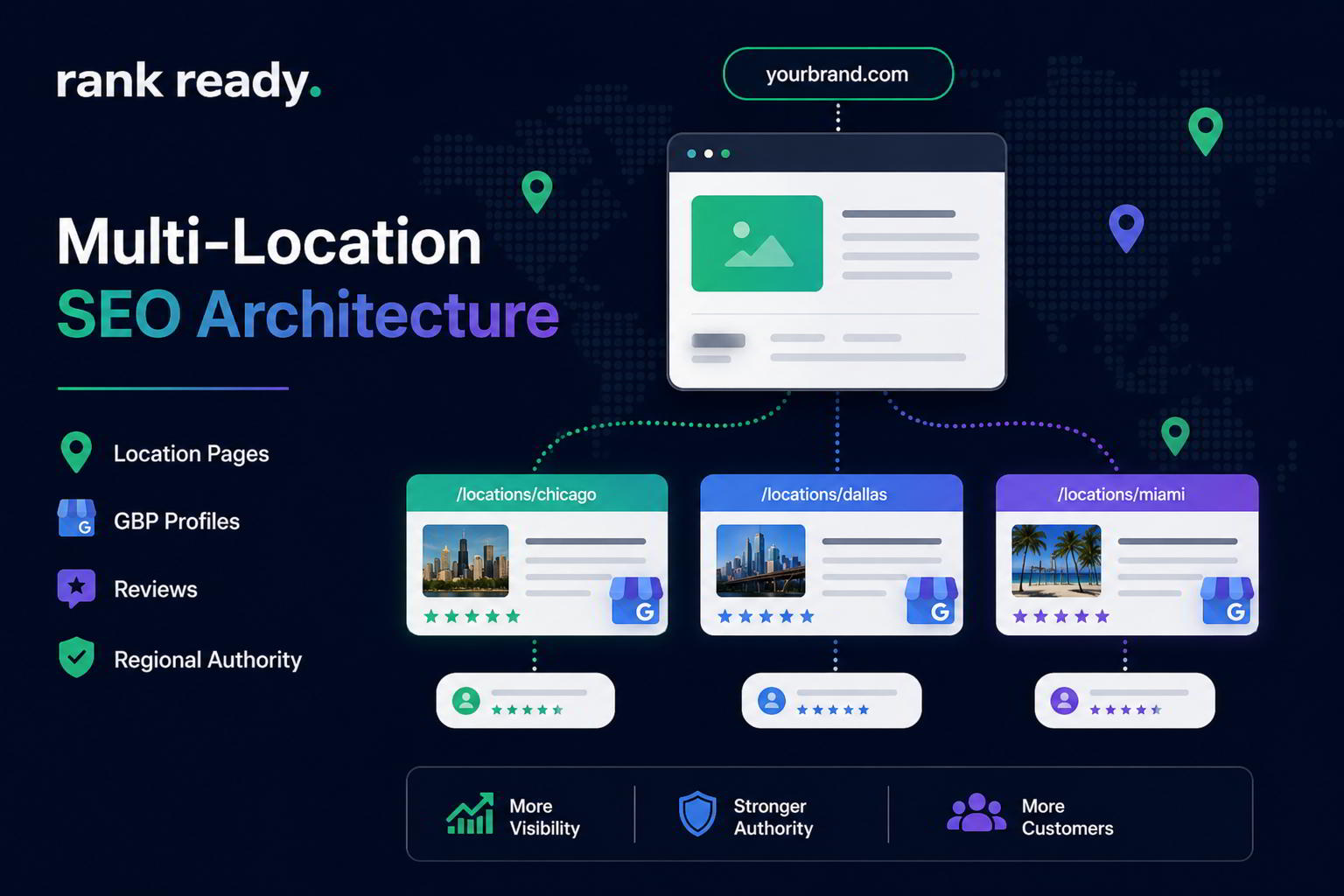
One location is a marketing problem. A hundred locations is an architecture problem. Here’s the complete playbook — pages, profiles, citations, and the structural choices that prevent cannibalization.
Most agencies treat multi-location SEO like a page factory. More city pages. More Google Business Profiles. More “near me” keywords. More copy with the city name swapped.
That works until the system starts fighting itself.
Nearby locations cannibalize each other. Google Business Profiles drift out of sync. Reviews pile up at 3 strong branches while 30 others stay invisible. Citations split across old phone numbers. Location pages look identical. The brand thinks it needs more content. It usually needs better architecture.
Good multi-location SEO is not local SEO repeated 100 times. It is a structured system for distributing authority across every location without creating duplicate content, fragmented signals, or internal competition.
This guide covers the decisions that matter: URL structure, location pages, service-area pages, GBP governance, citations, reviews, reporting, programmatic scale, and when to consolidate instead of expand.
Why multi-location SEO is fundamentally different
Single-location SEO is tactical. Multi-location SEO is structural.
That difference changes the entire strategy.
For one location, a business can win with a strong Google Business Profile, optimized service pages, reviews, local links, and solid on-page SEO. For 50 locations, those same tactics need governance. Without governance, every location becomes its own version of the brand.
That creates problems fast:
- Different naming formats across profiles
- Different GBP categories across branches
- Duplicate location page templates
- Unclear service-area overlap
- Unbalanced review velocity
- Weak internal linking
- Inconsistent schema
- Cannibalization between nearby cities
This is why multi-location SEO starts with architecture. Not title tags.
Multi-location SEO is centralized authority distributed intelligently — not 100 isolated local SEO campaigns.
Google has to understand the parent brand, each location entity, every service relationship, and how those pieces connect. If the structure is clean, authority compounds. If the structure is messy, scale creates noise.
That is where franchise SEO and chain SEO usually fail. The brand has size, but Google cannot clearly interpret the system.
The fix is not “publish more pages.” The fix is building a repeatable location architecture that can scale from 10 to 100 to 500 locations without breaking.
Decision 1: URL structure decides whether authority compounds
URL structure is one of the few multi-location SEO decisions that becomes painful to reverse later.
Changing a heading is easy. Rebuilding 300 indexed location URLs tied to Google Business Profiles, citations, internal links, and reporting dashboards is expensive.
Subdirectories usually scale best
For most brands, the strongest structure looks like this:
example.com/locations/chicago/
example.com/locations/dallas/
example.com/locations/phoenix/
This keeps authority under one domain. Every new location benefits from the parent brand’s strength. Every internal link reinforces one ecosystem.
Subdirectories usually support better:
- Crawl efficiency
- Authority consolidation
- Internal linking
- Analytics clarity
- Schema relationships
- Template governance
- Reporting consistency
For serious multi-location SEO, that matters. A 120-location brand should not rebuild authority 120 separate times.
Subdomains add friction
Subdomains can work, but they often create operational drag:
chicago.example.com
dallas.example.com
phoenix.example.com
The problem is fragmentation. Reporting gets harder. Governance gets harder. Technical maintenance increases. Internal linking becomes less efficient.
Some brands need subdomains because of franchise ownership, regional structures, or compliance requirements. Fine. But make that decision intentionally. Do not choose subdomains because they “look cleaner.”
Separate domains rarely scale well
Separate domains are usually the weakest option for multi-location SEO:
brandchicago.com
branddallas.com
brandphoenix.com
Every domain needs its own authority, links, technical maintenance, content governance, citation ecosystem, and reporting. That might work for 3 locations. It rarely works cleanly for 50.
Separate domains also confuse users and machines. Is this the same brand? A franchise? A local partner? A separate business? When Google has to guess, rankings suffer.
Decision 2: Page-per-location vs. service-area pages
This is where many location pages SEO strategies break.
Brands create hundreds of pages that look like this:
/plumber-dallas/
/plumber-austin/
/plumber-houston/
Same copy. Same structure. Same claims. Different city name.
That is not localization. That is duplication with a map pin.
Location pages should represent real local entities
A strong location page should prove that the location exists as a real operational entity.
It should include:
- Real address or service-area context
- Location-specific reviews
- Local team or provider information
- Unique services available at that branch
- Area-specific FAQs
- Local photos or proof
- Embedded map relevance
- Clear internal links to related services
This is the core of strong local landing pages. The goal is not to trick Google with 80 city variants. The goal is to make each location useful, specific, and structurally connected.
Service-area pages need stronger support
Service-area pages are different because they may not represent a physical branch.
That means they need more proof from other signals:
- Regional backlinks
- GBP service-area alignment
- Brand authority
- Internal links from service pages
- Real examples from that area
- Reviews mentioning nearby cities
Weak service-area pages are one of the fastest ways to damage multi-location SEO. They create thin pages with no real entity value.
Service-location relationships must be mapped
Not every location should target every service.
This is a common chain SEO mistake. The brand offers 12 services nationally, so every location page gets all 12 services. That creates overlap, weak relevance, and bloated pages.
Better systems map:
- Primary services per location
- Secondary services per region
- Specialized services by branch
- Services unavailable in certain areas
- Service pages that support location pages
This makes multi-location SEO cleaner because each page has a sharper role.
Decision 3: Centralized GBP management vs. local control
Google Business Profile management becomes a governance issue after 10 locations.
Too much central control creates stale profiles. Too much local control creates chaos.
Centralized control protects consistency
Centralized GBP management helps control:
- Business names
- Primary categories
- Secondary categories
- Opening hours
- Service lists
- Photos
- Review response standards
- Suspension risk
Our GMB management systems focus on this because inconsistency scales faster than rankings.
One wrong category is a small issue. Fifty wrong categories across 50 locations is a visibility problem.
Local teams still need controlled input
The best multi-location SEO systems give local teams limited, structured control.
Local teams can contribute:
- Fresh photos
- Local updates
- Holiday hours
- Service changes
- Review context
- Community involvement
Corporate should control the system. Local teams should feed the system.
That balance prevents brand drift while keeping profiles active and locally relevant.
GBP suspension risk increases with scale
At 3 locations, one suspended profile is annoying. At 80 locations, suspension patterns become an enterprise risk.
Suspensions often come from:
- Duplicate listings
- Virtual office abuse
- Category mismatches
- Incorrect addresses
- Keyword-stuffed business names
- Franchise naming conflicts
Strong multi-location SEO governance prevents these problems before they become cleanup projects.
The single-location playbook: fix the foundation first
Do not scale a broken location.
If one branch cannot rank, converting that same system into 40 branches will not solve the problem. It will multiply it.
Before scaling multi-location SEO, every brand needs a clean single-location foundation:
- Optimized GBP profile
- Strong local landing page
- Clean NAP consistency
- Review generation process
- LocalBusiness schema
- Service schema
- Internal links from relevant service pages
- Conversion tracking
Elite Home Services increased call volume 5× in 60 days because the foundation was corrected before scaling. The win was not one magic keyword. It was profile quality, review flow, service-area clarity, and page structure working together.
That is what scalable multi-location SEO should do: make each location stronger without making the system harder to manage.
Schema should be part of the foundation
Most brands add schema too late. Or worse, they add the same Organization schema everywhere and call it done.
A proper location setup usually needs:
- Organization schema for the parent brand
- LocalBusiness schema for each location
- Service schema for core offerings
- Breadcrumb schema for hierarchy
- FAQ schema where FAQs exist
- Review schema where eligible
The goal is simple: make the relationship between brand, location, service, and page easy for machines to understand.
Scaling 5-20 locations: where most brands hit the wall
The 5-to-20 location stage is dangerous.
At 5 locations, manual fixes still work. At 20, informal systems start breaking.
This is where brands usually see:
- Duplicate location pages
- Uneven review counts
- GBP category drift
- Internal cannibalization
- Weak regional hierarchy
- Inconsistent citations
- Confusing service-area overlap
Internal linking becomes a strategy
For multi-location SEO, internal linking is not just navigation. It is authority distribution.
A strong structure may include:
- National locations hub
- State pages
- Regional pages
- City pages
- Service-to-location links
- Location-to-service links
- Breadcrumbs
This becomes especially important in home services SEO, where nearby cities often compete for the same emergency, repair, and installation queries.
Templates need controlled flexibility
Templates are necessary. Copy-paste templates are dangerous.
A good multi-location SEO template standardizes:
- Page layout
- Schema structure
- CTA placement
- Review modules
- Map placement
- Conversion tracking
But it should allow variation in:
- Local proof
- FAQs
- Services
- Team details
- Neighborhood references
- Images
That is how location pages SEO avoids duplicate-content patterns. Our local landing pages duplicate content guide goes deeper into this exact problem.
Scaling 20-100 locations: governance replaces improvisation
At 20+ locations, multi-location SEO becomes a governance problem.
You need rules. Written rules.
Not Slack messages. Not “ask marketing.” Not one person remembering how things were done last time.
Create rules for every location event
Brands need documented rules for:
- Opening a new location
- Closing a location
- Moving a location
- Changing phone numbers
- Updating hours
- Adding services
- Removing services
- Responding to reviews
- Updating GBP categories
- Creating new landing pages
Without this, the system decays.
One location manager changes a business name. Another changes a phone number. Another creates a duplicate GBP profile. Six months later, SEO is cleaning up a mess that governance should have prevented.
Exception management matters
Not every location fits the template.
Some locations have different departments. Some have different providers. Some offer specialized services. Some operate under stricter healthcare, legal, or franchise rules.
Strong chain SEO allows controlled exceptions without breaking the system.
That means the template needs flexibility, but the rules must stay consistent.
Location closures need a real SEO process
Most brands handle closures badly.
They delete the page. Remove the GBP. Leave citations floating. Break internal links. Then wonder why local visibility drops in surrounding markets.
Better closure handling includes:
- Redirecting the old page to the nearest relevant location
- Updating the locations hub
- Updating internal links
- Marking the GBP correctly
- Correcting citations
- Adding user guidance when needed
Closures are part of multi-location SEO. Not an operations-only task.
Scaling 100+: when programmatic SEO makes sense
Programmatic SEO can help at scale — but only when the data is real.
Bad programmatic SEO creates thousands of thin pages. Good programmatic SEO turns structured business data into useful landing pages.
Good programmatic use cases
Programmatic systems work well for:
- Store locators
- Provider directories
- Location-service matrices
- Inventory by location
- Appointment availability
- Region-specific service coverage
These pages can support multi-location SEO when they are built from real operational data.
Bad programmatic use cases
They fail when used for:
- Mass city pages with no unique content
- AI-generated local blogs
- Fake neighborhood pages
- Doorway pages
- Service pages with no actual local difference
At 100+ locations, scale is not the enemy. Low-value scale is.
Google can tolerate large page counts when the pages serve real users and represent real business data.
Crawl control becomes a serious issue
Large location systems often create crawl waste through filters, duplicate paths, parameters, tag archives, and weak pagination.
For enterprise multi-location SEO, crawl management should monitor:
- Indexable location pages
- Duplicate URLs
- Parameter paths
- Soft 404s
- Redirect chains
- Orphan pages
- Depth from homepage
If Google cannot efficiently crawl the system, the best page copy will not save it.
Citation consistency at scale
Citations are boring until they break.
Then they become expensive.
At scale, NAP inconsistency becomes one of the most common multi-location SEO problems.
One platform lists:
Elite Home Services LLC
Another lists:
Elite Plumbing & HVAC
Another uses an old tracking number.
Another has the wrong suite number.
That creates trust noise.
Brands need a master location database
A serious franchise SEO system needs one source of truth for:
- Business name
- Address
- Phone number
- URL
- Hours
- Categories
- Services
- Opening date
- Location status
That database should feed the website, GBP profiles, citations, schema, and reporting systems.
Google’s Business Profile guidelines remain one of the clearest references for accurate local business representation.
Schema must match real-world data
Schema should not say one thing while GBP says another.
For strong multi-location SEO, LocalBusiness schema should match:
- GBP data
- Location page content
- Citation data
- Phone numbers
- Address formatting
- Opening hours
Structured data is not decoration. It is machine-readable consistency.
Reviews at scale: systems beat campaigns
Review campaigns create temporary spikes.
Review systems create durable local strength.
For multi-location SEO, review distribution matters as much as total review count.
A brand with 9,000 reviews can still have weak local visibility if 80% of reviews sit on 6 locations while the remaining 40 locations are ignored.
Every location needs review velocity
Each location needs:
- Steady review requests
- Fast response workflows
- Escalation rules
- Spam monitoring
- Sentiment tracking
- Service-level review insights
Review quality also matters.
“Great service” is weak.
“The Dallas team repaired our main electrical panel the same day” is stronger because it connects location, service, and outcome.
This is especially important in medical and dental SEO, where provider names, treatment references, and location-specific trust signals can influence local relevance.
Brand-wide standards protect local trust
Every location should follow the same response standards:
- Respond quickly
- Use specific language
- Avoid canned replies
- Escalate serious complaints
- Never ask for fake reviews
- Never gate review requests
Reviews are not just reputation. They are local relevance data.
Reporting at scale: local metrics vs. brand-wide metrics
Aggregate reporting hides local failure.
A brand can grow organic traffic 28% while 15 branches lose visibility.
That is why multi-location SEO reporting needs both levels: brand-wide and location-specific.
Track location-level performance
Each location should be tracked for:
- Organic sessions
- GBP views
- Calls
- Direction requests
- Form fills
- Local rankings
- Review velocity
- Conversion rate
- Service-level keyword performance
Track system-level performance
At the brand level, track:
- Total indexed location pages
- Crawl health
- Duplicate-content risks
- Cannibalization clusters
- Schema errors
- Internal link depth
- Regional visibility
- GBP suspension issues
The best reporting finds exceptions quickly.
Enterprise SEO is often won by fixing small local problems before they become network-wide issues.
Real clients: MetroDental and Elite Home Services
Theory is cheap. Execution is where multi-location SEO proves itself.
MetroDental: 120 unique location pages
MetroDental needed local visibility across a large healthcare footprint.
The challenge:
- 120 locations
- Shared services
- Provider-level relevance
- Regional overlap
- Healthcare trust standards
- Duplicate-content risk
The solution used controlled templates, location-specific schema, unique provider signals, structured internal linking, and regional differentiation.
Result: 120 unique location pages with zero duplicate-content flags in 4 months.
More proof is available in our SEO case studies.
Elite Home Services: 5× call volume
Elite Home Services needed stronger local demand capture across competitive service areas.
The system focused on:
- GBP optimization
- Review acquisition
- Service-area clarity
- Localized conversion pages
- Authority consolidation
Result: 5× call volume growth in 60 days.
Not from “more pages.” From better structure.
When to consolidate vs. when to expand
More pages are not always better.
Sometimes the strongest multi-location SEO move is consolidation.
Expand when:
- A real operational location exists
- Search demand is distinct
- GBP eligibility exists
- Reviews support the location
- Services differ by area
- The page can contain unique local value
Consolidate when:
- Two pages target the same intent
- Locations overlap heavily
- Pages cannibalize each other
- Content is thin
- No unique local proof exists
- Authority is fragmented
Smart multi-location SEO is not about creating the maximum number of pages. It is about creating the right number of pages with the strongest possible structure.
More location pages do not automatically create more local authority. Structure decides whether scale compounds or collapses.
Multi-location SEO is structural before it is tactical
Most agencies think in campaigns.
Scalable brands think in systems.
That is the difference.
Long-term multi-location SEO depends on:
- URL architecture
- Location hierarchy
- Internal linking
- GBP governance
- Review systems
- Citation control
- Schema consistency
- Reporting discipline
- Expansion rules
Get those wrong and every new location adds complexity.
Get them right and every new location strengthens the network.
That is how brands scale to 50, 100, or 500 locations without turning their website into a cannibalization machine.
Multi-location SEO is structural before it’s tactical. Our free audit covers the 3 architectural decisions that determine whether your brand can scale to 50, 100, or 500 locations without cannibalization. Get a free SEO audit and identify the structural issues limiting your location growth.

0 Comments