
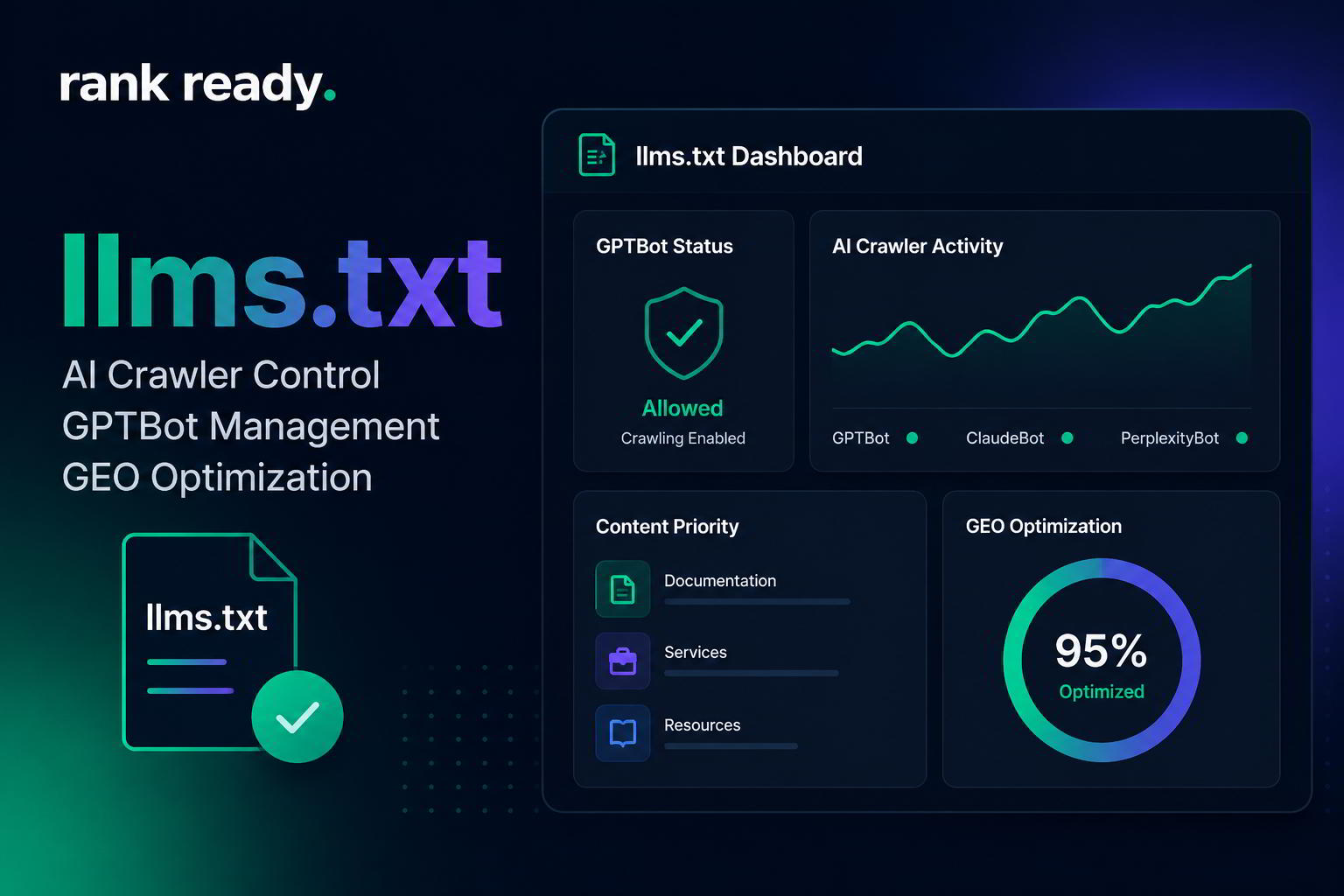
llms.txt is the file more SEO teams are about to care about. robots.txt was for search engines. llms.txt is for AI engines. The first one matters because it shapes how Google sees you. The second matters because it shapes how ChatGPT learns about you.
Most sites already have a search crawling strategy. They manage robots.txt, XML sitemaps, indexation, canonicals, and crawl paths. But ask the same team how GPTBot, ClaudeBot, PerplexityBot, or other AI crawlers should understand their content — and the answer is usually silence.
That is the gap.
For brands investing in GEO, that matters. AI engines need clarity. They need structure. They need canonical resources. A strong AI SEO setup makes the best version of your site easier to discover, parse, and trust.
What llms.txt Is — and What It Is Not
A guide for AI systems, not a ranking switch
llms.txt is a plain-text file placed at the root of a website, usually here:
https://example.com/llms.txt
Its job is to point AI systems toward the pages, documents, and resources you want them to understand first.
Think of it as a curated map.
Instead of making AI crawlers guess which pages matter, you give them a structured list of your highest-value content:
- Core service pages
- Product documentation
- API references
- Knowledge hubs
- Research resources
- Case studies
- Company background pages
- Canonical guides
What llms.txt is not:
- Not a replacement for robots.txt
- Not a guaranteed AI citation trigger
- Not a ranking factor in the traditional SEO sense
- Not an access-control file
- Not a substitute for strong content
The mistake is treating it like a shortcut. GEO does not work that way. Good GEO is making your expertise easier for AI engines to understand, verify, and retrieve.
llms.txt does not create authority. It helps AI engines find authority faster.
How llms.txt Differs from robots.txt
Access control vs. content guidance
robots.txt tells crawlers where they can and cannot go.
That difference matters.
robots.txt is built around crawling permissions:
- Allow
- Disallow
- User-agent rules
- Sitemap references
- Crawl-delay where supported
llms.txt is built around guidance:
- Important URLs
- Documentation paths
- Canonical explanations
- High-value resources
- Structured references
One controls access. The other improves interpretation.
A mature AI SEO setup uses both. robots.txt handles crawler permissions. llms.txt helps AI systems understand what deserves attention.
For example, you might allow GPTBot to crawl your site through robots.txt, but use llms.txt to point it toward your product documentation, service pages, and primary GEO resources instead of letting it waste attention on tag archives, outdated pages, or low-value templates.
What AI Crawlers Respect It
The crawler ecosystem is still moving
The AI crawler landscape is not as standardized as traditional search crawling.
That is the first thing to understand.
Some AI systems may reference structured discovery files. Others may rely more heavily on normal crawling, public web indexes, licensed data, or partner feeds. The ecosystem is changing quickly.
The major AI-related crawlers and user agents commonly discussed include:
- GPTBot from OpenAI
- ClaudeBot from Anthropic
- PerplexityBot from Perplexity
- Google-Extended
- CCBot
- Bytespider
GPTBot is the crawler most SEO teams recognize because of its connection to OpenAI systems. ClaudeBot and PerplexityBot also matter because more users now discover brands through AI answer engines, not only search results.
Still, the direction is clear. Brands need better ways to communicate with AI systems.
For technical crawler basics, Google’s official crawler documentation remains a strong reference for how major crawlers are identified and handled: Google Search Central crawler documentation.
Step 1: Decide What to Include vs. Exclude
If everything matters, nothing matters
The first step is not writing the file. The first step is deciding what deserves AI attention.
Most websites contain a mix of valuable and low-value URLs. AI systems do not need all of it.
Include pages that clarify your entity, expertise, services, products, and authoritative knowledge.
Good candidates include:
- Core service pages
- About page
- Product pages
- Documentation pages
- Research reports
- Original guides
- Case studies
- Industry pages
- Glossaries or resource hubs
Usually exclude or avoid emphasizing:
- Thin tag pages
- Duplicate archives
- Internal search results
- Expired campaigns
- Low-value blog posts
- Utility pages
- Outdated documentation
This is where AI GEO Optimization becomes more than a technical checklist. The goal is not just access. The goal is retrieval-ready clarity.
Step 2: Write Your llms.txt With a Real Example
Short, structured, and intentionally boring
A useful llms.txt file does not need to be clever. It needs to be clear.
Here is a simple example:
# Example Company ## About https://example.com/about/ ## Core Services https://example.com/services/ https://example.com/services/ai-optimization/ https://example.com/services/technical-seo/ ## Key Resources https://example.com/blog/complete-ai-seo-guide/ https://example.com/research/search-behavior-report/ https://example.com/case-studies/ ## Contact https://example.com/contact/
That is enough for many businesses.
The structure tells AI systems which pages matter most. It also reduces ambiguity across large sites where important content can be buried under thousands of URLs.
For Rank Ready, an example might include:
# Rank Ready ## GEO Resources https://rank-ready.com/services/ai-geo-optimization/ https://rank-ready.com/get-cited-by-chatgpt-geo-playbook/ ## SEO Services https://rank-ready.com/services/seo-audits/ https://rank-ready.com/services/semantic-seo-optimization-services/ ## Company https://rank-ready.com/about/ https://rank-ready.com/case-studies/
The point is prioritization.
A good llms.txt file helps AI systems reach the strongest explanation of who you are, what you do, and why you are credible.
Step 3: Add Structured /llms-full.txt for Documentation Sites
Use it when your best content lives in docs
Some websites need more than a short guide.
Documentation-heavy sites, SaaS products, developer tools, API platforms, and large knowledge bases often benefit from a second file:
https://example.com/llms-full.txt
The simple llms.txt file acts like a table of contents. The llms-full.txt file gives AI systems a deeper structured resource.
This is especially useful for:
- API documentation
- Developer onboarding
- Product manuals
- Technical knowledge bases
- Open-source projects
- SaaS help centers
A structured llms-full.txt file may include summaries, section links, canonical explanations, usage examples, and important technical references.
For example:
# Product Documentation ## Authentication Summary: Explains API authentication, token handling, and security. URL: https://example.com/docs/authentication/ ## Webhooks Summary: Explains webhook setup, retry logic, and event types. URL: https://example.com/docs/webhooks/ ## Billing API Summary: Covers subscription creation, plan updates, and invoice events. URL: https://example.com/docs/billing/
Do not create llms-full.txt just to stuff more URLs into another file.
Create it when the extra structure makes your best documentation easier to understand.
Step 4: Test and Verify It Is Being Respected
Implementation without validation is guessing
Publishing llms.txt is not the final step.
You need to verify that it works technically.
Check:
- The file is located at /llms.txt
- The file returns a 200 status code
- The file is not blocked by robots.txt
- Important URLs inside it return 200 status codes
- There are no unnecessary redirect chains
- The content is plain text and easy to parse
Then monitor server logs where possible.
You may be able to identify activity from:
- GPTBot
- ClaudeBot
- PerplexityBot
- Other AI crawlers
Do not expect perfect visibility. Many AI systems are opaque. But log monitoring still gives you better evidence than guessing.
Regular monitoring ensures your llms.txt implementation continues supporting your broader AI SEO setup as AI crawler behavior evolves.
What This Does for Your GEO Strategy
GEO is about making your expertise retrievable
Most brands misunderstand GEO.
They think it means “get mentioned by ChatGPT.” That is the outcome. Not the strategy.
The strategy is making your brand easier for AI systems to discover, verify, summarize, and cite.
llms.txt supports that by giving AI systems a cleaner path to your best content.
It works alongside:
- Entity SEO
- Schema markup
- Knowledge Graph optimization
- Topical authority
- Digital PR
- Review signals
- High-quality documentation
- Structured internal linking
If your site has weak content, llms.txt will not fix it.
That is why we treat it as one piece of a complete GEO playbook, not as a standalone tactic.
Common Mistakes and What They Cost
The file is small. The mistakes are not.
The most common llms.txt mistake is overconfidence.
Teams add the file, check a box, and move on. That misses the point.
Common mistakes include:
- Listing every URL: This removes prioritization.
- Using outdated links: Broken resources create confusion.
- Blocking key pages elsewhere: robots.txt and llms.txt should not contradict each other.
- Ignoring documentation: SaaS and technical sites often leave their best AI resources buried.
- Expecting instant citations: GEO compounds over time.
- Never updating the file: Your AI guidance should evolve as your site evolves.
Each mistake weakens the value of the file.
Worse, it can send AI systems toward the wrong resources.
For brands investing seriously in AI crawler control, maintenance matters. Review the file quarterly. Update it after major service changes, documentation launches, product shifts, or site migrations.
AI Visibility Starts With Clarity
Small file. Bigger strategy.
llms.txt will not win GEO by itself.
But ignoring it is lazy.
As AI engines become a bigger part of discovery, brands need cleaner systems for communicating what matters. The sites that win will not simply publish more content. They will make their expertise easier to find, easier to verify, and easier to cite.
For brands investing in GEO, llms.txt should be treated as part of a complete AI SEO setup rather than a standalone tactic.
llms.txt is one piece of a complete GEO setup — and surprisingly few sites have it right. Our GEO audit reviews llms.txt implementation plus 12 additional AI-readiness signals that influence visibility across ChatGPT, Perplexity, Claude, and Google AI experiences. Get a free SEO audit and see where your AI visibility gaps exist.

0 Comments