
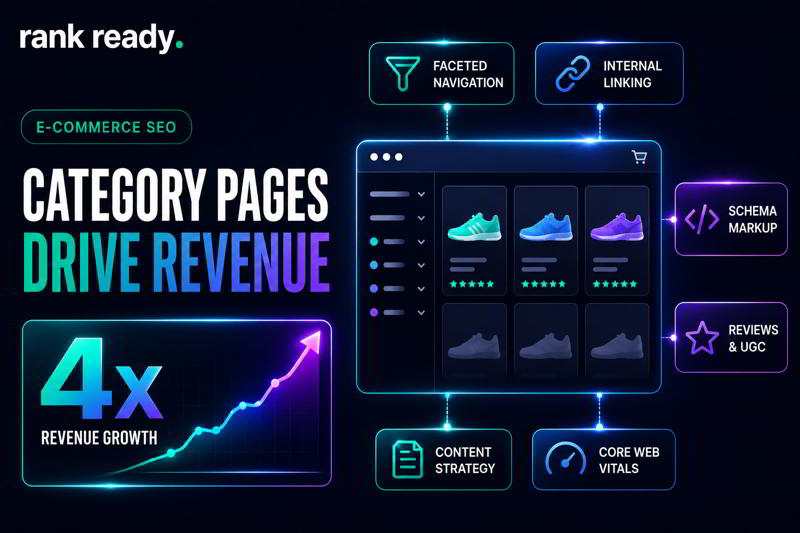
Why Category Pages Outperform Product Pages (With the Math)
The biggest misconception in e-commerce SEO is that product pages deserve most of the optimization effort.For most stores, they don’t.Product pages matter. But category pages usually drive significantly more traffic and revenue.Commercial intent lives at the category level
Consider two searches:- Nike Pegasus 42 Men’s Running Shoe
- Men’s Running Shoes
Products expire. Categories persist.
Products change constantly.Inventory shifts. Models get discontinued. URLs disappear.Categories remain.That stability allows category pages to accumulate authority, rankings, backlinks, and trust over time.We’ve repeatedly seen category pages generate 60–80% of organic e-commerce revenue while representing less than 10% of indexed URLs.Most product pages sell products. Category pages sell entire product lines.
What an SEO-Optimized Category Page Actually Contains
A modern category page should function as a search landing page.The strongest e-commerce SEO category pages typically include:- Keyword-focused H1
- Category introduction
- Optimized filters
- Supporting content
- Internal links
- Schema markup
- Reviews and UGC
- Fast loading times
Element 1: H1 + Intro That Targets the Category Query
The H1 remains one of the clearest relevance signals available.Yet many stores overcomplicate it.Match how customers actually search
If the category targets men’s running shoes, the H1 should simply be:Men’s Running ShoesNot:Premium Performance Footwear CollectionSearch engines reward clarity.Users do too.The introduction matters
Most category introductions only need 100–200 words.The objective is to:- Describe the category
- Support search intent
- Introduce subcategories
- Provide topical context
Element 2: Filtering + Faceted Navigation That Doesn’t Break SEO
Faceted navigation creates some of the largest SEO opportunities in e-commerce.It also creates some of the biggest technical disasters.The duplication problem
Imagine a category with:- 10 brands
- 8 colors
- 6 sizes
- 5 price ranges
Choose which filters deserve visibility
Not every filter should be indexed.Some combinations represent genuine search demand.Others create duplicate experiences.Examples that may deserve indexation include:- Women’s black running shoes
- Trail running shoes
- Waterproof hiking boots
Element 3: Content Above and Below the Product Grid
Many store owners worry that content hurts conversions.The data rarely supports that concern.Above-the-fold content
Keep introductory content concise.Buyers came to shop.Don’t make them scroll through 800 words before seeing products.Below-the-grid content
This is where supporting content shines.Include:- Buying guides
- Category FAQs
- Brand comparisons
- Use cases
- Feature explanations
Element 4: Internal Linking to Related Categories
Internal linking remains one of the highest-return activities in e-commerce SEO.Create category clusters
Example:- Men’s Running Shoes
- Women’s Running Shoes
- Trail Running Shoes
- Running Socks
- Running Accessories
Element 5: Schema (Product + ItemList + BreadcrumbList)
Schema remains one of the most overlooked opportunities in category page optimization.The category schema stack
- Product Schema
- ItemList Schema
- BreadcrumbList Schema
Element 6: Reviews and UGC at Category Level
Most brands collect reviews at the product level and stop there.Category-level reviews help establish trust earlier in the buying journey.- Higher engagement
- Stronger trust signals
- Improved conversion rates
- Additional content depth
Element 7: Speed + Core Web Vitals on Category Pages
Category pages are frequently the heaviest pages on an e-commerce site.Common performance killers
- Large images
- Heavy JavaScript
- Third-party apps
- Slow filtering systems
- Render-blocking resources
- Lower bounce rates
- Longer sessions
- Higher engagement
- Better conversion rates
Programmatic vs. Hand-Built Categories (The Right Mix)
Not every category deserves manual creation.The best strategy combines hand-built pages for high-value categories and programmatic systems for scalable opportunities.Where each approach works best
Hand-built pages should focus on:- Primary revenue categories
- High-volume keywords
- Strategic product lines
- Unique value
- Clear intent
- Controlled indexation
- Strong architecture
Real Example: How a DTC Brand 4×’d Organic Revenue
A consumer-products company approached us with a familiar challenge.Thousands of product pages. Minimal category optimization. Flat organic growth.The findings
- Thin category content
- Weak internal linking
- Limited schema markup
- Uncontrolled faceted URLs
- Slow category performance
The fixes
- Semantic category content
- Improved internal links
- Structured data implementation
- Performance optimization
- Controlled faceted navigation
The Pages That Usually Drive the Most Revenue
Many e-commerce brands assume revenue growth requires more products, more content, or more backlinks.Sometimes the opportunity already exists.It’s sitting inside category pages that have never been fully optimized.The highest-performing e-commerce SEO category pages act as landing pages, buying guides, navigation hubs, and conversion assets simultaneously.They rank for broader commercial searches, capture buyers earlier in the journey, and influence dozens of purchase decisions rather than just one.If you’re serious about growing organic revenue, category-page optimization should move near the top of the priority list.Why Most E-Commerce Category Pages Still Underperform
The opportunity around category pages isn’t a secret anymore.
Most e-commerce teams know category pages matter.
The problem is execution.
Many stores launch category pages once, then rarely revisit them. Content becomes outdated. Internal links weaken as new categories are added. Filters create indexation issues. Competitors continue improving while the page remains unchanged.
Over time, rankings stagnate.
Revenue follows.
Small weaknesses compound over time
Rarely is there a single issue holding category performance back.
More often it’s a collection of small problems:
- Thin category descriptions
- Weak internal linking
- Missing schema markup
- Poor Core Web Vitals
- Unoptimized faceted navigation
Individually, these issues seem minor.
Together, they can create a significant competitive disadvantage.
The strongest e-commerce SEO category pages are treated as living assets. They’re reviewed, expanded, and improved continuously. That’s why they keep gaining visibility while competitors wonder why rankings have stalled.

0 Comments