
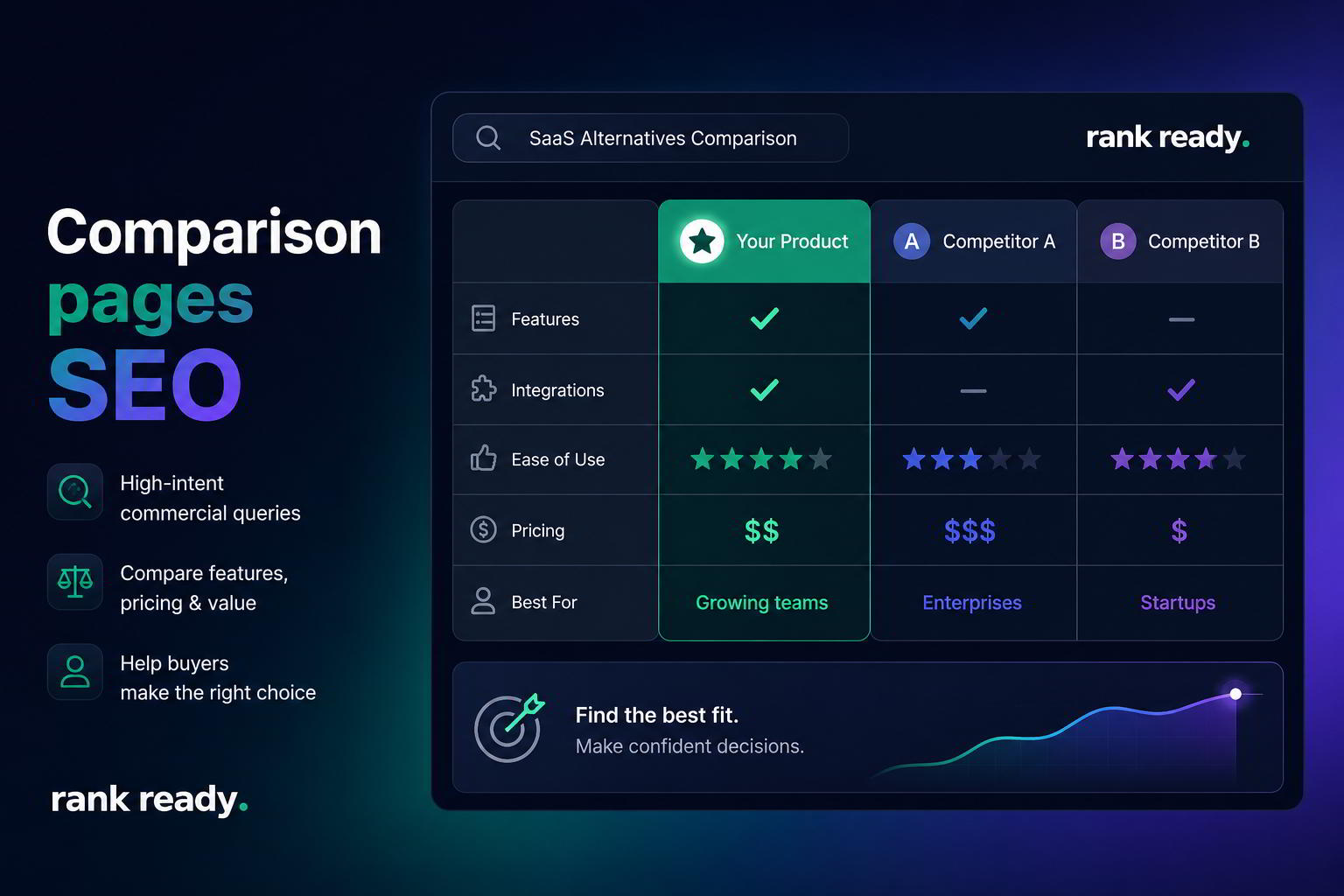
Most SaaS and service companies keep publishing awareness content while their best buyers are already comparing vendors. That is the gap. Someone searching “best HubSpot alternatives” or “Asana vs Monday” is not casually browsing. They are evaluating options.That is why comparison pages SEO is one of the most underused bottom-funnel assets in B2B content marketing. These pages capture buyers who already understand the problem, already know the category, and are actively deciding who deserves the shortlist.Generic SEO agencies chase traffic. Smart brands chase intent.Comparison pages let you control the narrative before a sales call ever happens. Done well, they rank, educate, qualify, and convert. Done badly, they read like a biased sales sheet and get ignored.This guide shows how to build comparison pages that actually help buyers — and win organic revenue.
Comparison content captures buyers other content can’t reach. We map your category’s comparison opportunities and identify the 3-5 highest-ROI pages to ship first. Get a free SEO audit and see which comparison opportunities your competitors are already capturing.
Why comparison pages are bottom-funnel gold
One advantage of comparison pages SEO is that it captures buyers after they have already identified the category and are evaluating specific vendors.Most blog content attracts people who are still learning. Comparison pages attract people who are already deciding.That difference matters.A search like “what is project management software” is informational. A search like “ClickUp alternatives” is commercial. The buyer has moved from problem awareness to vendor evaluation.That is where comparison pages SEO becomes powerful.These pages help brands capture:- Competitor-aware buyers
- Alternatives searches
- Migration intent
- Pricing comparison intent
- Feature comparison intent
- Buyers close to demo or consultation stage
Comparison pages do not create demand. They capture demand already looking for a decision.For SaaS, this can shorten the path from organic visit to demo request. For service businesses, comparison content can help prospects understand why one agency, platform, or provider is a better fit than another.That is why comparison pages belong inside serious ecommerce and SaaS SEO strategies.
The two formats: “X vs Y” and “X alternatives”
Most comparison pages fall into two formats: direct “vs” pages and broader “alternatives” pages.“X vs Y” pages
These compare two specific options.Examples:- HubSpot vs Salesforce
- Shopify vs WooCommerce
- Stripe vs Square
- Asana vs Monday
“X alternatives” pages
Alternatives pages capture broader dissatisfaction intent.Examples:- Best HubSpot alternatives
- Shopify alternatives for growing stores
- Mailchimp alternatives
- Zendesk alternatives for support teams
What a great comparison page contains
Bad comparison pages are obvious. They pretend the brand writing the page is perfect and every competitor is weak.Buyers do not trust that.A great comparison page feels useful first and persuasive second. It gives the buyer enough detail to make a smarter decision.1. Clear positioning
Start by explaining who each option is best for.Example:- “Tool A is stronger for enterprise teams with complex workflows.”
- “Tool B is better for smaller teams that need fast setup.”
2. Feature comparison table
Tables make the page scannable. Include pricing, features, integrations, support, onboarding, reporting, automation, and scalability.3. Honest tradeoffs
Every product has weaknesses. Say them clearly. Honest tradeoffs build trust and improve conversion quality.4. Use-case breakdowns
Segment the page by buyer type:- Best for startups
- Best for enterprise teams
- Best for ecommerce
- Best for agencies
- Best for technical teams
5. Pricing context
Do not just list the starting price. Explain what actually changes cost: seats, usage, integrations, onboarding, support, contracts, or add-ons.6. Proof
Add reviews, case studies, testimonials, screenshots, or measurable outcomes where available.7. FAQs
FAQs help capture long-tail comparison queries and support FAQPage schema.8. Buyer-stage CTA
Comparison visitors are not early-stage readers. Use CTAs like demo, audit, migration review, pricing walkthrough, or consultation.How to write a comparison page that’s genuinely useful
Successful comparison pages SEO strategies focus on helping buyers make informed decisions rather than pushing a single product narrative.The fastest way to ruin comparison content is to write propaganda.Buyers can feel fake objectivity instantly.Strong comparison pages use direct, balanced, specific language. They explain where each option wins, where each option struggles, and who should choose which path.Use language like:- “Choose this if…”
- “Avoid this if…”
- “This works better for…”
- “The tradeoff is…”
- “The hidden cost is…”
Schema for comparisons
Most brands underuse schema on comparison pages.For SaaS and product-led pages, consider:- Product schema
- SoftwareApplication schema
- AggregateRating schema
- Review schema
- FAQPage schema
- Breadcrumb schema
Where to link comparison pages internally
Strong internal linking amplifies the impact of comparison pages SEO by helping search engines understand the relationship between comparison content, product pages, and conversion-focused assets.
Comparison pages should not sit orphaned.They need internal links from pages that already attract relevant users.Good internal link sources include:- Product pages
- Service pages
- Pricing pages
- Feature pages
- Migration pages
- Industry pages
- Related blog posts
- Help Google discover and prioritize the page
- Move qualified visitors deeper into the funnel
- Connect comparison content to broader topical authority
When to publish comparison pages
As competition increases across SaaS categories, comparison pages SEO becomes one of the most efficient ways to acquire high-intent organic traffic.Most brands publish comparison pages too late.They wait until competitors already own the SERP, paid search costs are rising, and sales teams are tired of answering the same objections.Publish comparison pages when you have clear positioning.You need to know:- Who you serve best
- Who you are not right for
- Which competitors appear in sales calls
- Which alternatives buyers ask about
- Where your product or service clearly wins
- Where your competitor may be a better fit
- One “best alternatives” category page
- Two direct competitor “vs” pages
- One migration-focused page
- One pricing comparison page
How to keep them updated
Brands that consistently update their comparison content usually see stronger long-term results from comparison pages SEO than brands that publish once and never revisit the page.Comparison pages age fast.Competitors change pricing. Features launch. Integrations disappear. Products reposition. Review sentiment shifts.A comparison page that was accurate 9 months ago may now be misleading.Use a simple maintenance cycle:- Review pricing every 30 days
- Review feature tables every 60 days
- Review screenshots every quarter
- Review FAQs every quarter
- Review competitor positioning every 6 months
8 examples that work
The strongest comparison pages win because they help buyers decide.1. HubSpot vs Salesforce
Works because the buyer is choosing between usability, enterprise depth, implementation effort, and CRM scale.2. Shopify alternatives
Works because ecommerce buyers often search alternatives when pricing, flexibility, or platform limits become painful.3. Stripe vs Square
Works because payment buyers care about use case: online payments, POS, developer flexibility, fees, and business model.4. Asana vs Monday
Works because teams compare workflow style, ease of use, project complexity, automation, and reporting.5. Mailchimp alternatives
Works because many buyers search alternatives when list size grows, pricing changes, or automation needs become more advanced.6. Zendesk vs Intercom
Works because support teams compare ticketing, live chat, automation, help centers, and customer experience.7. WooCommerce vs Shopify
Works because the decision is architectural: control and flexibility versus simplicity and managed infrastructure.8. Ahrefs alternatives
Works because SEO teams compare pricing, backlink data, keyword data, reporting, and workflow fit.Notice the pattern. These pages work because the decision is already active. The searcher is not asking “what is this?” They are asking “which one should I choose?”Comparison pages capture buyers other content misses
Most SEO content captures attention. Comparison content captures evaluation.That is the difference.Strong comparison pages SEO gives SaaS and service brands a way to rank for high-intent searches, shape the buyer’s decision criteria, answer sales objections early, and create a cleaner path from organic search to revenue.The mistake is treating these pages like aggressive sales collateral. The win is treating them like decision-support assets.Useful. Honest. Specific. Structured.That is how comparison pages become one of the highest-ROI assets in B2B content marketing.Comparison content captures buyers other content can’t reach. We map your category’s comparison opportunities and identify the 3-5 highest-ROI pages to ship first. Get a free SEO audit and see which comparison opportunities your competitors are already capturing.

0 Comments