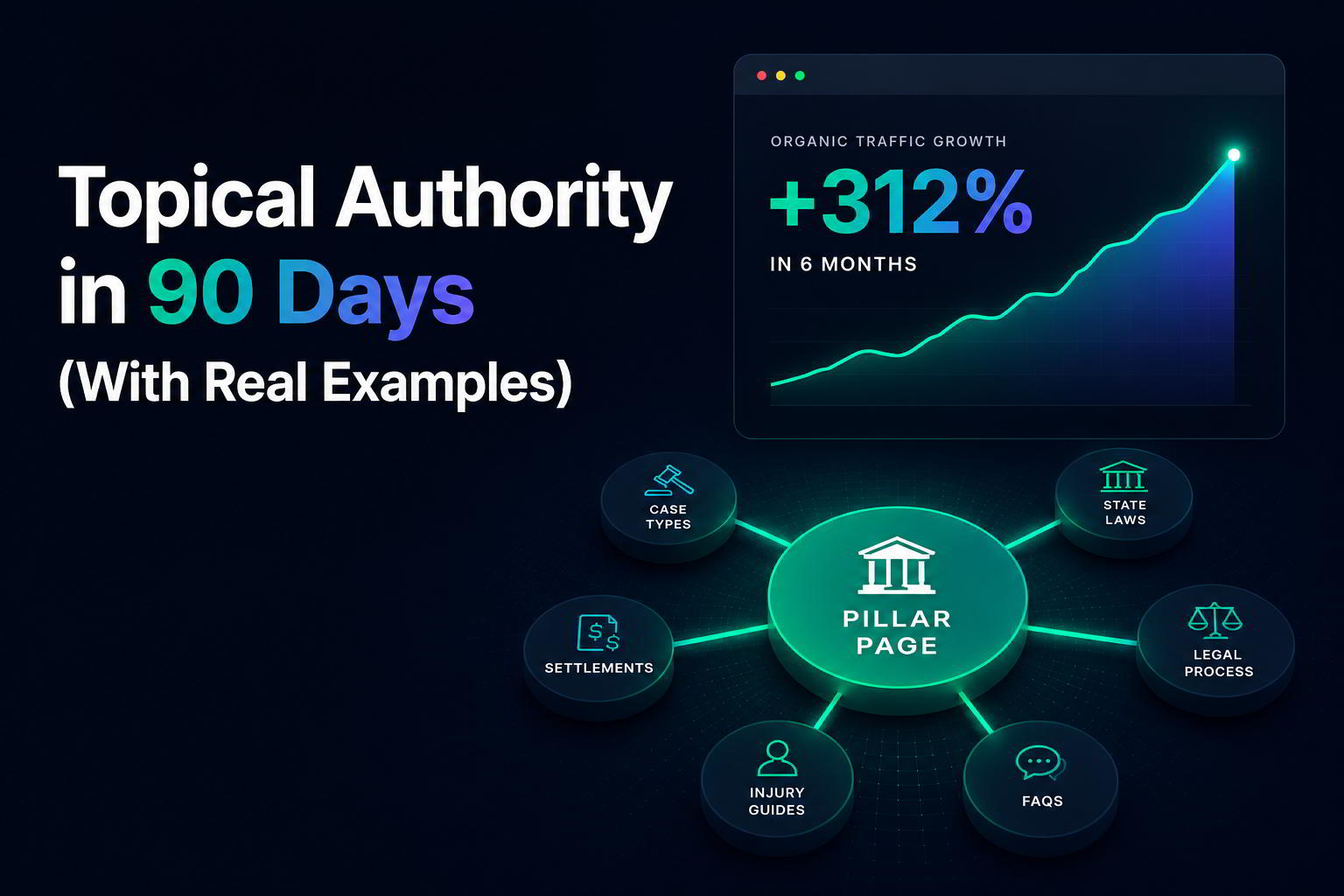
Topical authority is the SEO moat your competitors can’t buy. Most agencies will tell you it takes 12–18 months to build. They’re wrong — or they’re slow.Google increasingly rewards websites that demonstrate deep subject coverage, strong entity relationships, and structured semantic relevance across an entire topic ecosystem.Most businesses still approach SEO page-by-page. That’s the problem.The reality is simpler. Most companies never actually build authority around a topic. They publish disconnected blog posts, chase isolated keywords, and hope volume creates relevance.It doesn’t.A site with 35 strategically connected pages can outperform a site with 400 scattered articles if the relationships between those pages are stronger, deeper, and semantically aligned.That’s why the businesses gaining visibility now are not treating SEO like blogging anymore. They’re building authority ecosystems.We’ve seen this firsthand across legal, SaaS, healthcare, and local service campaigns. One legal client saw +312% organic traffic growth in six months after restructuring their content architecture around topic clusters and entity relationships instead of isolated service pages.This guide breaks down exactly how to build topical authority SEO in 90 days — including the framework, production sequence, internal linking model, and real-world examples behind it.
Modern search is not a keyword game anymore.Google increasingly evaluates entity clarity, topical authority, structured relationships, and machine-readable understanding. AI search pushes the same shift even further.The businesses winning now are building authority ecosystems around the entities they want to own.Most agencies still optimize page-by-page. Rank Ready builds authority system-by-system.Semantic SEO is the foundation behind everything we do — including GEO. Our free semantic SEO audit shows you which entities your site already owns, which it’s underbuilding, and the roadmap to topical authority in your category.Most teams know they need topical authority. Few know what to ship in week 3 versus week 8. We map the topic graph, content cluster structure, and 90-day production roadmap in our free strategy call.If your category demands depth — and your competitors are already building it — this is the right time to move.Explore our Semantic SEO services or book a strategy session to see how we structure authority-first SEO campaigns.
What Topical Authority Actually Is (And What It Isn’t)
Most businesses misunderstand topical authority because they still think SEO is primarily about ranking individual pages.Google increasingly evaluates whether your site demonstrates consistent expertise across an entire subject area — not whether one page was optimized for one keyword.Authority comes from depth, coverage, and relationships
Topical authority is Google’s confidence that your website comprehensively covers a subject better than competing sites.Not because you published more articles.Not because your homepage has a high authority score in a third-party SEO tool.Because your content demonstrates subject depth across:- Core entities
- Supporting entities
- Related subtopics
- Multiple search intents
- Commercial and informational layers
Google stopped matching strings in 2013. Every agency still obsessing over keyword density is fighting the last war.Most websites still structure content like it’s 2016:
- One service page
- Three unrelated blogs per month
- Weak internal links
- No semantic relationships
How Google Measures It (Signals, Not Metrics)
There is no official topical authority score inside Google Search Console.Google evaluates patterns instead — relationships between pages, entity coverage, user behavior, and how comprehensively your site satisfies a topic.Google evaluates semantic consistency across your website
Google evaluates a combination of overlapping signals:- Semantic relevance between pages
- Query breadth coverage
- Internal linking consistency
- Entity relationships
- Freshness updates
- User engagement behavior
- External references and citations
Entity coverage matters more than keyword repetition
A personal injury website shouldn’t only discuss car accidents.It should also cover:- Whiplash symptoms
- Insurance negotiations
- Comparative negligence laws
- Medical documentation
- Settlement timelines
- Truck accident liability
The 90-Day Framework: 4 Phases × 3 Weeks Each
Most SEO campaigns fail before the content is even published.The issue usually isn’t content quality. It’s lack of sequencing, structure, and semantic planning.Most SEO campaigns fail because production starts too early
Here’s the simplified framework we use:- Days 1–21: Topic mapping and gap analysis
- Days 22–42: Pillar and cluster content production
- Days 43–63: Internal linking architecture
- Days 64–90: Authority reinforcement and refresh cycles
Random publishing creates random rankings.A proper authority system works differently. Every new article strengthens the entire topic graph.
Phase 1 (Days 1–21): Topic Mapping and Gap Analysis
The first three weeks determine whether the next three months succeed.Without proper topic mapping, most SEO campaigns produce disconnected content that never compounds into authority.Start with topic graphs, not keyword spreadsheets
Before writing anything, map the topic ecosystem.This means identifying:- Core commercial topics
- Informational support queries
- Adjacent semantic entities
- User journey stages
- Competitor gaps
- 1 pillar page
- 10–20 support articles
- Commercial support pages
- FAQ expansion opportunities
- Schema-supported entities
Gap analysis reveals the fastest ranking opportunities
We compare:- Competitor topic coverage
- Missing entities
- Weak internal link structures
- SERP feature ownership
- Uncovered search intent layers
Phase 2 (Days 22–42): Pillar + Supporting Cluster Build
Once the topic ecosystem is mapped, content production becomes far more strategic.The goal isn’t publishing more articles. The goal is publishing connected assets that reinforce authority from multiple directions.Pillar pages organize the topic ecosystem
Pillar pages are central authority hubs.They’re not oversized blog posts stuffed with keywords.Good pillar pages:- Cover the full subject landscape
- Create semantic hierarchy
- Link naturally to supporting clusters
- Target broad commercial-intent searches
Cluster articles should target intent layers
Every supporting article should serve a different user intent:- Informational
- Comparative
- Transactional
- Problem-solving
- Local-intent searches
- Faster topic consolidation
- Higher crawl efficiency
- Broader keyword visibility
- Improved AI search citations
Phase 3 (Days 43–63): Internal Linking Architecture
Most businesses massively underestimate internal linking.Search engines rely on internal architecture to understand which pages matter most and how topics connect across the site.Internal links distribute authority across the system
This is where most SEO campaigns quietly fail.The average agency adds random “related post” widgets and calls it architecture.Real internal linking systems are intentional.Every cluster page should:- Link upward to the pillar page
- Link sideways to adjacent topics
- Link downward to supporting resources
- Use semantically relevant anchor text
Anchor text reinforces entity understanding
Weak anchors:- “Read more”
- “Click here”
- “This guide”
- “semantic SEO methodology”
- “personal injury content clusters”
- “entity-based internal linking”
Phase 4 (Days 64–90): Authority Signals and Refresh Cycle
The final phase focuses on strengthening and reinforcing the authority system already built.This is where topical authority begins compounding instead of plateauing.Freshness compounds authority over time
Most sites publish once and abandon the page forever.Google notices.High-authority websites refresh strategically.Our refresh cycle usually includes:- Entity expansion
- Statistics updates
- Schema refinement
- Internal link improvements
- SERP intent alignment
- FAQ additions
Authority extends beyond your website
Search engines increasingly evaluate:- Brand mentions
- Review signals
- Citation consistency
- AI engine references
- Topical co-occurrence patterns
Real Example: Building Topical Authority for Personal Injury Law
Personal injury law is one of the most competitive local SEO categories online.Most firms still approach it with shallow site structures and generic blog publishing strategies.Most law firm SEO structures are painfully shallow
Typical law firm setup:- Homepage
- One practice area page
- Five generic blogs
- 1 master injury pillar page
- 14 accident subtype pages
- 23 informational support articles
- 12 FAQ-focused resources
- Location-layer semantic variations
- +312% organic traffic growth
- 4.7× increase in qualified inquiries
- Page-one rankings across injury-related searches
- Expanded AI-generated visibility
Why Most Agencies Take 18 Months (And How to Skip Those Mistakes)
Topical authority does not naturally require 18 months.Most campaigns take that long because the systems behind them are inefficient from day one.They publish without a semantic system
Most SEO agencies:- Outsource strategy to junior teams
- Target isolated keywords
- Ignore entity relationships
- Skip internal architecture
- Never revisit existing pages
- Random production
- Weak content briefs
- No topic map
- Disconnected workflows
- No authority model
Fast topical authority comes from publishing connected assets, not isolated articles.
How to Know It’s Working (The Leading Indicators)
Most businesses track authority growth too late.Traffic spikes are lagging indicators. The earlier signals usually appear weeks before major ranking growth.Traffic is a lagging metric
The earlier indicators:- Growth in ranking keyword breadth
- Higher impressions across long-tail searches
- Faster indexing speed
- Increased crawl activity
- Rising AI citation frequency
- Pages ranking for untargeted queries
Modern search is not a keyword game anymore.Google increasingly evaluates entity clarity, topical authority, structured relationships, and machine-readable understanding. AI search pushes the same shift even further.The businesses winning now are building authority ecosystems around the entities they want to own.Most agencies still optimize page-by-page. Rank Ready builds authority system-by-system.Semantic SEO is the foundation behind everything we do — including GEO. Our free semantic SEO audit shows you which entities your site already owns, which it’s underbuilding, and the roadmap to topical authority in your category.Most teams know they need topical authority. Few know what to ship in week 3 versus week 8. We map the topic graph, content cluster structure, and 90-day production roadmap in our free strategy call.If your category demands depth — and your competitors are already building it — this is the right time to move.Explore our Semantic SEO services or book a strategy session to see how we structure authority-first SEO campaigns.

0 Comments