
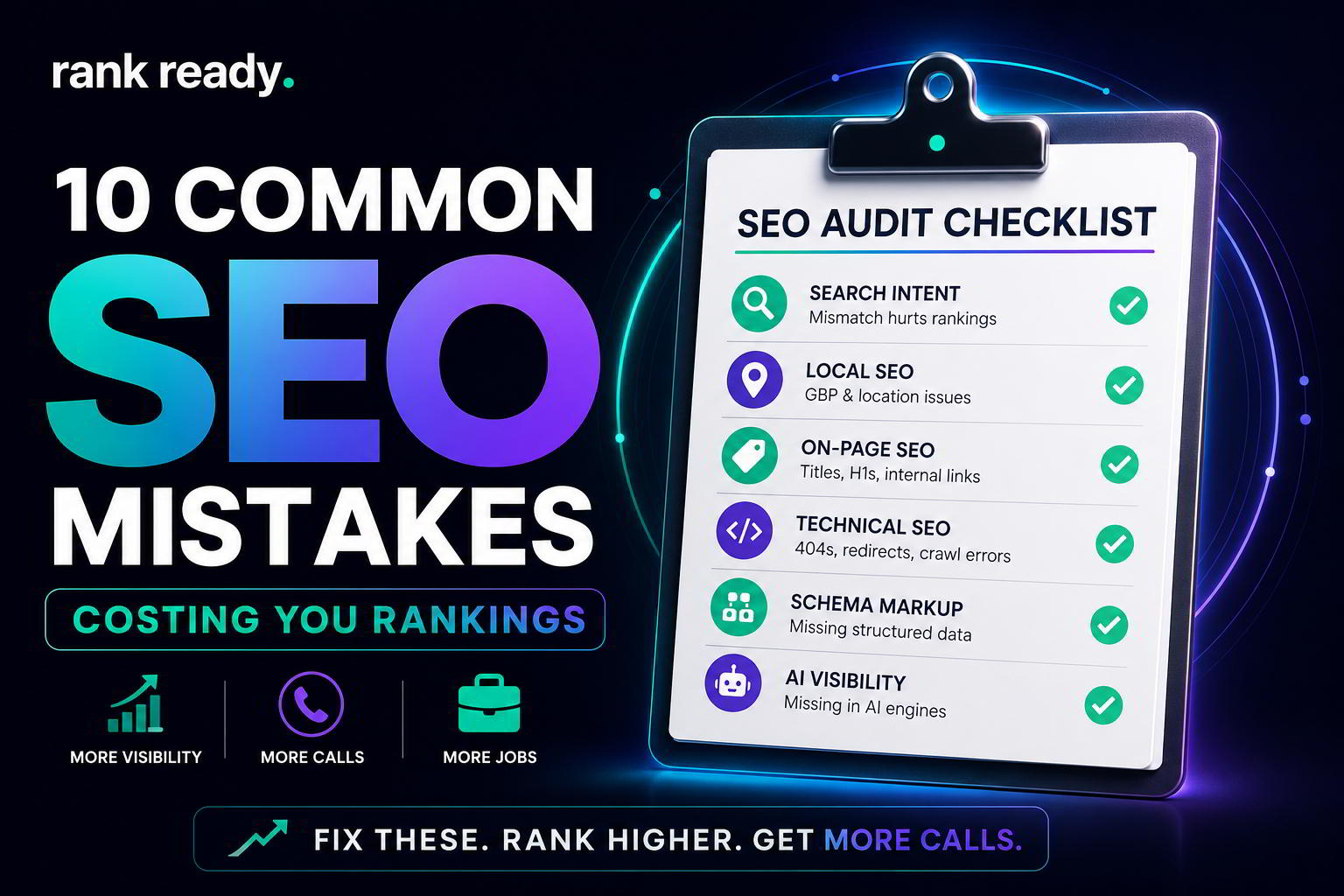
Mistake 1: Targeting Keywords Without Checking SERP Intent
This remains one of the most expensive common SEO mistakes.Businesses often target keywords based on search volume without examining what Google actually ranks.Intent beats volume
If Google ranks product pages and you’re publishing blog posts, you’re fighting the algorithm.Before creating content, review the first page.- Are results informational?
- Are they transactional?
- Are they local?
- Are they comparison pages?
Mistake 2: Using GBP Categories That Don’t Match What You Actually Do
Local businesses frequently sabotage their own visibility.Wrong categories create relevance problems
Your primary Google Business Profile category should reflect your main service.We’ve audited businesses using categories that were only loosely related to what they actually offered.That weakens local relevance and reduces visibility.Category selection remains one of the strongest local SEO signals available.For service businesses, fixing category alignment can create measurable improvements surprisingly quickly.Mistake 3: Title Tags That Match the H1
This mistake wastes valuable search real estate.Title tags and H1s serve different purposes
Your H1 explains the page topic.Your title tag helps attract clicks from search results.They shouldn’t be identical in most situations.Example:H1: SEO Audit ServicesTitle Tag: SEO Audit Services | Find Ranking Issues FastThe additional context creates stronger click-through opportunities.It’s a simple fix that appears constantly during audits.Mistake 4: No FAQ Schema on Pages With FAQ Content
Many websites include FAQ sections but fail to mark them up properly.Missed structured data opportunities
If FAQ content exists, FAQ schema often should too.Structured data helps search engines understand page content more clearly.It’s not a ranking hack.It’s a clarity signal.Many sites invest time creating useful FAQs while ignoring the technical layer that supports them.Mistake 5: 404s on Old URLs Instead of 301 Redirects
Few ranking issues waste authority faster than unnecessary 404 errors.Link equity disappears
When old pages receive links and then disappear without redirects, valuable authority can be lost.Every migration, redesign, and content cleanup should include redirect planning.Use:- 301 redirects for permanent changes
- Redirect maps during migrations
- Regular crawl audits
Mistake 6: Internal Links With “Click Here” Anchor Text
Internal links help search engines understand page relationships.Generic anchors waste context
“Click here” tells Google almost nothing.Compare:- Click here
- Technical SEO audit checklist
Mistake 7: No Tracking on Phone Calls From Organic Search
This mistake creates reporting blind spots.You can’t optimize what you can’t measure
Many local businesses track forms but ignore calls.That’s a major problem.For service businesses, phone calls often represent the most valuable conversions.Without call tracking, you’re making decisions with incomplete data.Ranking reports don’t pay bills.Revenue does.Mistake 8: Service Pages With No Schema
Service pages remain one of the most overlooked opportunities in local SEO.Help search engines understand your services
Appropriate schema may include:- Service Schema
- LocalBusiness Schema
- Review Schema
- FAQ Schema
Mistake 9: Location Pages With Copy-Paste Content
This is one of the most common local SEO problems.Changing city names isn’t localization
Many businesses create dozens of location pages using identical content.The only difference is the city name.That’s not a local strategy.It’s duplication.Strong location pages include:- Unique content
- Local proof
- Service-specific information
- Area-relevant examples
Mistake 10: Ignoring AI Engines Entirely
This is the newest entry on our list of common SEO mistakes.Search behavior is changing
Buyers increasingly use:- ChatGPT
- Perplexity
- Gemini
- AI Overviews
Why Fixing Common SEO Mistakes Delivers Faster Results Than Publishing More Content
Many businesses respond to declining rankings by creating more content.
In many cases, that’s the wrong move.
The biggest gains often come from fixing common SEO mistakes that already exist across the website.
Think about it this way: if search engines are struggling to understand your services, encountering broken redirects, finding duplicate location pages, or missing important schema signals, adding more content simply adds more pages to an already inefficient system.
Optimization usually beats expansion
Across more than 100 audits, we’ve found that resolving foundational SEO errors frequently produces faster ranking improvements than publishing new articles.
Common examples include:
- Fixing search-intent mismatches
- Improving internal linking
- Repairing redirect chains
- Adding structured data
- Strengthening local landing pages
These improvements help search engines process and trust existing content more effectively.
The result is often better visibility without creating a single new page.
If you’re experiencing persistent ranking issues, start by auditing what already exists. Most websites have enough content to grow. They simply need fewer common SEO mistakes standing in the way.
How to Scan for All 10 in 60 Minutes
You don’t need a week-long audit to identify most of these issues.A practical 60-minute review process
- Review your top pages for search intent alignment.
- Check Google Business Profile categories.
- Compare title tags against H1s.
- Validate FAQ schema.
- Crawl for 404 errors.
- Review internal anchor text.
- Verify phone-call tracking.
- Check service-page schema.
- Review location-page uniqueness.
- Search for your brand in AI engines.

0 Comments