
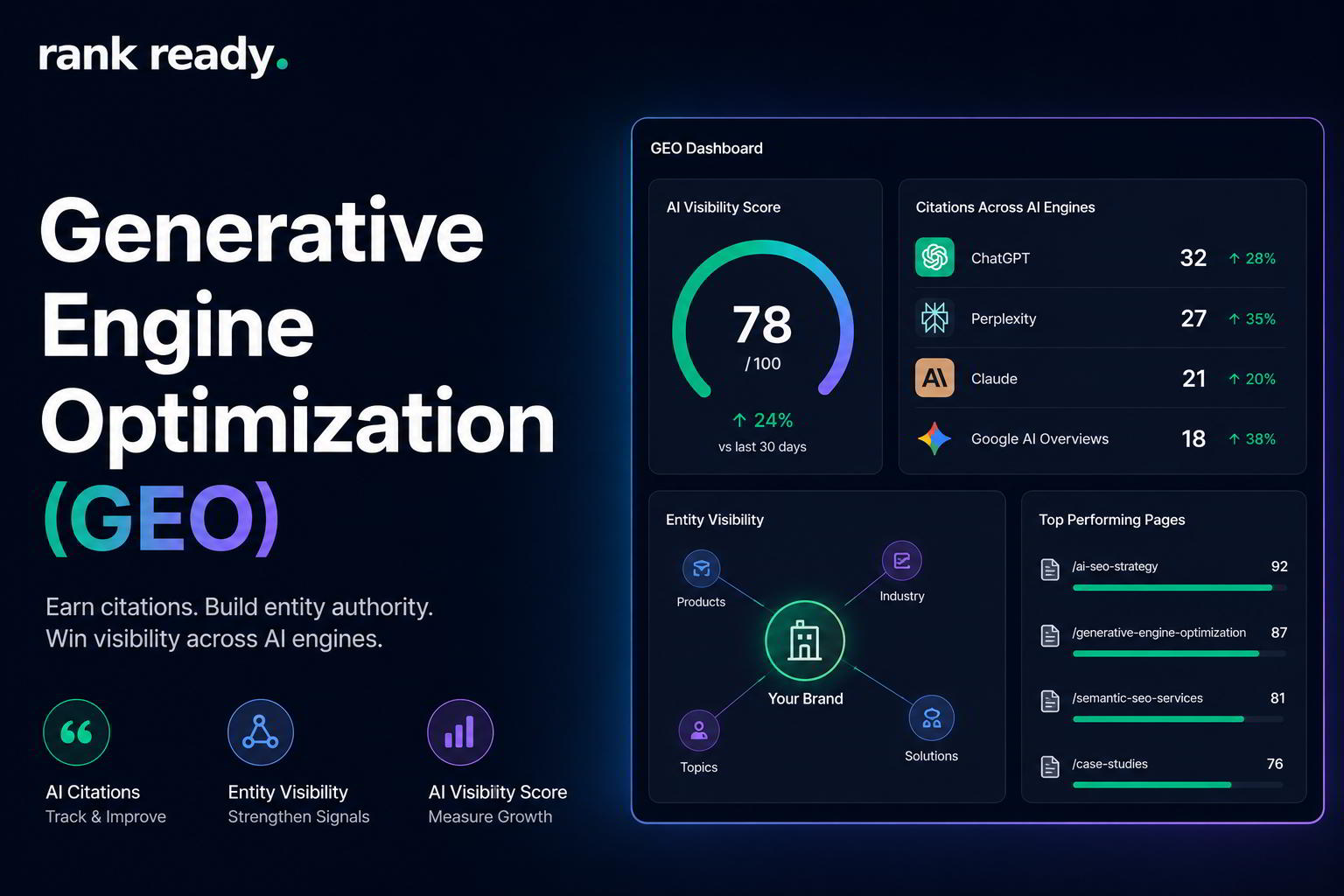
Users now ask ChatGPT for software recommendations. They ask Perplexity for product comparisons. They ask Claude for workflows. They trust AI summaries before clicking traditional search results.
That changed the visibility game entirely.
Generative Engine Optimization is the process of making your brand retrievable, citeable, and trusted inside AI-generated answers.
Not rankings alone.
Citations.
Mention frequency. Entity clarity. Retrieval structure. Authority relationships.
The businesses winning this shift are not waiting for “best practices” to become mainstream.
They are building AI visibility systems now.
We’ve been doing this since 2023 — before most agencies even realized AI engines would become a traffic layer.
And the gap is already widening.
What GEO Is — And What It Isn’t
The industry created noise fast.
Every agency suddenly added “AI optimization” to their homepage.
Most of them are describing traditional SEO with slightly updated language.
Generative Engine Optimization is not:
- adding ChatGPT to title tags
- stuffing AI keywords into pages
- publishing generic AI-written articles
- rewriting old SEO checklists
GEO focuses on one core question:
Will AI systems retrieve, trust, and cite your brand when generating answers?
That changes the optimization model completely.
SEO ranks pages. GEO earns citations.
Traditional SEO focuses heavily on ranking position.
GEO focuses heavily on:
- retrieval probability
- entity understanding
- citation likelihood
- authority relationships
- source trustworthiness
The overlap between SEO and GEO is substantial.
But they are not identical systems.
Search engines rank documents. AI engines synthesize sources.
That distinction matters enormously.
A page can rank well organically and still fail to appear inside AI-generated answers.
Why?
Because ranking alone does not guarantee retrieval trust.
AI systems increasingly evaluate whether your content:
- explains clearly
- aligns with known entities
- contains high-information density
- appears corroborated across the web
- matches likely user intent patterns
That means many “SEO-first” websites still struggle with AI visibility.
Especially sites built around thin content production instead of topical authority.
The brands succeeding with GEO usually look more like publishers than marketers.
They build:
- authoritative topic clusters
- strong entity consistency
- structured semantic relationships
- citation-worthy educational content
That creates a different type of discoverability.
Not just visibility inside Google.
Visibility across retrieval ecosystems.
Why GEO Matters Right Now
User behavior already changed.
Quietly at first. Then all at once.
People increasingly use AI systems for:
- product research
- vendor comparisons
- software recommendations
- technical explanations
- local discovery
- buying decisions
Especially in B2B SaaS and high-information industries.
Traffic patterns are already shifting toward AI-assisted discovery behavior.
The Data Most Businesses Are Missing
Traditional analytics often fail to capture AI-assisted brand exposure fully.
Someone may discover your brand inside ChatGPT, then search your company directly later.
That attribution path becomes blurry.
But the influence is real.
AI engines are increasingly functioning as pre-search filters.
Users ask AI systems for:
- top vendors
- best agencies
- recommended software
- trusted providers
If your brand never appears inside those answers, you are invisible earlier in the decision cycle.
That compounds over time.
Especially because AI recommendation loops naturally reinforce already-cited entities.
The brands appearing consistently inside AI-generated recommendations are already building disproportionate awareness advantages.
That matters because recommendation trust is extremely high inside conversational systems.
Users increasingly assume:
“If ChatGPT recommended these five vendors repeatedly, they are probably the market leaders.”
That perception shift alone changes:
- lead generation
- trust formation
- shortlist creation
- brand recall
- buying confidence
And the acceleration is happening faster than most businesses realize.
Some industries already receive measurable inbound traffic from AI assistants indirectly.
Others are seeing increases in:
- branded search demand
- direct traffic
- referral traffic
- assisted conversions
without fully understanding the AI layer influencing those patterns.
GEO is rapidly becoming an early-stage visibility moat.
How AI Engines Actually Source Answers
Most businesses fundamentally misunderstand how AI answers are assembled.
They imagine one giant “AI database.”
The reality is more layered.
RAG Changes Everything
Modern AI systems increasingly rely on retrieval-augmented generation, also known as RAG.
That means the system retrieves external information sources dynamically before generating responses.
Those sources may include:
- websites
- documentation
- forums
- Wikipedia
- news coverage
- YouTube transcripts
- podcasts
- public datasets
That retrieval layer matters enormously.
If your brand lacks retrievable authority signals, you disappear from the sourcing pipeline entirely.
Training Data vs. Live Retrieval
AI systems use both:
- training-based knowledge
- live retrieval systems
Training influences entity familiarity.
Retrieval influences citation frequency.
The strongest GEO strategies optimize for both simultaneously.
That requires:
- entity establishment
- structured content
- authoritative mentions
- retrieval-friendly formatting
Businesses still treating AI visibility like a pure keyword problem are already behind.
Another important distinction:
AI systems do not retrieve content exactly the way traditional search engines crawl pages.
Retrieval systems often prioritize:
- chunk clarity
- semantic alignment
- concise explanations
- trusted references
- question-answer formatting
This is why highly structured educational content increasingly performs well in AI-generated responses.
Not because it “targets AI keywords.”
Because it is easier to retrieve accurately.
Many AI systems also cross-reference multiple sources simultaneously before generating summaries.
That means corroboration matters more now.
If your claims appear repeatedly across trusted sources, confidence increases.
If your content exists in isolation with no external reinforcement, retrievability weakens.
This is one reason GEO increasingly overlaps with:
- digital PR
- semantic SEO
- authority building
- entity establishment
The systems are converging.
Layer 1: Entity Presence
AI systems rely heavily on entity understanding.
If your brand lacks strong entity signals, retrieval becomes dramatically harder.
The Entity Sources That Matter Most
- Wikipedia
- Wikidata
- Google Knowledge Graph
- Crunchbase
- industry databases
- authoritative publications
Entity consistency matters heavily across:
- company descriptions
- brand positioning
- executive information
- service definitions
- industry associations
One reason many startups struggle with AI visibility is because they lack strong entity establishment.
AI systems trust recognizable entities more easily.
AI systems do not “know” brands equally. They understand entities through relationships and repeated validation.
Entity consistency also reduces ambiguity.
If your brand appears differently across platforms, AI systems struggle to form confident associations.
That weakens:
- retrieval confidence
- citation frequency
- semantic clarity
- recommendation probability
Strong entity establishment usually includes:
- consistent brand descriptions
- aligned category definitions
- executive presence
- industry association signals
- repeated external validation
The strongest GEO campaigns often begin with entity cleanup before any content expansion happens.
Because retrieval systems need stable semantic understanding first.
This becomes especially important for:
- SaaS brands
- local businesses
- agencies
- medical companies
- legal firms
- fast-growing startups
Many businesses unknowingly create fragmented entity signals by using inconsistent language across:
- Crunchbase
- About pages
- press mentions
- social profiles
That fragmentation weakens retrievability.
AI systems prefer semantic consistency.
Layer 2: Mention Velocity From Authoritative Sources
Citation-worthy brands usually have one thing in common:
Other authoritative sources already talk about them.
Repeatedly.
Mention Velocity Matters More Than Most People Realize
AI systems increasingly evaluate authority through distributed mentions across the web.
That includes:
- news sites
- industry blogs
- podcasts
- YouTube discussions
- forums
- community recommendations
This is one reason digital PR became more important again.
Not for vanity.
For retrieval reinforcement.
Repeated mentions across trusted sources strengthen:
- entity confidence
- brand legitimacy
- retrieval probability
- citation likelihood
Weak brands talk about themselves.
Strong brands get referenced by other trusted entities.
Mention velocity also creates compounding effects.
Once a brand becomes repeatedly associated with a topic cluster, retrieval systems increasingly connect that entity with future related prompts.
That means:
- early authority compounds
- citations reinforce more citations
- retrieval visibility strengthens over time
The strongest GEO campaigns often focus heavily on:
- founder visibility
- industry commentary
- podcast participation
- collaborative research
- data studies
- expert interviews
Why?
Because distributed authority signals are easier for AI systems to validate.
A company mentioned by respected blogs, YouTube creators, Reddit discussions, journalists, and industry analysts appears substantially more trustworthy than a company talking only about itself.
This is one reason many AI-visible brands already had strong PR ecosystems before GEO became mainstream terminology.
They already built distributed authority naturally.
Layer 3: On-Page Structure for Retrieval
Most websites are structured for human scanning.
Not AI retrieval.
That creates a major visibility gap.
Why Chunk-Level Retrieval Matters
AI systems increasingly retrieve:
- paragraphs
- sections
- FAQs
- definitions
- lists
Not entire webpages.
That means structure matters enormously.
Strong retrieval-friendly pages usually include:
- clear heading hierarchy
- high-information paragraphs
- clean semantic organization
- direct definitions
- supporting entity references
Poor structure weakens retrievability dramatically.
Schema Strengthens Retrieval Context
Structured data reinforces semantic clarity.
Especially:
- Organization schema
- FAQ schema
- Article schema
- Person schema
- Breadcrumb schema
Our semantic SEO optimization services are designed heavily around machine-readable entity relationships because modern AI retrieval depends on structured clarity.
Another important shift:
AI systems increasingly favor content that answers questions directly without excessive filler.
That means:
Weak retrieval paragraph:
“Many businesses may potentially experience challenges associated with…”
Strong retrieval paragraph:
“AI systems retrieve structured, entity-rich content more reliably than generic marketing copy.”
Specificity improves retrievability.
So does formatting.
The strongest GEO pages usually contain:
- concise explanatory blocks
- high-signal subheadings
- semantic grouping
- strong contextual flow
Content structure increasingly affects whether your information gets surfaced at all.
Especially in RAG-based systems where chunk retrieval happens dynamically.
That changes content strategy fundamentally.
Layer 4: AI-Friendly Metadata
Traditional SEO metadata is no longer enough.
AI retrieval systems increasingly rely on additional context layers.
Why llms.txt Matters
The emerging llms.txt standard helps AI systems understand:
- important pages
- preferred crawl paths
- documentation hierarchy
- critical resources
Think of it as a directional layer for AI retrieval systems.
Still early.
But increasingly important.
Our GEO playbook explains how to get cited by ChatGPT and improve AI visibility.
FAQ Schema Matters More Now
AI systems increasingly favor content already organized around question-answer structures.
That makes FAQ formatting extremely retrieval-friendly.
Especially when paired with:
- direct answers
- semantic clarity
- strong entity references
Weak FAQ sections filled with filler language rarely perform well.
Concise, authoritative answers do.
Metadata also increasingly influences retrieval confidence.
Strong metadata systems reinforce:
- topical clarity
- entity relationships
- content hierarchy
- crawl prioritization
Businesses ignoring these layers often create unnecessary retrieval friction.
Especially large websites.
The strongest GEO implementations increasingly align:
- schema markup
- metadata hierarchy
- internal linking
- semantic organization
- FAQ systems
into one unified machine-readable structure.
That creates clearer retrieval pathways.
And clearer retrieval pathways improve citation probability.
Layer 5: Direct Citations From Forums, News, Podcasts & YouTube
AI systems increasingly pull from conversational content.
Not just polished websites.
The Overlooked GEO Channels
- YouTube transcripts
- industry podcasts
- community discussions
- technical forums
This matters because conversational sources often contain:
- recommendations
- comparisons
- brand sentiment
- practical use cases
Those signals help AI systems understand:
- trustworthiness
- industry relevance
- market positioning
- brand associations
That is one reason strong GEO campaigns increasingly combine:
- SEO
- digital PR
- podcast visibility
- community participation
- YouTube presence
Authority is now multi-channel.
AI systems increasingly observe where real humans discuss brands organically.
That creates a major shift in visibility strategy.
Some of the strongest GEO signals now come from:
- authentic discussions
- technical explanations
- user recommendations
- founder interviews
- industry debates
Not just corporate blog content.
This is why many invisible brands struggle with retrieval.
Nobody talks about them externally.
Meanwhile, highly discussed brands accumulate:
- semantic reinforcement
- entity association
- recommendation signals
- conversational trust
The businesses winning GEO increasingly behave like media ecosystems instead of static company websites.
How to Measure GEO
Most GEO measurement systems are still primitive.
The industry is early.
But meaningful tracking is absolutely possible.
The Manual Prompt Protocol
We regularly test AI visibility through structured prompt testing across:
- ChatGPT
- Perplexity
- Claude
- Gemini
- AI Overviews
Example prompt categories:
- best vendors
- top agencies
- recommended software
- industry comparisons
- workflow recommendations
We track:
- citation frequency
- mention consistency
- ranking inside generated answers
- entity positioning
This reveals visibility gaps quickly.
The GEO Tools Emerging Now
Several AI visibility platforms are emerging rapidly.
Most still rely heavily on prompt tracking.
But the category is evolving fast.
Especially around:
- citation monitoring
- AI visibility scoring
- retrieval analysis
- entity mapping
One important point:
Single-prompt testing is unreliable.
Strong GEO measurement requires:
- repeated prompts
- multiple AI systems
- multiple phrasing variations
- ongoing tracking windows
Because AI outputs fluctuate.
The goal is not perfection.
The goal is directional visibility consistency.
We also increasingly evaluate:
- citation positioning
- answer prominence
- recommendation context
- semantic associations
Not all citations carry equal value.
Being mentioned as a primary recommendation is dramatically different from being buried deep inside generated responses.
This is why mature GEO campaigns increasingly resemble reputation systems as much as visibility systems.
What Separates Citation-Worthy Content From Invisible Content
Most content is invisible to AI systems.
Not because it is badly written.
Because it lacks retrieval value.
The Traits AI Systems Favor Repeatedly
- clear structure
- specificity
- entity-rich context
- authoritative sourcing
- concise explanations
- high information density
Weak content tends to:
- ramble
- avoid specifics
- lack semantic clarity
- say generic things everyone already says
AI systems increasingly reward content that teaches clearly and references entities accurately.
Generic content competes for rankings. Specific content earns citations.
This is one reason many AI-written blogs struggle.
They often sound fluent while saying almost nothing uniquely valuable.
Strong GEO content usually includes:
- original frameworks
- clear definitions
- practical examples
- strong supporting entities
- trustworthy references
Another important difference:
Citation-worthy content usually demonstrates expertise.
Not just optimization.
That means:
- proprietary observations
- industry-specific insights
- nuanced explanations
- clear reasoning
matter increasingly.
AI systems are becoming better at distinguishing informational depth from superficial content.
The websites dominating future retrieval visibility will likely resemble educational knowledge hubs more than traditional marketing blogs.
The GEO-SEO Relationship
GEO does not replace SEO.
It builds on it.
Strong GEO campaigns almost always sit on top of strong SEO foundations.
Why Semantic SEO Matters First
Weak websites struggle with AI retrieval because they already lack:
- entity clarity
- topical authority
- semantic organization
- structured trust signals
That weakens both:
- search visibility
- AI visibility
Our AI GEO optimization frameworks build directly on top of structured semantic SEO systems.
Because retrieval quality depends heavily on semantic clarity.
The strongest AI-visible brands usually already dominate their topical entity clusters organically.
SEO creates discoverable infrastructure.
GEO amplifies retrieval visibility on top of that infrastructure.
This relationship matters because many businesses now attempt GEO without fixing foundational SEO weaknesses first.
That rarely works.
If your website lacks:
- topical authority
- semantic organization
- crawl clarity
- entity consistency
AI retrieval systems struggle to trust it consistently.
This is why semantic SEO increasingly acts as the foundational layer beneath modern GEO campaigns.
Strong retrieval depends on structured understanding.
And structured understanding depends on semantic architecture.
Real Client Journey: NorthPeak SaaS
NorthPeak SaaS started with essentially zero AI visibility.
No meaningful citations.
No retrievable authority.
No entity reinforcement.
The First 90 Days
We focused on:
- entity establishment
- structured semantic content
- industry mention velocity
- retrieval-friendly formatting
- FAQ expansion
- authority-source alignment
The result:
0% → 74% AI engine citation visibility in 90 days.
That visibility increase correlated directly with:
- higher branded search demand
- stronger inbound lead quality
- improved direct traffic
- more referral visibility
The important point:
We did not “hack AI.”
We strengthened retrievable authority.
That is what sustainable GEO actually is.
More examples are available through our case studies.
One of the biggest improvements came from restructuring existing content.
Not creating hundreds of new pages.
We improved:
- retrieval clarity
- semantic hierarchy
- FAQ expansion
- authority alignment
- supporting entity relationships
The campaign also increased visibility across:
- Perplexity
- ChatGPT
- AI Overviews
- industry recommendation prompts
The key lesson:
AI visibility compounds once retrieval systems repeatedly associate your brand with trustworthy topic clusters.
Common GEO Mistakes
The spam tactics already started.
Predictably.
The Tactics That Backfire
- fake AI mentions
- automated citation spam
- mass AI-generated blogs
- keyword stuffing around AI terms
- low-quality syndicated content
AI systems increasingly evaluate source trust.
That makes low-quality manipulation harder over time.
Especially because retrieval systems increasingly prioritize:
- trusted domains
- entity consistency
- source authority
- citation corroboration
Weak GEO tactics usually create short-lived noise.
Strong GEO systems build durable authority.
Another major mistake:
Businesses obsess over “appearing in AI” without improving content quality itself.
That usually fails.
AI systems increasingly reward:
- expertise
- trustworthiness
- semantic clarity
- retrieval value
not gimmicks.
The strongest GEO campaigns often look surprisingly boring operationally.
Because they focus on:
- authority building
- semantic consistency
- structured content
- entity reinforcement
instead of shortcuts.
That is also why many spam-heavy GEO tactics collapse quickly.
The retrieval layer is becoming more sophisticated rapidly.
What Happens Next: 2026–2027
The retrieval layer is becoming more important every quarter.
Especially as AI interfaces absorb more discovery behavior.
Our Predictions
- AI citations become a measurable KPI
- Brands optimize directly for retrieval systems
- Structured entity data becomes mandatory
- llms.txt adoption grows substantially
- AI recommendation loops reinforce authority concentration
- Generic websites lose visibility faster
The biggest shift:
AI engines will increasingly reward brands already recognized across multiple trusted ecosystems.
That means:
- strong semantic SEO
- high-authority mentions
- clean retrieval structure
- entity consistency
- cross-platform authority
will matter even more.
Businesses waiting for GEO to become “standard practice” are probably already behind.
The citation layer is forming now.
The early entities accumulate disproportionate advantages.
Another likely shift:
AI systems will increasingly personalize recommendations based on:
- context
- intent
- expertise level
- geographic relevance
- behavioral patterns
That means entity depth becomes even more important.
The brands that become deeply associated with specific topic clusters will likely dominate future retrieval visibility.
We also expect:
- stronger source filtering
- better hallucination reduction
- more trusted-domain weighting
- deeper entity validation systems
The retrieval ecosystem is becoming more sophisticated extremely quickly.
And that means weak authority signals will matter less over time.
Strong brands will likely compound visibility advantages faster than ever before.
Why Most Brands Still Aren’t Prepared for AI Discovery
Most companies still treat AI visibility like an experimental side channel.
That is the mistake.
AI discovery is quickly becoming part of the default research journey for both consumers and B2B buyers. Users increasingly ask ChatGPT, Perplexity, Gemini, and Claude to shortlist vendors before they ever open Google.
That means the visibility battle is shifting earlier in the funnel.
The problem is that most websites were never structured for retrieval systems.
They were built for rankings alone.
Weak semantic organization, fragmented entity signals, shallow content depth, and inconsistent authority positioning all reduce citation probability dramatically.
Google’s own helpful content guidance increasingly aligns with what AI retrieval systems reward as well — clarity, expertise, trust signals, and genuinely useful information.
The businesses gaining momentum in GEO right now are not necessarily publishing more content.
They are publishing clearer content.
More structured content. More retrievable content. More authoritative content.
That difference compounds because AI systems naturally reinforce entities they already trust.
Once a brand becomes consistently associated with a topic cluster, citation frequency accelerates.
And once citation frequency accelerates, visibility compounds across multiple AI systems simultaneously.
That is why GEO is becoming an infrastructure decision — not just a marketing tactic.
The Brands Winning GEO Look Structured, Trusted & Retrievable
The businesses dominating AI visibility are not necessarily the loudest.
They are the clearest.
Clear entity positioning. Clear semantic structure. Clear authority relationships. Clear retrievable value.
That is what AI systems reward increasingly.
Generative Engine Optimization is not a temporary trend layered on top of SEO.
It is the next visibility layer forming across search, discovery, and recommendation systems simultaneously.
The companies building retrievable authority now are positioning themselves ahead of where user behavior is already moving.
And the compounding effect is substantial.
Because once AI systems repeatedly trust and cite an entity, visibility accelerates naturally.
That is the real shift happening underneath the noise.
The businesses winning this transition understand something important:
AI visibility is becoming infrastructure.
Not a temporary marketing tactic.
The brands investing now in:
- semantic authority
- entity establishment
- structured retrieval systems
- distributed trust signals
are building advantages that become harder to replicate later.
Especially because recommendation systems naturally reinforce already-visible entities.
That creates a compounding visibility loop.
And that loop is already underway.
GEO is what we’ve been building since 2023 — before the industry even had consistent terminology for it. Our free GEO audit evaluates your visibility across ChatGPT, Perplexity, Claude, Gemini, and AI Overviews, then identifies the 3–5 highest-leverage opportunities to improve retrievability, authority signals, and citation frequency across AI systems.

0 Comments