
Most “service area” pages are templated copies with the city name swapped. Google noticed years ago. Here’s how multi-location brands build 50, 100, 500 pages without triggering duplicate-content problems.Most local landing pages fail because they are not actually local.They are generic templates pretending to be geographic relevance.Same service descriptions. Same FAQs. Same testimonials. Same imagery. Same structure. Different city name.Search engines became dramatically better at detecting that pattern once semantic evaluation and entity analysis evolved beyond basic text matching.That changed how city pages SEO works completely.Modern multi-location SEO is no longer about creating the most pages.It is about creating pages that deserve independent existence.The businesses winning local search in 2026 are not publishing mass-produced templates.They are building scalable systems for meaningful differentiation.
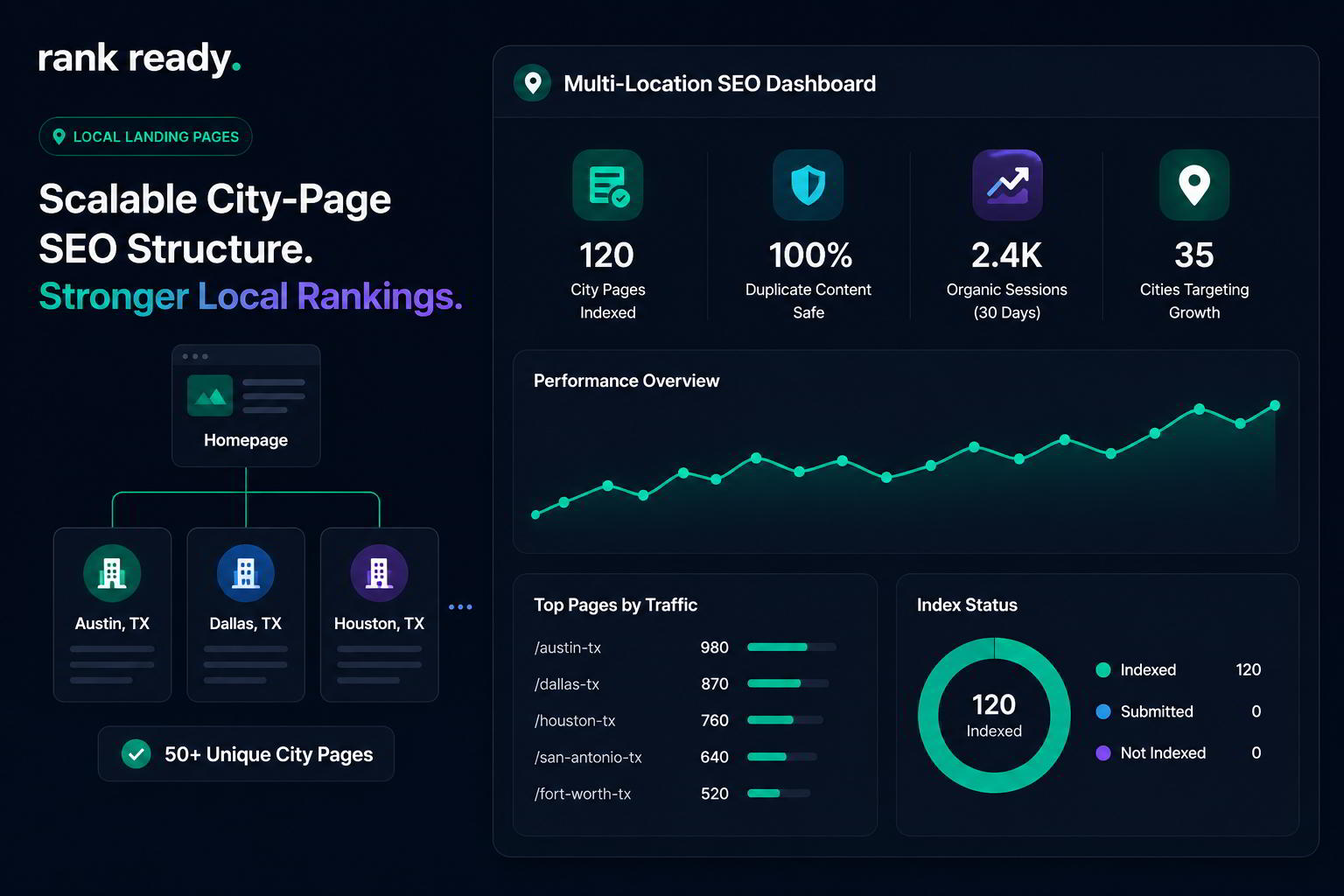
Building 100 location pages correctly takes a system — not a template. Our methodology has already supported 120-page rollouts with zero duplicate-content issues by combining localized data layers, entity-driven structure, scalable editorial workflows, and controlled semantic differentiation. If your current setup relies heavily on repetitive service-area templates, our local SEO audit process can identify the structural bottlenecks limiting long-term visibility before they compound further.
Why Templated Location Pages Stopped Working
There was a time when swapping city names into large template sets worked surprisingly well.Publish 50 pages. Add slightly different headings. Change a few paragraphs.Rankings often followed.That era ended years ago.Modern search systems evaluate:- semantic overlap
- entity duplication
- topical redundancy
- context similarity
- structural repetition
Why Google became stricter
Search systems increasingly evaluate whether a page contributes genuinely distinct value compared to nearby pages on the same domain.If 40 pages communicate essentially the same meaning, Google often consolidates or deprioritizes them.That frequently causes:- index instability
- ranking volatility
- canonical clustering
- weaker local visibility
Google does not care whether the wording changed 20%. It cares whether the page deserves independent existence.That single shift changed duplicate content SEO entirely for multi-location brands.Most modern local landing pages fail because search systems now evaluate semantic similarity far beyond simple text duplication.
What “Genuinely Unique Content” Actually Requires
Most SEO teams misunderstand uniqueness completely.Changing wording alone is no longer enough.True uniqueness operates across multiple independent layers simultaneously.The three things Google evaluates together
- Unique information
- Unique structure
- Unique contextual relevance
- different supporting entities
- different geographic context
- different supporting proof
- different informational relationships
The Three Layers of Uniqueness
The strongest scalable framework for location pages uses three simultaneous uniqueness layers:- Data
- Structure
- Prose
Why layered uniqueness works
When all three layers vary meaningfully, pages become substantially harder for search systems to cluster together.That creates stronger:- index consistency
- local relevance
- entity differentiation
- topical specificity
Layer 1: Data — Local Stats, Market Data & Local Case Examples
Data is the strongest uniqueness layer because it changes the informational value of the page itself.Most weak local pages contain zero meaningful local information.That is the first problem.Examples of useful local data
- regional market statistics
- city-level demand trends
- neighborhood service patterns
- local climate considerations
- pricing differences
- location-specific case studies
Layer 2: Structure — What Changes Beyond the City Name
Most location pages use nearly identical layouts.That creates structural sameness immediately.Structure influences semantic overlap
Search systems increasingly evaluate:- section hierarchy
- content sequencing
- supporting entities
- internal linking relationships
- page architecture
- different FAQ sections
- different proof elements
- different supporting services
- different local resources
- different media usage
Layer 3: Prose — Voice & On-the-Ground Details
This is the layer most agencies focus on first.Ironically, it is usually the weakest uniqueness layer by itself.Still important. Just insufficient alone.Specificity beats generic rewriting
Weak prose variation:“We proudly serve customers throughout Dallas.”Better prose variation:“Older homes near Lakewood often experience different plumbing pressure issues than newer developments expanding through North Dallas suburbs.”The second example demonstrates actual local familiarity.That matters increasingly.Search systems are much better at identifying whether content sounds grounded in regional understanding or generic template language.Strong prose variation includes:- regional terminology
- local landmarks
- community references
- market-specific conditions
- neighborhood context
Most local SEO pages are technically different but contextually identical. Search systems understand that distinction now.Strong prose also helps differentiate nearby suburban pages where services remain similar but local context changes dramatically.That contextual depth is one reason stronger location pages tend to outperform lightly rewritten city templates over time.
Workflow for Scaling to 100+ Pages Without Losing Quality
Most teams fail at scale because the workflow collapses before the rollout finishes.Quality drops rapidly once production volume increases.The workflow that scales properly
Strong systems usually separate:- data collection
- structural planning
- entity mapping
- content generation
- editorial review
- schema implementation
- structured frameworks
- localized data layers
- human editorial review
- controlled semantic variation
When to Use Programmatic SEO vs Hand-Written Pages
Programmatic SEO is not inherently bad.Bad programmatic SEO is bad.Where programmatic systems work well
- inventory-driven pages
- large-scale directories
- structured local datasets
- data-heavy geographic content
- healthcare
- legal
- home services
- real estate
- automation for scalable structure
- editorial refinement for uniqueness
- entity mapping for semantic clarity
Schema Requirements Per Page
Structured data reinforces local differentiation.Especially when paired with strong entity mapping.The schema types that matter most
- LocalBusiness
- Place
- FAQPage
- Review
- BreadcrumbList
- location relevance
- service relationships
- geographic entities
- business associations
How to Monitor Canonical Clustering After Launch
Publishing pages is only the beginning.You also need to monitor how Google interprets those pages afterward.Signs pages are clustering together
- pages disappearing from the index
- unexpected canonical selection
- ranking instability across nearby cities
- pages competing against each other
- Google indexing fewer pages than published
- Search Console index patterns
- canonical reporting
- crawl consistency
- query overlap analysis
The Future of Multi-Location SEO Belongs to Real Geographic Relevance
The era of mass-produced templates is ending.Search systems are becoming dramatically better at evaluating whether pages provide genuinely independent geographic value.The businesses winning with local landing pages today are not simply producing more pages.They are producing more differentiated pages.Better local data. Better structure. Better entity mapping. Better geographic understanding.That compounds across:- indexation stability
- local rankings
- conversion quality
- semantic authority
Building 100 location pages correctly takes a system — not a template. Our methodology has already supported 120-page rollouts with zero duplicate-content issues by combining localized data layers, entity-driven structure, scalable editorial workflows, and controlled semantic differentiation. If your current setup relies heavily on repetitive service-area templates, our local SEO audit process can identify the structural bottlenecks limiting long-term visibility before they compound further.

0 Comments