
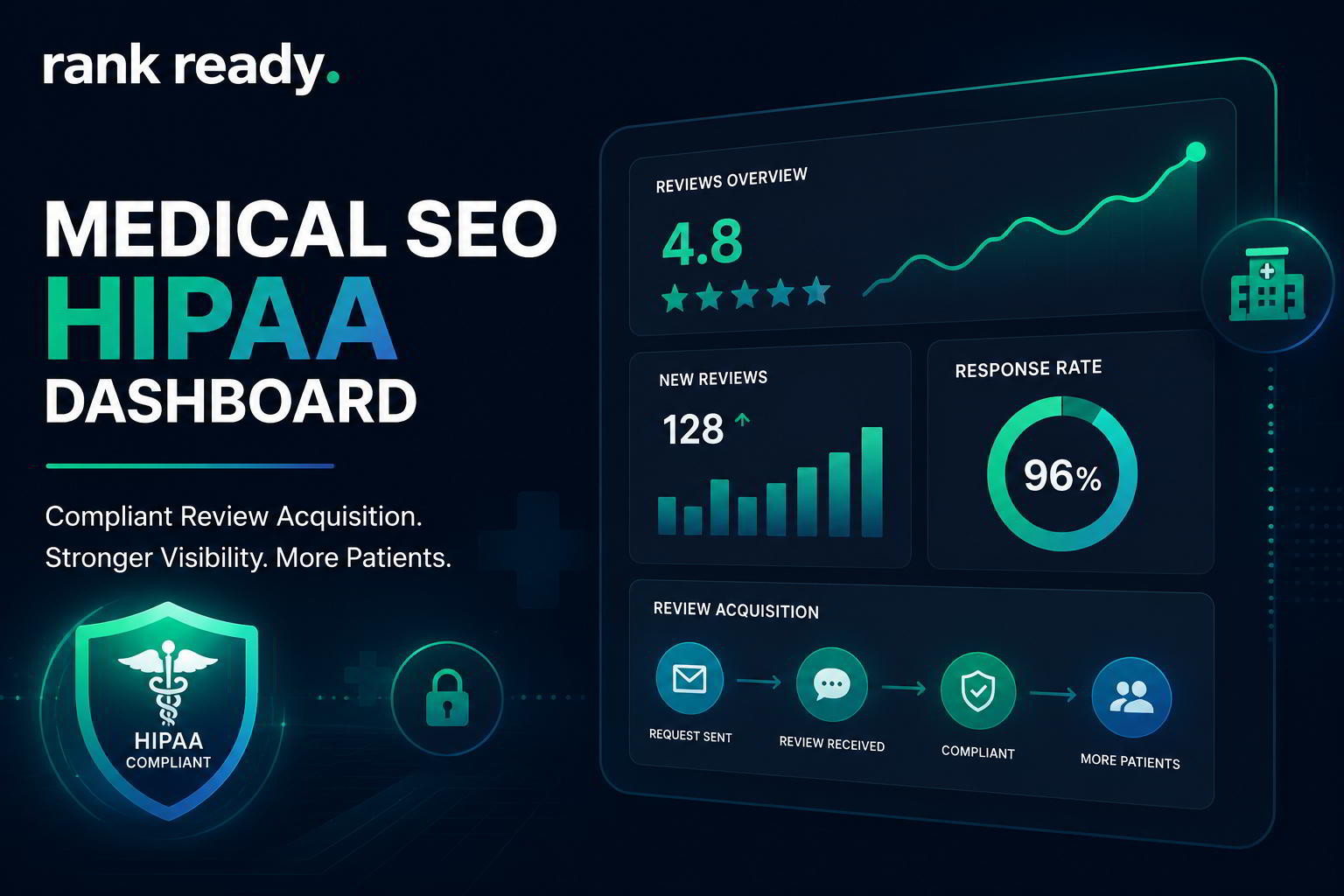
Reviews influence patient trust, Google Business Profile visibility, local rankings, and appointment decisions. They are one of the strongest signals in healthcare SEO. Yet many practices avoid reviews because HIPAA scares them. Others ask aggressively, reply carelessly, and create public compliance risk.
Both approaches lose.
The right answer is a review system built for healthcare from day one. A strong medical SEO HIPAA strategy helps practices earn patient feedback, strengthen local visibility, improve trust, and protect privacy at the same time.
The most successful medical SEO HIPAA strategies treat reviews as both a reputation asset and a compliance responsibility. When the process is built correctly, practices improve visibility without increasing risk.
Why Medical SEO HIPAA Reviews Matter for Rankings
Medical reviews are not optional anymore. Patients compare providers before booking, and Google uses review signals to evaluate local prominence.
Before scheduling, patients usually compare review count, star rating, review recency, response quality, location, and provider credibility. A practice with 420 recent reviews and a 4.7 rating has a stronger trust profile than a competitor with 44 reviews from three years ago.
Reviews influence local visibility
Google Business Profile performance is shaped by relevance, distance, and prominence. Reviews sit heavily inside prominence. They help Google understand whether a practice is active, trusted, and relevant in a local market.
That is why reviews belong inside a complete medical and dental SEO strategy, not as a random front-desk task.
But healthcare has a problem most industries do not. A restaurant can reply, “Glad you enjoyed dinner.” A clinic cannot reply, “Thanks for trusting us with your treatment.”
In healthcare, the review is public. The patient relationship is not.
That single difference is what makes medical SEO HIPAA more complex than standard local SEO.
What HIPAA Actually Says About Medical SEO HIPAA Reviews
HIPAA protects individually identifiable health information. The official HIPAA Privacy Rule from the U.S. Department of Health and Human Services explains how covered entities must protect medical records and protected health information. You can review the official guidance here: HHS HIPAA Privacy Rule.
For online reviews, the practical rule is simple: do not confirm, deny, imply, or reference that someone is a patient.
Patient disclosure does not create permission
A patient may write:
“Dr. Khan treated my root canal last week and the team was amazing.”
The practice should not reply:
“We’re glad your root canal went well.”
That response confirms both the patient relationship and the treatment. The patient disclosed it first, but the practice should not repeat or validate it.
A safer reply would be:
“Thank you for sharing your feedback. We appreciate your kind words about our team.”
This is the core rule of medical SEO HIPAA review management: stay general, professional, and non-clinical.
The 5-Step Medical SEO HIPAA Review Acquisition Process
Review acquisition should follow a structured patient journey. Random requests produce random results. Systems create predictable growth.
Step 1: Choose the right timing
Ask after a completed appointment, successful check-out, positive staff interaction, or resolved service moment. Do not ask during complaints, billing disputes, urgent issues, or sensitive care discussions.
Step 2: Use neutral language
The request should never mention treatment, diagnosis, procedure, provider outcome, or condition.
Use:
“We value your feedback. If you would like to share your experience, you can leave a review here.”
Avoid:
“If you loved your treatment, please leave us a five-star review.”
Step 3: Send patients to the right profile
Every location should have its own Google review destination. A 12-location group should not send every patient to one headquarters profile. Location-specific reviews strengthen local relevance.
Step 4: Track review velocity
Track total reviews, average rating, reviews per month, response rate, negative themes, and location-level performance. A practice getting 40 reviews per month looks strong until 32 came from one location and five locations received zero.
Step 5: Train before automating
Automation spreads whatever process already exists. A proper medical SEO HIPAA system starts with staff scripts, approved templates, and escalation rules. Tools come second.
Medical SEO HIPAA Response Templates That Stay Compliant
Every healthcare organization should maintain approved response templates. Not because every reply should sound robotic. Because every reply must avoid the same risks.
Positive review template
“Thank you for sharing your feedback. We appreciate your kind words and are grateful you took the time to share them.”
Team-focused response
“Thank you for your comments. Our team works hard to provide a professional and welcoming experience.”
Short response
“Thank you for taking the time to share your feedback. We appreciate it.”
These responses work because they acknowledge the review without confirming patient status.
What not to say
- “Thanks for trusting us with your surgery.”
- “We’re glad your recovery is going well.”
- “It was great seeing you last Tuesday.”
- “We’re happy your dental implants turned out well.”
- “Thank you for choosing Dr. Lee for your child’s care.”
Each example confirms information that should remain private. A strong medical SEO HIPAA response policy keeps replies short, neutral, and non-clinical.
The safer medical review response is usually the shorter one.
Negative Review Responses: The 3-Line Formula
Negative reviews create the highest compliance risk. Providers often want to defend themselves, correct the record, explain the chart, or mention what really happened.
Do not do that publicly.
The formula
- Acknowledge the concern without confirming patient status.
- State that privacy rules limit public discussion.
- Move the conversation offline.
Use this template:
“Thank you for sharing your concerns. Because privacy rules limit what we can discuss publicly, we cannot address details in an online review. Please contact our office directly so the appropriate team member can review this with you.”
This response shows professionalism, protects privacy, and gives the reviewer a private path to resolution. Effective medical SEO HIPAA management prioritizes compliance over winning an argument online.
Review Acquisition Systems for Medical SEO HIPAA Success
Most healthcare organizations use three review acquisition systems: QR codes, follow-up emails, and in-office requests. All three can work. All three can create risk if implemented lazily.
QR codes
QR codes work well at reception desks, checkout areas, printed cards, and post-visit materials. Keep the message neutral.
Use “Share your feedback.” Avoid “Loved your appointment? Give us five stars.”
Follow-up emails
Email works when the message is short and non-clinical.
“Thank you for visiting our office. We value feedback from the people we serve. If you would like to share your experience, you can leave a review here.”
Kiosks
Kiosks can be useful, but staff should not hover, pressure patients, or route only happy patients to Google while unhappy patients are sent elsewhere. Consistency matters more than volume.
For practices that need profile management, review workflows, and local visibility handled together, Rank Ready’s GMB management service builds review acquisition into the Google Business Profile strategy from day one.
Schema Markup and Medical SEO HIPAA Best Practices
Schema helps search engines understand your medical entity, locations, services, providers, and content. It does not replace reviews. It gives reviews and local signals a clearer structure.
Use the right schema types
Most practices should consider schema such as:
- MedicalClinic
- Dentist
- Physician
- LocalBusiness
- Organization
- Article
- FAQPage when a real FAQ section exists
The mistake is adding generic LocalBusiness schema across every page and calling the job finished. A 12-location dental group with 30 providers and dozens of service pages needs stronger entity mapping.
Review markup caution
Review markup should be accurate, visible on the page, and aligned with Google’s structured data policies. Do not invent ratings. Do not mark up hidden testimonials. Do not copy patient reviews into pages without considering compliance and platform rules.
Bad schema does not make weak reputation stronger. It just makes the mess machine-readable.
Effective medical SEO HIPAA programs combine structured data, review acquisition, Google Business Profile optimization, and local content into one unified system.
When to Escalate Negative Reviews
Not every negative review is a legal issue. Most are reputation issues. They need a calm response, internal review, and service recovery.
Usually not legal
- Long wait times
- Billing frustrations
- Front-desk complaints
- General dissatisfaction
Potential escalation cases
- Threats of violence
- Harassment of staff
- Fake reviews
- Competitor attacks
- Impersonation
- Clear platform policy violations
Document everything. Screenshot the review. Save timestamps. Use the platform reporting process. In serious cases, involve counsel before replying further.
The Medical SEO HIPAA Playbook for Multi-Location Practices
A single-location clinic can manage reviews manually for a while. A 12-location dental service organization cannot.
Set location-level targets
Do not use one brand-wide goal. Each location needs its own review target, response benchmark, and reporting dashboard.
A practical 12-location model:
- 10 new reviews per month per location
- 95% response rate within 72 hours
- Monthly negative theme review
- Quarterly Google Business Profile audit
- Location page and GBP alignment checks
Centralized compliance, local execution
Corporate should own templates, rules, reporting, and escalation. Local teams should own patient experience and day-to-day review requests.
This prevents two problems: corporate strategy that front-desk staff never use, and local improvisation that creates compliance risk. The best medical SEO HIPAA systems combine centralized control with local action.
Real Example: MetroDental’s Medical SEO HIPAA Review System
MetroDental Group had the classic multi-location problem: strong services, uneven local visibility, and location pages that needed scale without duplicate content risk.
The project covered 120 unique location pages with zero duplicate content flags. That mattered because reviews alone were not enough. The practice needed location-level relevance, structured content, internal linking, Google Business Profile consistency, and review management working together.
The review system supported the broader healthcare SEO architecture. Each location had clearer local signals, cleaner profile alignment, and a stronger path for patient feedback.
That is the difference between collecting reviews randomly and building a real medical SEO HIPAA system. You can see more proof points from multi-location and service business growth on our case studies page.
The Review System Medical Practices Actually Need
Medical practices need reviews because patients rely on them and Google reads them as local prominence signals. But healthcare cannot use the same review tactics as restaurants, home services companies, or e-commerce brands.
The winning system is specific: neutral requests, compliant responses, location-level tracking, clean escalation rules, structured data, and Google Business Profile management that respects HIPAA from the beginning.
Strong medical SEO HIPAA work balances two priorities that often seem to conflict: stronger visibility and patient privacy. The practices winning local search today are not avoiding reviews. They are building compliant systems that generate feedback, protect trust, and improve healthcare SEO performance over time.
The goal of medical SEO HIPAA is not simply generating more reviews. The goal is creating a repeatable system that improves rankings while protecting patient privacy.
If your practice is leaving review revenue on the table because compliance concerns are slowing down your review acquisition efforts, you’re not alone. Most healthcare organizations either avoid asking for reviews altogether or use processes that create unnecessary HIPAA risk. Our managed GBP and review system is HIPAA-compliant by design, helping medical practices earn more patient feedback, strengthen local visibility, and improve healthcare SEO performance safely. Get a free SEO audit and see exactly where your review strategy, Google Business Profile, and medical SEO HIPAA performance can improve.

0 Comments