Google stopped matching strings in 2013. Every agency still chasing keyword density is fighting the last war. Here’s what they’re missing — and the methodology that actually works.
Semantic SEO is the difference between a site that ranks by accident and a site Google can actually understand.
Old SEO asked one question: “Did we use the keyword enough?” Modern search asks better questions. What entity is this page about? What related concepts does it cover? Is this brand a credible source on the topic? Do the pages connect in a way that proves expertise?
That shift is why random blog publishing stopped working. It is why thin location pages get ignored. It is why AI Overviews and ChatGPT increasingly surface brands with clearer entity signals, not just louder keyword targeting.
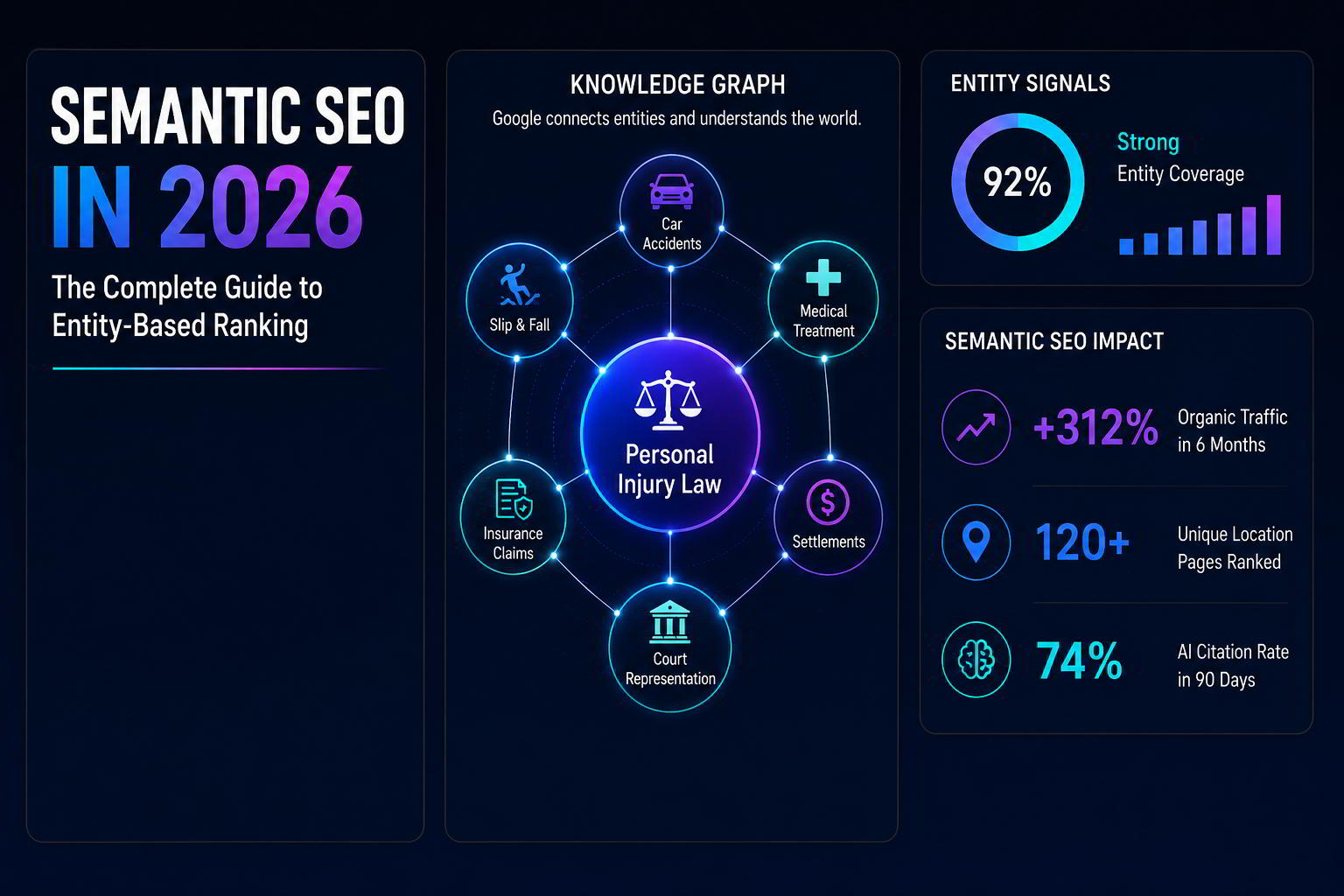
Rank Ready has been building entity-based ranking systems since 2018. Long before “GEO” became the next acronym. One legal client — Smith & Associates Law — increased organic traffic +312% in 6 months after we rebuilt their practice-area architecture, entity signals, and internal authority flow.
This guide breaks down how entity-based ranking works in 2026, how to build pages Google understands, and how this approach becomes the foundation for GEO and AI visibility.
What Semantic SEO Actually Means (Entities, Not Keywords)
Most agencies still treat search like a matching game. Add the keyword to the title. Add it to the H1. Repeat it a few times. Build links. Wait.
That playbook is incomplete.
Search visibility increasingly depends on clarity, context, relationships, and topical consistency across the entire site.
Search engines now evaluate meaning
Modern search systems look at context, relationships, entities, and intent. A page about “dental implants” is not only about that phrase. It also connects to oral surgery, bone grafting, crowns, cosmetic dentistry, insurance, local providers, recovery time, and patient eligibility.
That is the point of semantic SEO: helping search engines understand the complete meaning of a topic, not just the target phrase.
An entity can be:
- A person
- A company
- A place
- A service
- A product
- A legal practice area
- A medical condition
- A software category
Entity SEO works because Google does not want isolated pages. It wants clear subjects, clear relationships, and clear evidence of expertise.
“Semantic SEO is not optimizing pages. It is building machine-readable expertise.”
This is why some newer websites outrank older domains with bigger backlink profiles. They are easier to understand. Their content is better structured. Their internal links reinforce the right relationships. Their schema removes ambiguity.
Our semantic SEO framework is built around that exact principle: make the site easier for search engines and AI systems to trust, retrieve, and rank.
A Brief History: From PageRank → Hummingbird → BERT → MUM → AI Overviews
Google did not become an entity-first search engine overnight. The shift happened over more than two decades.
PageRank made authority measurable
In the late 1990s, Google’s early advantage was PageRank. Links acted like votes. Anchor text helped describe relevance. Sites with stronger link profiles usually had stronger ranking power.
That system changed search. But it also created a generation of SEO campaigns obsessed with links and keywords while ignoring meaning.
Hummingbird changed the rules in 2013
Hummingbird was the point where Google moved harder toward understanding queries instead of matching phrases. Search became more conversational. Intent became more important. Related terms mattered because they clarified meaning.
This is where semantic search optimization became unavoidable.
BERT improved language understanding
BERT helped Google understand nuance inside sentences. Small words started mattering more. Query meaning became less mechanical. A search engine could better understand what the user actually wanted — not just what words appeared in the query.
MUM expanded context across formats
MUM pushed Google further into complex understanding across languages, formats, and topic layers. Search was no longer just a text-matching engine. It was moving toward deeper interpretation.
AI Overviews changed visibility again
AI Overviews and generative search added another layer. Search engines now synthesize information instead of only ranking blue links. That means your site must be understandable enough to summarize, cite, and retrieve.
This is why GEO optimization is a natural extension of entity-based SEO. AI systems need structured understanding before they can confidently cite your brand.
The Knowledge Graph: How Google Understands the World
Google’s Knowledge Graph launched publicly in 2012. Most businesses still underestimate what that means.
Google connects things, not just pages
The Knowledge Graph helps Google understand people, places, companies, services, categories, and their relationships.
Example: Google can understand that a personal injury lawyer is connected to legal services, car accidents, liability, settlements, medical bills, court representation, and specific cities.
That relationship map matters because rankings are no longer based only on whether a page says the right words. Rankings increasingly depend on whether the page fits into a broader understanding of the topic.
Google’s own structured data documentation explains how machine-readable information helps search systems interpret content more clearly.
Most websites fail here. They publish pages that humans can skim but machines struggle to classify. The brand, service, location, author, and topic relationships are weak or inconsistent.
That creates ambiguity.
And ambiguity is expensive.
If Google cannot clearly understand what your business does, where you do it, and why you are authoritative, your competitors with clearer entity signals get the advantage.
Entities, Attributes, Relationships — Explained With Real Examples
Entity-based ranking sounds abstract until you break it down.
Entities are the nouns Google needs to understand
Suppose you run a dental practice. The core entities might include dentist, dental implants, cosmetic dentistry, Invisalign, emergency dentistry, dental insurance, and the city where the practice operates.
Those entities are not random keywords. They are concepts Google can connect.
Attributes describe the entity
Attributes add detail. For a dentist, attributes might include location, credentials, services offered, appointment availability, accepted insurance, years of experience, and patient review profile.
For a law firm, attributes might include practice areas, attorney credentials, jurisdictions, case results, bar admissions, and office locations.
Relationships create meaning
Relationships explain how entities connect.
- Dental implants relate to oral surgery and crowns.
- Truck accident claims relate to personal injury law and insurance disputes.
- B2B SaaS analytics relates to dashboards, reporting, attribution, and revenue operations.
Strong entity SEO reinforces these relationships across the site. The content says it. The internal links support it. The schema labels it. The navigation makes it visible.
This is why our work in medical and dental SEO starts with entity mapping before content production. Healthcare search is too competitive for vague topical coverage.
How to Build Entity-Rich Pages (The Technical Side)
Most pages are not bad because they are short. They are bad because they are semantically thin.
Thin pages do not build enough context
A weak page usually has a target keyword, a few headings, and generic copy. It may technically mention the service. But it does not explain the surrounding concepts Google expects to see.
An entity-rich page works differently.
It includes:
- The primary entity
- Supporting subtopics
- Relevant attributes
- Related services
- Common user questions
- Internal links to connected pages
- Schema that labels the page clearly
Example: a personal injury page should naturally discuss liability, insurance claims, medical treatment, settlement timelines, evidence, negligence, and case evaluation. Not because we are stuffing keywords. Because those concepts genuinely belong in the topic.
A dental implants page should cover candidacy, bone density, procedure steps, recovery, cost ranges, alternatives, and maintenance. A SaaS analytics page should cover dashboards, integrations, attribution, reporting workflows, user roles, and business outcomes.
That is the technical side of semantic SEO: building enough structured context that search systems can classify the page confidently.
Topical Authority: Building It Deliberately, Not Accidentally
Topical authority is not a content calendar. It is a system.
Authority compounds faster when every supporting page reinforces the same commercial topic cluster.
Depth beats random publishing
Most businesses publish based on whatever topic seems useful that week. One blog on trends. One blog on FAQs. One blog on tools. No structure. No topic ownership.
That does not build authority.
Strong topical authority starts with a map.
For a law firm, that might include:
- A personal injury pillar page
- Truck accident pages
- Slip-and-fall pages
- Wrongful death pages
- Insurance claim guides
- State-specific legal resources
- Attorney bio pages tied to practice areas
Each page supports the larger topic ecosystem.
This is the same strategic logic we used for Smith & Associates Law before their organic traffic increased +312% in 6 months. The work was not “more content.” It was better topical architecture.
“Most agencies publish content calendars. We build authority ecosystems.”
This matters heavily in competitive verticals like legal SEO, where one generic service page will not win against firms with deeper practice-area ecosystems.
Schema as the Structural Language of Semantic SEO
Schema is not magic. It will not make weak content rank.
But schema does make strong content easier for machines to understand.
Schema labels the important things
Schema can clarify:
- What the page is about
- Who authored or reviewed it
- Which organization owns it
- Which services are offered
- Which locations are relevant
- Which questions are answered
Most schema implementations are incomplete. We regularly audit sites missing Service schema, Person schema, LocalBusiness markup, FAQ structure, and meaningful organization markup.
That matters because structured data gives search systems cleaner context.
A service page should not only “look” like a service page to a human. It should be labeled as one for machines. A law firm page should connect attorneys, services, practice areas, and locations. A healthcare page should connect providers, treatments, conditions, and location entities.
Schema is the structural language behind better semantic search optimization.
Internal Linking That Signals Topical Relationships
Internal links are not just crawl paths. They are relationship signals.
Most internal links pass nowhere useful
A footer link is not a strategy. A “learn more” link is not a strategy. Random blog cross-linking is not a strategy.
Strong internal linking tells search systems which pages support each other.
Example: a truck accident page should connect to personal injury, insurance disputes, settlement timelines, attorney bios, and relevant city pages. Those links reinforce the topic cluster.
For a dental site, an implants page might connect to bone grafting, cosmetic dentistry, patient financing, oral surgery, and provider bio pages.
For a SaaS site, a reporting dashboard page might connect to attribution, integrations, revenue analytics, data governance, and industry-specific use cases.
One B2B SaaS client improved commercial keyword visibility by 29% largely through internal authority restructuring — without significant backlink growth.
The lesson: internal links are not decoration. They shape how authority flows through the site and how concepts connect.
Why Most “SEO Content” Fails Semantic Search Tests
Publishing volume is not the same thing as building authority
Most SEO content fails because it was designed for publishing velocity instead of contextual depth.
The typical workflow still looks like this:
- Pick a keyword
- Generate a quick outline
- Write 1,500 words
- Add internal links
- Publish and repeat
The problem is that this process rarely builds meaningful semantic relationships.
Search engines increasingly evaluate whether pages contribute to broader topic understanding. If every article exists in isolation, the site never develops durable topical authority.
Strong semantic SEO content works differently.
Each page should reinforce:
- Core entities
- Supporting subtopics
- Commercial relevance
- Industry relationships
- Authority pathways
This is why semantic SEO campaigns usually outperform generic blog strategies over time. The content compounds instead of fragmenting.
One healthcare client came to us with more than 400 indexed blog posts but weak commercial rankings. The issue was not publishing frequency. The issue was disconnected architecture.
After restructuring topic clusters, internal relationships, and entity alignment, non-branded organic leads increased 61% within four months — without dramatically increasing publishing output.
Measuring Semantic SEO Progress (Entity Coverage, Not Keyword Positions)
Keyword rankings still matter. They just do not tell the whole story anymore.
Measure coverage, depth, and retrieval
Traditional reporting usually tracks:
- Keyword positions
- Traffic
- Clicks
- Impressions
Entity-first reporting also tracks:
- Entity coverage
- Topic depth
- Semantic overlap against competitors
- Internal relationship strength
- Schema completeness
- AI citation visibility
This gives a more accurate view of whether the site is becoming more understandable and authoritative.
NorthPeak SaaS increased AI citation visibility from 0% → 74% in 90 days largely through stronger semantic architecture, better retrieval formatting, and clearer entity alignment.
That is the direction search measurement is moving. Less obsession over one keyword. More focus on whether your brand is becoming a trusted source across the full topic space.
Common Semantic SEO Mistakes That Keep Sites Stuck
Most sites do not fail at semantic SEO because the team is lazy. They fail because the strategy is still built around old SEO assumptions.
Mistake #1: Treating every page as a standalone asset
A single strong page can rank. But a disconnected page rarely builds durable authority.
Search systems increasingly evaluate whether a page belongs inside a broader topic ecosystem. If your service page has no supporting content, no internal links, no schema reinforcement, and no clear relationship to adjacent topics, it looks isolated.
That isolation weakens semantic SEO performance.
Mistake #2: Publishing content without an entity map
Most content calendars are built around keywords.
Better systems start with entities.
Before writing, map the people, services, problems, locations, tools, outcomes, and categories the site needs to own. Then build content around those relationships.
This is where semantic SEO becomes strategic instead of reactive.
Mistake #3: Using schema as decoration
Schema is not something you “add at the end.”
It should reflect the same entity relationships already present in the content and internal links.
If your page says one thing, your internal links suggest another, and your schema barely labels anything, Google receives mixed signals.
Strong semantic search optimization works because content, links, schema, and site architecture all reinforce the same meaning.
Mistake #4: Measuring only keyword movement
Keyword rankings are useful. They are not the full picture.
A semantic SEO campaign should also measure entity coverage, topic depth, internal link strength, schema completeness, and AI citation visibility.
When those signals improve, rankings usually follow — but the real win is deeper authority across the category.
The Rank Ready Methodology: 6 Phases We Run for Every Client
Most agencies execute SEO tactically. We build systems.
Phase 1: Entity mapping
We identify the entities that matter: services, locations, people, products, categories, competitors, problems, and outcomes. This creates the foundation for every page, link, and schema decision.
Phase 2: Topical architecture
We build the site map around authority clusters. Pillars, supporting pages, commercial pages, FAQ resources, and location pages all get assigned a role.
Phase 3: Content development
We write pages to establish meaning. That means entity clarity, useful subtopics, commercial intent alignment, and contextual completeness. No fluff. No generic “ultimate guide” padding.
Phase 4: Schema and structured data
We label the important entities. Organization, Service, LocalBusiness, Person, FAQ, Article, and industry-specific schema all support machine understanding.
Phase 5: Internal authority distribution
We connect pages based on topical relationships. Authority flows toward the pages that drive revenue, not just the pages that happen to be in the navigation.
Phase 6: GEO expansion
Once the entity system is strong, we extend it into AI visibility. That includes retrieval formatting, trusted-source reinforcement, citation tracking, and AI answer testing.
This is where semantic SEO becomes the foundation for GEO.
Real Client Results: Smith & Associates Law (+312%) Deconstructed
Smith & Associates Law did not need a prettier blog. They needed a clearer authority system.
The growth came from structure, not tricks
The firm already had real legal expertise, years of content, and a decent backlink profile. But rankings had plateaued because the site structure did not clearly reinforce practice-area authority.
We found:
- Weak entity clustering
- Service-page cannibalization
- Thin supporting content
- Disconnected attorney bios
- Poor internal authority flow
- Incomplete schema
Over six months, we rebuilt the practice-area architecture, clarified entity relationships, improved attorney and service schema, and connected supporting content to commercial pages.
The result: +312% organic traffic growth in 6 months.
More important, the growth was not vanity traffic. It came from commercial-intent practice-area queries, local legal visibility, and pages tied to consultation demand.
That is the difference between publishing content and building authority.
More examples are available in our SEO case studies.
What’s Coming Next: GEO as the Natural Extension of Semantic SEO
If semantic systems were the search playbook for 2020-2025, GEO is the playbook for 2025-2030.
AI retrieval systems increasingly reward brands with cleaner semantic structures and stronger entity consistency.
AI retrieval needs structured understanding
AI systems increasingly retrieve and synthesize information instead of simply ranking pages. That means they need clean entity signals before they can cite, summarize, or recommend a brand confidently.
AI engines look for:
- Clear entities
- Trusted sources
- Structured answers
- Consistent external references
- Machine-readable context
That is why GEO does not replace entity-based SEO. It extends it.
Strong semantic architecture improves AI retrieval, citation visibility, contextual understanding, and trust signals across ChatGPT, Perplexity, Claude, and AI Overviews.
Most businesses still optimize primarily for rankings.
The next generation of visibility depends on retrievability.
“If semantic SEO was the playbook for 2020-2025, GEO is the playbook for 2025-2030.”
That transition is already happening faster than most businesses realize.
Modern search is not a keyword game anymore.
Google increasingly evaluates entity clarity, topical authority, structured relationships, and machine-readable understanding. AI search pushes the same shift even further. If your site is hard to understand, it becomes harder to rank, harder to summarize, and harder to cite.
The businesses winning now are not simply publishing more content. They are building authority ecosystems around the entities they want to own.
That requires structure. It requires deliberate topical depth. It requires internal links, schema, and content that all point in the same direction.
Most agencies still optimize page-by-page. Rank Ready builds authority system-by-system.
Semantic SEO is what we’ve been doing since 2018, and it’s the foundation of everything else — including GEO. Our free semantic SEO audit shows you exactly which entities your site already owns, which it’s underbuilding, and the 3-month roadmap to topical authority in your category.

0 Comments