
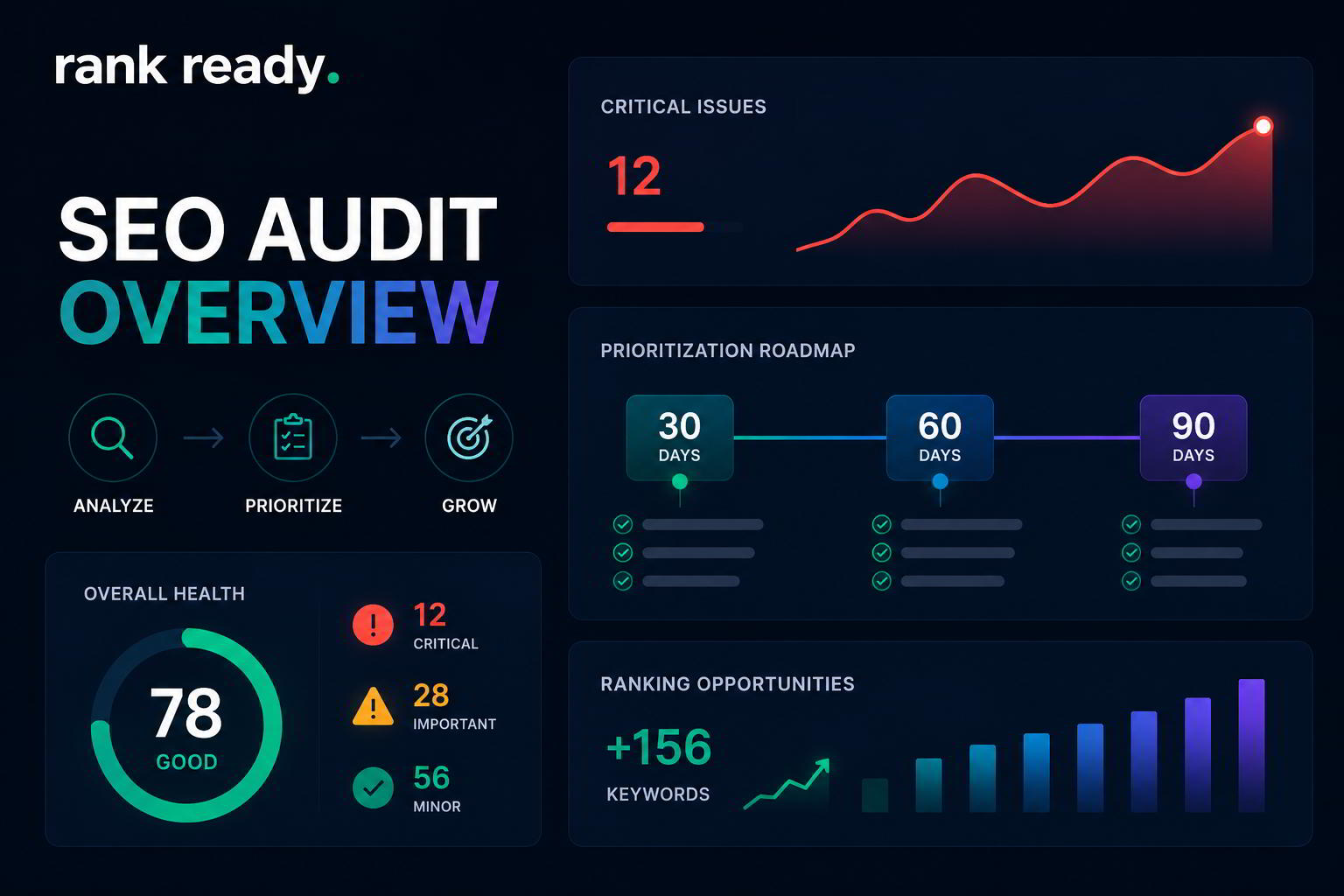
You paid $5,000 for an audit. You got a 60-page PDF. Six months later, your rankings haven’t moved. Here’s how to tell — within 5 minutes — whether what you got was diagnosis or theater.The SEO audit industry has a quality problem. Anyone can export reports from Ahrefs, Semrush, Screaming Frog, or Google Search Console. Anyone can add screenshots, charts, and red warning icons. The result looks technical. It feels valuable.But looking valuable and creating results are two different things.A real audit identifies the few issues actually holding growth back. A bad audit creates a giant list of everything that could possibly be improved. That is how an SEO audit waste happens.
Most SEO audits identify dozens of issues. The reality is that only a handful are usually responsible for stalled growth. Our audits are senior-led, completed within 48 hours, and focus on the three things actually holding you back — not 80. Get a free SEO audit and see exactly where your rankings, traffic, and conversions are being constrained.
Sign #1: It’s Mostly Screenshots From a Tool You Could’ve Run Yourself
The fastest way to identify an SEO audit waste is to count screenshots.If most of the document consists of exports from SEO tools, you probably paid someone to collect data instead of analyze it.Data collection is not diagnosis
Tools can show broken links, missing meta descriptions, PageSpeed scores, keyword rankings, and crawl errors. That data matters, but it is not the audit.What you are paying for is interpretation: which issues matter, why they matter, what should be fixed first, and how the fix connects to revenue.A screenshot is not insight. It is evidence.Many examples of SEO audit waste begin with tool exports presented as strategy. Data collection is valuable, but without interpretation, businesses often mistake reporting for analysis.
Sign #2: No Prioritization Means Everything Is Noise
This is one of the biggest signs of a bad SEO audit.Every issue cannot be critical. If your audit lists 83 critical issues, 41 high-priority issues, and 22 medium-priority issues, nothing is actually prioritized.Real audits force trade-offs
A business with limited resources cannot fix 146 things at once. A good audit identifies the few changes most likely to create impact.For example, fixing indexation issues, improving internal linking, and resolving duplicate location page content may drive more growth than editing 80 image alt tags.If everything is urgent, you received a useless SEO audit, not a roadmap.Sign #3: No Mention of Your Industry-Specific Signals
Every industry has different search signals. Yet many audits read exactly the same whether they are for a law firm, dental group, SaaS company, real estate brand, or e-commerce store.SEO is not one-size-fits-all
A local dentist needs location pages, Google Business Profile optimization, review acquisition, provider entities, and local schema.A law firm needs practice-area authority, local service pages, case result visibility, and legal entity signals.A SaaS company needs topic clusters, comparison pages, product-led content, and commercial search intent coverage.If your audit only talks about title tags, H1s, and meta descriptions, it missed the point.That is why our SEO audit service is built around business type, search intent, and industry-specific ranking signals.Sign #4: Generic Recommendations Instead of Specific Fixes
A recommendation without implementation detail is just a suggestion.Most bad SEO audit reports say things like:- Improve internal linking
- Build more backlinks
- Optimize content
- Improve page speed
Specific beats generic
A real recommendation looks like this:Add contextual internal links from 15 service pages into the commercial HVAC landing page using service-intent anchor text. Estimated impact: improved authority flow to a page currently ranking positions 8–12.That tells your team what to do, where to do it, why it matters, and what outcome to expect.The fastest way to spot SEO audit waste is to ask whether a recommendation can be implemented immediately. If additional meetings are required just to understand the recommendation, the audit is incomplete.Ask one question: could a developer, writer, or SEO specialist execute the recommendation without another meeting? If not, the recommendation is unfinished.
Sign #5: No 30/60/90-Day Implementation Plan
The best audit in the world is worthless if nobody knows what happens next.This is where many agencies fail. They deliver the report, schedule a call, and disappear.Strategy without sequencing creates paralysis
Most teams do not need more information. They need a roadmap.A useful audit should clearly show:- What happens in the first 30 days
- What happens in days 31–60
- What happens in days 61–90
What a Real SEO Audit Actually Contains
A high-quality audit contains four things: root cause analysis, prioritization, business context, and implementation sequencing.The 4 must-haves
- Root cause analysis: Not just symptoms. Why rankings, traffic, or leads are stuck.
- Prioritized recommendations: Three to ten actions ranked by likely impact.
- Business context: SEO fixes tied to leads, calls, revenue, or pipeline.
- Implementation roadmap: A clear sequence for the next 30, 60, and 90 days.
How Long Should a Real Audit Take?
Not five minutes. Not five days. And not five weeks.Fast audits are usually automated
If an agency promises a complete audit within a few hours, they are probably exporting reports. Automation has value, but automation is not analysis.Slow audits are not always better
Some agencies spend weeks producing giant documents nobody implements. Longer does not automatically mean deeper.For most businesses, a senior-led audit takes roughly 24–48 hours of actual analysis time. Enough time to find root causes. Not enough time to create bloated theater.Many cases of SEO audit waste come from audits completed too quickly to uncover root causes or stretched so long that they become bloated with low-impact observations.
How to Vet Your Next Audit Before Paying
Before signing any proposal, ask sharper questions.- Who actually performs the audit?
- How many recommendations do you usually deliver?
- Do you prioritize by impact?
- Do you provide a 30/60/90-day roadmap?
- How much of the audit is manual?
- Can you show a redacted sample?
Why SEO Audit Waste Happens So Often
Most cases of SEO audit waste do not happen because the agency is intentionally misleading clients. They happen because audits are often treated as reporting exercises rather than strategic analysis.Modern SEO tools can generate thousands of data points within minutes. The problem is that data without interpretation rarely creates results. Many businesses receive a document filled with metrics, warnings, and screenshots but never receive a clear explanation of what is actually limiting growth.That is why SEO audit waste is so common. The report looks comprehensive, but the recommendations are disconnected from business goals, search intent, and competitive realities.A quality audit should reduce complexity. If an audit leaves your team more confused than before, there is a good chance you paid for documentation instead of diagnosis.The Hidden Cost of a Useless SEO Audit
The biggest problem with a useless SEO audit is not the money spent on the report. It is the opportunity cost that follows.When businesses spend three to six months implementing low-impact recommendations, they delay the changes that could actually improve rankings, leads, and revenue. In some cases, the cost of acting on the wrong recommendations is much higher than the audit fee itself.We have reviewed audits where companies spent months fixing minor technical issues while ignoring internal linking problems, topical authority gaps, and content architecture weaknesses that were holding back growth.The result is classic SEO audit waste: more activity, more meetings, more reports — but no meaningful ranking improvement.A real audit identifies the few constraints creating the biggest bottlenecks. Everything else is secondary.The Difference Between Diagnosis and Theater
The goal of an audit is not to impress you. The goal is to improve performance.A quality audit makes the next 90 days obvious. It identifies the few constraints creating the biggest performance drag and gives your team a clear path to fix them.Most businesses do not need a 60-page report. They need answers.The best audits are not the longest. They are the most actionable.Most SEO audits identify dozens of issues. The reality is that only a handful are usually responsible for stalled growth. Our audits are senior-led, completed within 48 hours, and focus on the three things actually holding you back — not 80. Get a free SEO audit and see exactly where your rankings, traffic, and conversions are being constrained.

0 Comments