Every SaaS company tries to rank for “best [category] software.” Almost none of them do. Here’s the actual content sequence that works — sequenced by buyer intent, not by what feels productive.
Most SaaS SEO strategies fail before they even start. Founders want demo requests fast, so teams rush toward bottom-of-funnel keywords immediately. “Best CRM software.” “Top project management platform.” “Best AI writing tool.”
The problem: those SERPs are already crowded with review giants, affiliate sites, marketplaces, and category leaders with years of authority.
So newer SaaS companies burn months chasing impossible rankings while ignoring the content layers that actually build topical trust first.
Strong SEO for B2B SaaS is not about publishing random blogs until traffic appears. It is about sequencing content around how buyers move from awareness to evaluation to purchase.
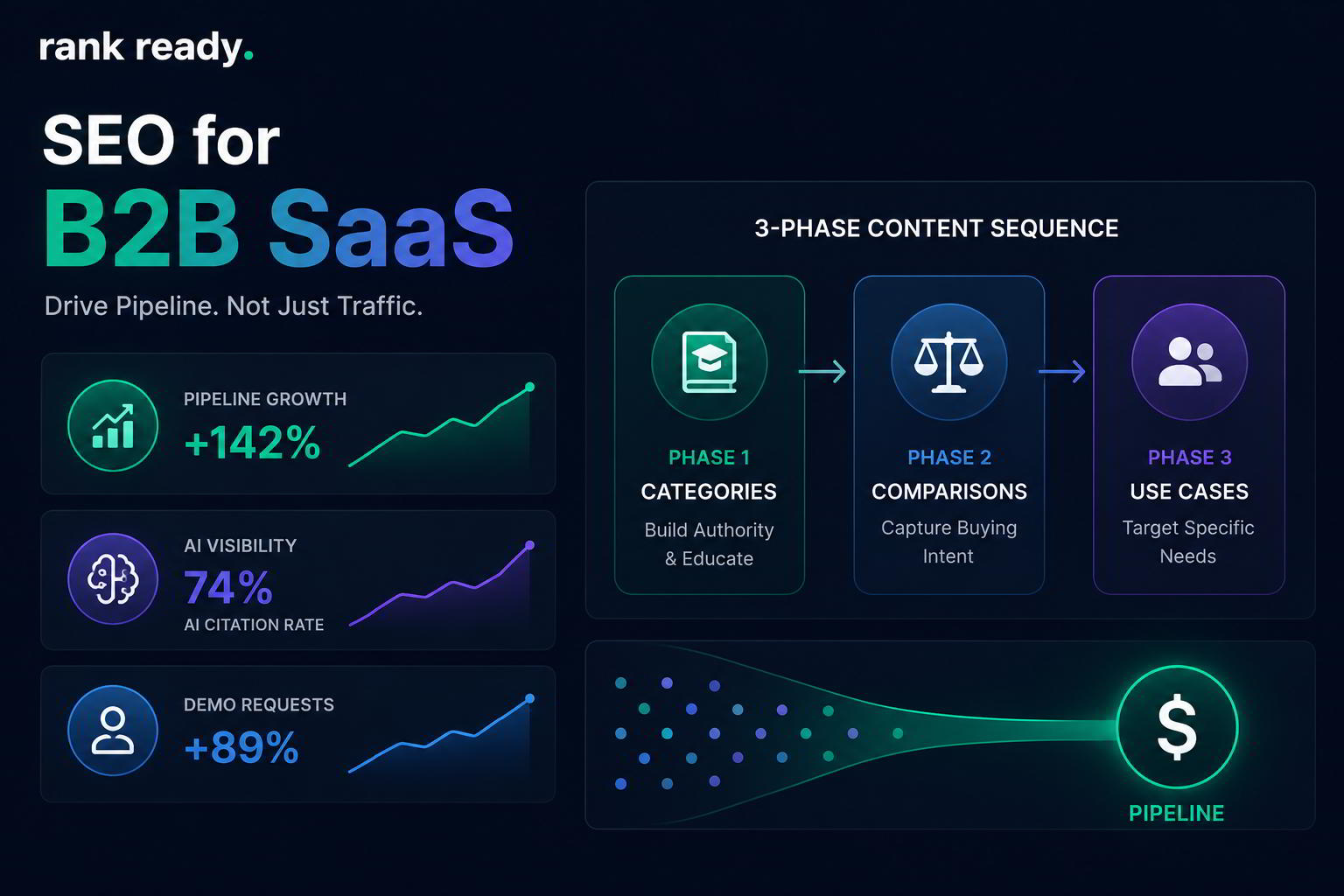
This is the 3-phase framework we use to build SaaS pipeline through search, semantic authority, and AI visibility.
The B2B SaaS SEO problem: high CPC, low organic conversion
B2B SaaS search is brutally competitive because the economics are enormous.
One enterprise customer can be worth:
- $5,000 ARR.
- $50,000 ARR.
- Sometimes millions.
That means paid search becomes expensive fast. Many SaaS categories now see CPCs above $30-$80 per click on commercial queries.
So companies rush toward SEO expecting cheaper acquisition.
Then the second problem appears: traffic does not convert.
Most SaaS SEO fails because the content sequence ignores buyer psychology.
A blog post ranking for “what is workflow automation” attracts a completely different buyer than “best workflow automation software for enterprise teams.”
But many SaaS sites treat both searches the same.
That creates traffic without pipeline.
For companies operating in crowded software categories, our SaaS SEO framework focuses heavily on sequencing intent instead of chasing vanity traffic.
Another issue: SaaS founders often underestimate how long authority takes to compound in competitive verticals. Large review sites and established vendors have already built years of topical reinforcement, backlinks, branded searches, and user engagement data.
Trying to outrank those sites immediately with a handful of commercial landing pages rarely works.
That is why strong SEO for B2B SaaS campaigns usually start by building contextual relevance before aggressively competing for the hardest commercial terms.
Why most SaaS SEO fails: chasing the wrong queries first
Most SaaS SEO roadmaps start backward.
Teams immediately publish:
- “Best [category] software.”
- “Top alternatives to [competitor].”
- “[Brand] vs [Competitor].”
Those pages matter. But they rarely rank early because Google already trusts established category entities more.
Newer SaaS brands usually lack:
- Topical authority.
- Brand searches.
- Entity recognition.
- Supporting educational coverage.
So comparison pages end up isolated.
No authority flows into them.
No contextual support exists around the category.
The smarter move: build informational authority first, then commercial capture pages second.
That is where SEO for B2B SaaS starts compounding instead of stalling.
Most failed SaaS SEO strategies are not failing because the writing is bad. They fail because the content hierarchy is broken. Google sees disconnected pages instead of a structured ecosystem covering the category from multiple intent layers.
Strong SEO systems connect:
- Educational content.
- Comparison assets.
- Use-case pages.
- Feature pages.
- Documentation.
That structure creates semantic reinforcement across the entire site.
Phase 1: Category education (build E-E-A-T before you sell)
The first phase is category education.
This is where you teach the market how the problem works before aggressively selling the solution.
Most SaaS buyers spend weeks researching before they shortlist vendors.
Educational content captures that research stage early.
What category education content looks like
- “What is workflow automation?”
- “How enterprise knowledge bases work.”
- “Why customer onboarding fails.”
- “How AI sales assistants improve outbound conversion.”
These pages are not conversion pages first.
They are trust-building assets.
Google increasingly rewards content demonstrating topical depth and expertise. That is especially true in competitive SaaS niches where dozens of companies target the same commercial queries.
Educational clusters help establish:
- Entity relevance.
- Topical coverage.
- Semantic relationships.
- Internal authority flow.
This is where strong semantic SEO architecture becomes critical. Educational content should reinforce broader category understanding instead of functioning as isolated blog posts.
Good SaaS SEO builds trust before asking for the demo.
Educational content also increases branded search growth over time because buyers repeatedly encounter the company during research-stage searches.
That matters because branded search volume often becomes one of the strongest indicators of category authority in SaaS SEO campaigns.
Phase 2: Comparison content (capture the bottom-of-funnel intent)
This is where pipeline acceleration starts.
Once educational authority exists, comparison content performs dramatically better.
Why?
Because Google already understands your site belongs inside the category conversation.
Comparison content captures buying intent
Strong comparison assets include:
- Competitor comparisons.
- Alternative pages.
- “Best software” roundups.
- Feature comparison pages.
- Pricing comparison content.
These queries usually convert better because the buyer already understands the problem.
They are now evaluating solutions.
This is why comparison pages are one of the most underused SaaS SEO assets when executed properly.
Strong comparison pages also create excellent internal linking opportunities because they naturally connect:
- Educational guides.
- Feature pages.
- Use-case pages.
- Product documentation.
This improves contextual reinforcement across the entire SaaS cluster.
Strong SEO for B2B SaaS relies heavily on this authority layering process.
Comparison content also performs well inside AI retrieval systems because the structure naturally answers evaluative questions users ask conversationally.
Queries like:
- “What is the best CRM for remote sales teams?”
- “Which AI writing platform is best for agencies?”
increasingly trigger AI-generated recommendations instead of traditional blue-link searches.
Phase 3: Use-case content (capture top-of-funnel research)
Most SaaS companies think use-case content belongs at the beginning.
Usually it performs better after category authority and comparison coverage already exist.
Because now Google understands:
- Your category relevance.
- Your solution space.
- Your semantic coverage.
Use-case content expands demand capture
Examples:
- “CRM software for recruiting firms.”
- “Knowledge base software for remote engineering teams.”
- “Best AI note-taking workflow for sales calls.”
These pages capture highly specific research intent.
Often lower volume.
Often much higher conversion quality.
Use-case content also compounds internal topical depth because it reinforces:
- Industries.
- Personas.
- Workflows.
- Business outcomes.
That contextual layering increasingly matters for both search engines and AI retrieval systems.
Strong use-case pages also reduce bounce rates because the messaging aligns much more closely with the visitor’s exact operational problem.
That alignment improves:
- Session duration.
- Conversion engagement.
- Pipeline quality.
- Product-fit clarity.
Why this sequence and not the obvious one
The obvious SEO sequence feels intuitive:
- Bottom-of-funnel keywords first.
- Educational content later.
But Google rarely rewards newer SaaS sites that way.
Why?
Because search engines evaluate category trust before commercial authority.
Educational content helps establish:
- Topic depth.
- Entity relevance.
- Content breadth.
- User engagement signals.
Then comparison pages inherit stronger contextual support.
This sequence also mirrors how buyers behave:
- First: understand the problem.
- Second: evaluate vendors.
- Third: validate fit for their specific use case.
Most SaaS SEO skips phase one entirely.
That is why so many “best software” pages never move.
Schema for SaaS: SoftwareApplication + Product + FAQPage
Most SaaS schema implementation is incomplete.
One generic Organization schema. Maybe Product schema if the CMS plugin adds it automatically.
That is not enough for modern SaaS search visibility.
The SaaS schema stack
- SoftwareApplication schema: application category, operating system, pricing, features.
- Product schema: pricing and product-related information.
- FAQPage schema: support educational and comparison pages.
- Organization schema: strengthen entity understanding.
- Review schema: where legitimate review content exists.
Google’s structured data documentation confirms that SoftwareApplication schema helps clarify application-related information for search systems.
Google’s SoftwareApplication structured data documentation provides the baseline implementation guidance.
For SEO for B2B SaaS, schema becomes increasingly important because software entities often overlap heavily in language and positioning.
Structured data helps clarify differentiation.
GEO layer: getting recommended by ChatGPT for category queries
Traditional rankings are no longer the only visibility layer.
AI engines increasingly recommend vendors directly.
That changes SaaS SEO completely.
Instead of only competing for blue-link rankings, SaaS brands now compete for AI citations and retrieval visibility.
How GEO changes SaaS search
Generative engines tend to favor:
- Strong entity clarity.
- Consistent topical coverage.
- Well-structured comparison content.
- Clear use-case relevance.
- Strong semantic relationships.
This is where GEO optimization becomes critical.
AI systems do not just evaluate keywords. They evaluate retrieval confidence.
That means SaaS websites increasingly need:
- Entity reinforcement.
- Clear contextual linking.
- Structured topical clusters.
- Strong schema implementation.
Strong SEO for B2B SaaS now includes both traditional search visibility and AI recommendation visibility.
Real client: NorthPeak SaaS, 0→74% AI citation rate
NorthPeak SaaS entered a highly competitive B2B category with minimal AI search visibility.
Their content existed, but it lacked:
- Structured topical sequencing.
- Comparison coverage.
- Entity reinforcement.
- GEO-focused architecture.
We rebuilt the content ecosystem around the 3-phase framework:
- Educational authority first.
- Comparison assets second.
- Use-case expansion third.
Then layered:
- Schema optimization.
- Internal semantic linking.
- AI retrieval optimization.
- Entity-focused architecture.
The result: 0% to 74% AI engine citation rate in 90 days.
That visibility increase also improved branded search growth and commercial landing-page engagement.
More proof is available on our case studies page.
Measurement: pipeline metrics, not just traffic
SaaS SEO reporting breaks when teams obsess over traffic alone.
Traffic without pipeline is just expensive publishing.
Strong SaaS SEO campaigns should track:
- Demo requests.
- Qualified pipeline.
- SQL generation.
- Assisted conversions.
- AI citation visibility.
- Branded search growth.
Some low-volume comparison pages outperform high-traffic educational posts because buyer intent is dramatically stronger.
That is why the sequencing model matters.
Educational pages build trust.
Comparison pages capture commercial intent.
Use-case pages expand qualified demand.
Together, they create compounding pipeline growth instead of disconnected traffic spikes.
The best SaaS SEO strategies are sequenced, not random
Most SaaS companies publish content based on what feels urgent.
Strong SaaS SEO works differently.
First build category understanding. Then capture comparison intent. Then scale use-case relevance.
That sequence creates:
- Stronger topical authority.
- Better conversion alignment.
- Higher AI retrieval visibility.
- More efficient pipeline growth.
That is how SEO for B2B SaaS becomes a revenue engine instead of a traffic experiment.
SaaS SEO that actually drives pipeline requires the right sequence. Our free audit maps your existing content against the 3-phase framework and identifies the 2-3 highest-ROI gaps slowing growth right now. Start with our free SEO audit.

0 Comments