
SEO for law firms is not content marketing with a gavel emoji. The CPCs are absurd, the rules are restrictive, and the firms that win do something specific — they treat each practice area as its own SEO ecosystem.
That’s the part most agencies still get wrong.
They build one “Personal Injury Lawyer” page, publish a few generic blogs, buy some backlinks, and expect rankings to follow.
Meanwhile, firms dominating legal search are building practice-area authority at a completely different level: – deeper topical coverage – geographic specificity – attorney-level entity signals – intent-driven internal linking – compliant trust systems
One structural advantage compounds into another.
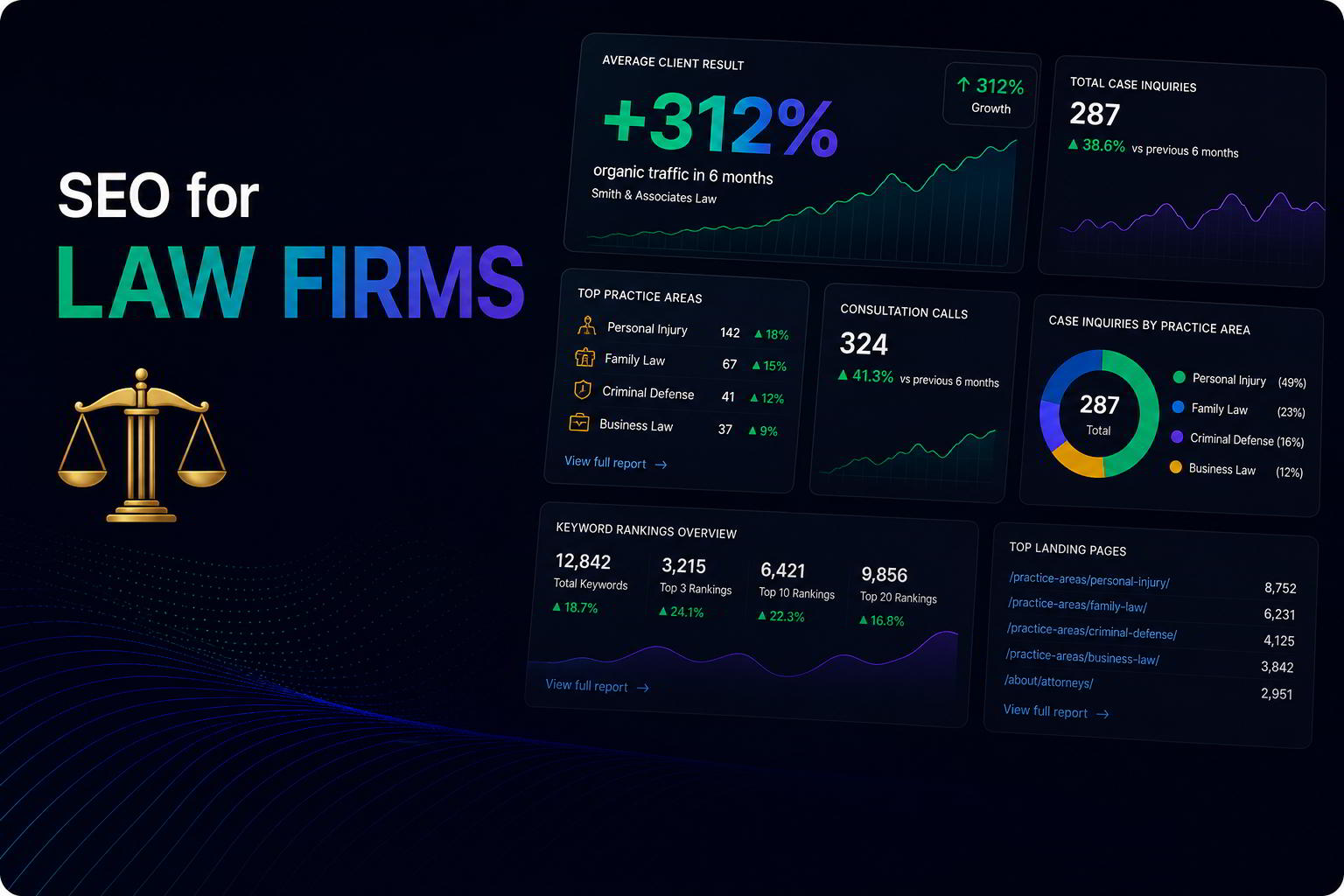
We’ve seen this firsthand. Smith & Associates Law increased organic traffic +312% in 6 months after restructuring practice-area architecture, improving internal authority flow, and rebuilding local intent coverage.
Most legal SEO campaigns fail because they optimize for traffic volume instead of case acquisition quality.
This post breaks down the seven SEO for law firms plays we repeatedly see driving real consultation growth and signed-case revenue.
Why Generic Legal SEO Doesn’t Work Anymore
Most law firm SEO still looks interchangeable
Search results for legal terms have become brutally competitive.
In major metros:
- Personal injury CPCs regularly exceed $200-$500 per click
- Firms invest millions annually into digital acquisition
- AI search summaries increasingly compress informational traffic
- Google favors deeper authority signals over broad generalization
That means generic legal SEO strategies no longer create sustainable ranking advantages.
Most underperforming legal sites share the same problems:
- Thin practice-area pages
- Weak geographic relevance
- Minimal attorney authority signals
- Poor internal linking
- No semantic entity structure
- Blog-heavy strategies disconnected from conversion intent
Google increasingly evaluates: – expertise depth – topical completeness – entity clarity – local intent alignment – trust signals
“The firms winning legal SEO aren’t publishing more content. They’re building stronger authority systems.”
That’s why modern practice area authority strategies outperform generic legal marketing almost every time.
SEO for Law Firms Play #1: Practice-Area Pillar Pages With Deep Authority
One strong page beats ten shallow ones
Most firms still create practice-area pages that barely scratch the surface:
- 700-900 words
- Generic legal definitions
- Minimal case specificity
- No supporting clusters
That model worked in 2016.
Not now.
High-performing legal SEO pages typically include:
- Case-type subtopics
- Settlement process explanations
- Statute discussions
- Insurance considerations
- Local legal nuances
- FAQ sections
- Attorney authority elements
Google wants evidence that the firm genuinely understands the subject deeply — not just enough to rank a keyword.
One personal injury firm we audited had: – 4 weak service pages – overlapping keyword targeting – almost no supporting topical depth
After restructuring into comprehensive practice-area pillars: – rankings improved across 63 commercial queries – average session duration increased 41% – consultation submissions increased significantly
Topical depth builds trust before the consultation ever happens.
Strong pillar pages also improve: – AI visibility – semantic relevance – internal linking efficiency – case qualification quality
SEO for Law Firms Play #2: Geographic × Practice Area Landing Page Matrices
Location intent changes everything in legal SEO
Legal search is heavily geographic.
Someone searching: – “truck accident lawyer Dallas” – “divorce attorney Scottsdale” – “medical malpractice lawyer Miami”
…does not want a generic statewide page.
They want: – local relevance – nearby expertise – jurisdiction familiarity – geographic trust signals
That’s why high-performing legal firms build city × practice-area structures intentionally.
Examples:
- Phoenix Truck Accident Lawyer
- Scottsdale Wrongful Death Attorney
- Dallas Business Litigation Lawyer
- Tampa Medical Negligence Attorney
But here’s where most agencies fail: they scale these pages with near-duplicate templates.
That creates: – canonical clustering – weak indexing – diluted authority – local relevance suppression
Our local landing page strategy focuses on creating genuinely differentiated geographic entity signals — not spinning city names into duplicate copy.
Metro-level legal SEO now depends on local specificity more than ever.
Well-built city × practice-area systems also strengthen: – local pack visibility – AI-generated local citations – map relevance – nearby intent matching
SEO for Law Firms Play #3: Case-Result Content That Signals Expertise (Compliantly)
Experience signals matter — especially in YMYL industries
Google treats legal SEO differently because law falls under YMYL (“Your Money or Your Life”) standards.
That means expertise and trust signals carry more weight.
One of the strongest authority assets many firms already have:
- Case results
- Verdict summaries
- Settlement examples
- Litigation experience
But most firms either: – hide them – underutilize them – or publish them without structure
Well-structured case-result content can reinforce:
- Topical expertise
- Attorney authority
- Practice-area relevance
- Trustworthiness
The key is compliance.
Strong compliant approaches include:
- Educational framing
- No guaranteed-outcome language
- Jurisdiction disclaimers
- Fact-specific summaries
- Clear ethical positioning
Case-result pages also create powerful internal linking opportunities back into primary practice-area pages.
That strengthens semantic authority across the entire practice cluster.
SEO for Law Firms Play #4: FAQ Schema for the Questions Clients Actually Ask
Most legal FAQ sections are written for SEO tools, not humans
Generic FAQs like: – “What is personal injury law?” – “Do I need a lawyer?” – “How much does an attorney cost?”
…rarely move the needle anymore.
The better approach: answer the questions prospects actually ask before contacting the firm.
Examples:
- “Can I still sue if I was partially at fault?”
- “How long does a truck accident settlement take in Texas?”
- “Will my insurance rates increase after filing a claim?”
- “What happens if the other driver was uninsured?”
These queries align with: – commercial intent – consultation intent – real user uncertainty
Adding structured FAQ schema also improves machine readability for: – Google AI Overviews – ChatGPT citations – voice search – rich results
Our semantic SEO methodology heavily emphasizes structured entity understanding because AI-driven search increasingly depends on machine-readable clarity.
For implementation guidance, Google’s own FAQPage schema documentation remains the benchmark.
FAQ-rich practice pages also tend to improve: – time on page – consultation readiness – featured snippet visibility – conversational search relevance
SEO for Law Firms Play #5: Bar-Compliant Review Acquisition Systems
Reviews influence far more than reputation
Legal reviews impact:
- Local pack visibility
- Click-through rates
- Trust perception
- Consultation conversion rates
But law firms operate under stricter ethical guidelines than most industries.
That means aggressive review acquisition systems can create compliance risk quickly.
The firms succeeding here usually build: – automated but compliant request systems – timing-based follow-ups – post-resolution outreach – staff-driven workflows
Not: – incentivized reviews – filtered feedback systems – manipulative reputation funnels
We regularly see review quality correlate directly with: – local pack rankings – consultation conversion rates – branded search trust
Especially in personal injury and family law.
“In legal SEO, trust signals often influence conversion rates more than rankings themselves.”
Firms with stronger review ecosystems also tend to perform better in: – branded search CTR – map pack engagement – referral conversion confidence
SEO for Law Firms Play #6: Author Bio + Attorney Schema on Every Page
Legal SEO needs visible expertise signals
Many law firms still publish practice-area pages with: – no attorney attribution – no author details – no legal credentials – weak trust architecture
That’s increasingly risky in competitive legal SERPs.
Every meaningful legal page should reinforce: – attorney expertise – jurisdiction relevance – practice specialization – professional credibility
Strong implementations include:
- Attorney bio sections
- Bar admission details
- Practice focus indicators
- Case experience references
- Attorney schema markup
Google increasingly evaluates whether authoritative experts appear connected to the content itself.
That’s especially true in YMYL verticals like: – law – healthcare – finance
Weak entity association reduces trust.
Strong attorney attribution strengthens it.
Attorney schema also improves: – entity recognition – AI citation trust – author relevance – semantic consistency
SEO for Law Firms Play #7: Internal Linking That Builds Practice-Area Authority
Most legal sites waste their authority flow
Internal linking is one of the most underutilized advantages in legal SEO.
Most firms publish: – blogs – FAQs – verdict pages – attorney bios – city pages
…without connecting them strategically.
The result: – isolated authority – weak semantic clustering – diluted ranking signals
Strong legal SEO linking structures reinforce: – practice-area hierarchy – geographic relationships – attorney relevance – supporting topic clusters
Example:
- Truck accident FAQ → truck accident pillar page
- Case-result summary → relevant practice page
- City page → jurisdiction-specific service page
- Attorney bio → practice-area authority hub
Smith & Associates Law improved organic visibility dramatically after restructuring internal authority flow across practice clusters. Their organic traffic increased +312% in 6 months.
You can see the broader strategy approach inside our legal SEO case studies.
Strong internal linking also improves: – crawl efficiency – indexing consistency – semantic clustering – practice-area depth signals
Why AI Search Is Changing SEO for Law Firms
Legal visibility is no longer limited to Google rankings
More prospective clients are now discovering attorneys through: – ChatGPT responses – Google AI Overviews – voice assistants – AI-generated legal summaries
That changes how authority gets evaluated.
AI-driven search systems rely heavily on: – semantic clarity – entity relationships – attorney attribution – structured data – topical completeness
Law firms with shallow practice pages and weak entity signals are becoming less visible inside AI-generated answers — even when they still rank traditionally.
This is one reason modern SEO for law firms increasingly overlaps with GEO (Generative Engine Optimization). Firms that build stronger practice-area ecosystems, structured attorney authority, and deeper topical coverage are more likely to appear inside AI-assisted search experiences over the next several years.
What “Converts Cases” Really Means (And How to Measure It)
Traffic without consultations is vanity
Many firms still evaluate SEO success through: – rankings – impressions – traffic volume
But legal SEO economics are different.
One signed case can justify an entire campaign.
That means smarter firms track:
- Qualified consultation calls
- Signed-case attribution
- Intake quality
- Practice-area conversion rates
- Geographic conversion patterns
The highest-traffic page is not always the most valuable page.
Sometimes a lower-traffic, high-intent practice-area page produces significantly better case acquisition economics.
That’s why modern SEO for law firms strategies focus on: – conversion quality – commercial intent – authority depth – geographic precision
Not just raw traffic graphs.
Firms that connect SEO directly to signed-case economics usually make better long-term marketing decisions — especially in highly competitive practice areas.
Legal SEO has become significantly more competitive — but also more predictable.
The firms winning organic visibility consistently are not relying on generic blogs or shallow service pages. They’re building practice-area ecosystems with stronger authority, better geographic alignment, deeper semantic relevance, and clearer trust signals.
That’s the shift most law firms still underestimate.
Practice-area depth. Local specificity. Attorney authority. Structured internal linking. These are no longer “advanced SEO tactics.” They’re baseline requirements in competitive legal search markets.
The good news: most firms are still underbuilt in at least three of these areas.
Auditing your firm’s practice-area coverage takes us about 90 minutes — we’ll show you which areas are underbuilt, where authority gaps exist, and which two-three pages would move the needle most. Your first SEO audit is free.

0 Comments