
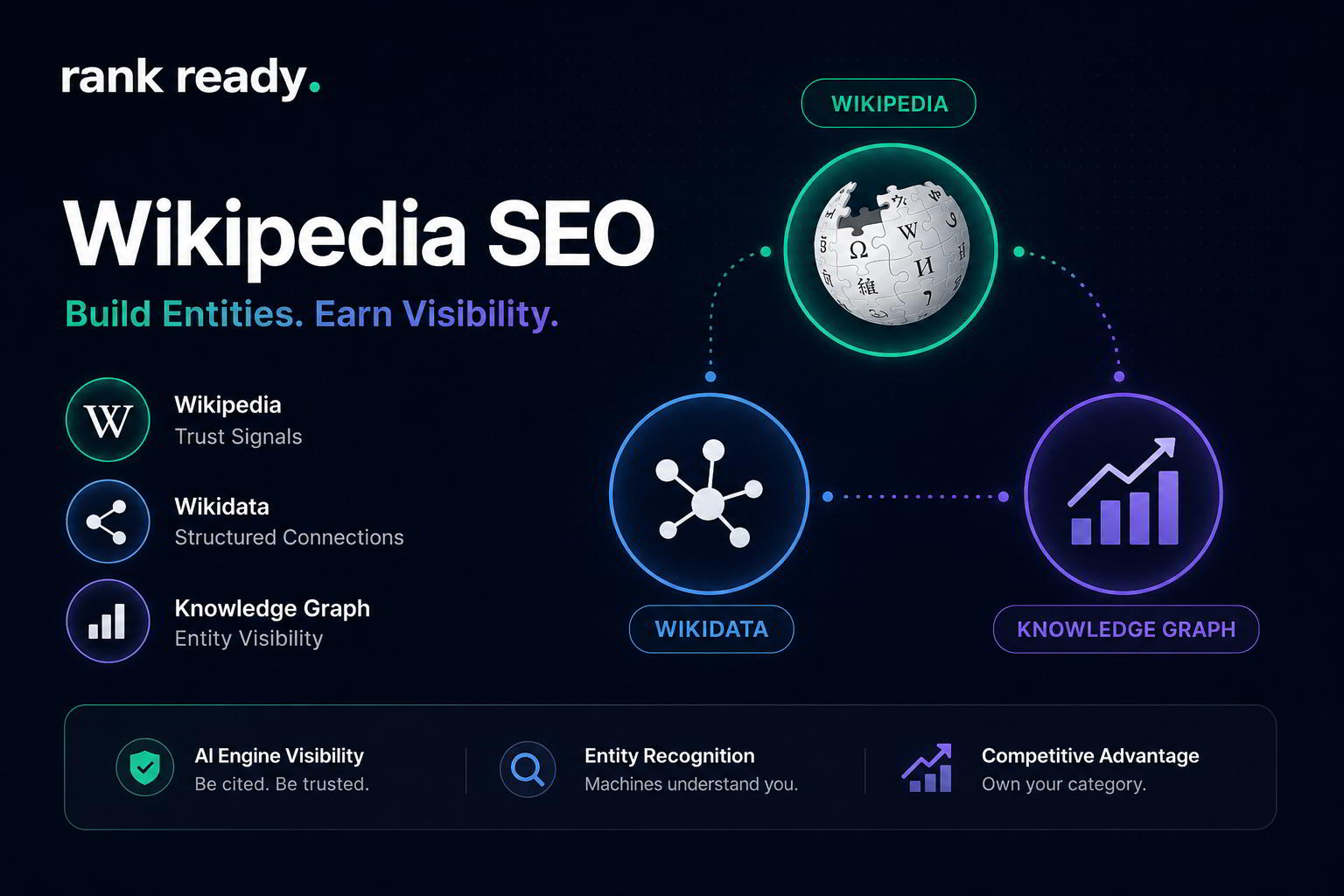
LLMs trained on the open web disproportionately weight a few sources — and Wikipedia is at the top of the list. If you’re not in the Knowledge Graph, you’re invisible to half the entity-driven world.That is the new problem. Not rankings. Recognition.Wikipedia SEO is not about sneaking promotional copy onto a public encyclopedia. That gets removed fast. It is about building enough verified, third-party entity evidence that Wikipedia, Wikidata, Google, and AI engines can understand who you are, what you do, and why your brand deserves to be connected to a topic.For GEO, that matters. ChatGPT, Perplexity, Gemini, and AI Overviews lean on trusted entity sources when they decide which brands to mention. A weak entity footprint means your content can rank — and still be ignored by AI systems.This guide shows how Wikipedia, Wikidata, entity SEO, and knowledge graph optimization fit together.
Why Wikipedia matters to AI engines: the data layer behind trust
Wikipedia is one of the most reused knowledge sources on the web. Search engines cite it. Knowledge panels pull from it. AI systems train on it, retrieve from it, or use it as a confidence layer when resolving entities.That makes Wikipedia different from a normal backlink.A backlink says, “This site mentioned you.” A Wikipedia presence says, “This entity is recognized enough to be documented by neutral third-party sources.” That distinction matters in GEO because AI engines are not just ranking pages. They are selecting entities.Google stopped matching strings in 2013. AI engines are not matching strings either. They are resolving entities.A brand with a strong entity profile has clearer signals:
- Consistent name, description, and category
- Reliable third-party coverage
- Structured data across trusted databases
- Clear relationships to founders, products, industries, and locations
- Mentions from sources AI systems already trust
Wikipedia notability: what actually qualifies a brand
Most brands do not fail at Wikipedia because they are too small. They fail because they misunderstand notability.Wikipedia does not care that you have 50 employees, a polished website, or a strong founder story. It cares whether independent, reliable sources have covered you in meaningful detail.That means:- Not your own website
- Not your press release
- Not a paid placement
- Not a directory profile
- Not a founder interview with no editorial depth
- Industry publication profiles
- Major media coverage
- Research citations
- Acquisition or funding coverage
- Government or institutional references
- Independent awards with editorial standards
The right way to be on Wikipedia — and the wrong way
The wrong way is easy to spot: a brand writes its own page, fills it with product claims, adds a founder quote, and calls it “neutral.” The page gets flagged, trimmed, or deleted.The right way is slower.Start with evidence. Map every independent source that proves the brand exists as a notable entity. Then remove anything that sounds like marketing. Wikipedia does not want “leading,” “innovative,” “trusted,” or “best-in-class.” It wants verifiable facts.A neutral Wikipedia-style brand summary should include:- What the company is
- When it was founded
- Where it operates
- What category it belongs to
- Major milestones backed by sources
- Known products, services, or public work
Wikidata: the structured data layer most brands ignore
Wikidata is the machine-readable cousin most marketing teams ignore. Wikipedia is written for humans. Wikidata is built for structured facts.A Wikidata item can define:- Entity name
- Description
- Official website
- Industry
- Founding date
- Founders
- Headquarters
- Social profiles
- Parent or subsidiary relationships
- Identifiers from other databases
How to set up your Wikidata entry without creating a mess
Before creating anything, search Wikidata properly. Duplicate entities create confusion. AI systems do not need more ambiguity. They need cleaner resolution.A basic setup process looks like this:- Search for the brand name and close variants.
- Confirm whether an item already exists.
- Create a concise label and description.
- Add factual statements only.
- Attach reliable references to important claims.
- Add the official website and external identifiers.
- Connect social profiles only when they are official.
Linking your Wikidata entry to the Knowledge Graph
Wikidata does not automatically give you a Google Knowledge Panel. That is the mistake most brands make.It is a signal. A strong one. But still one signal.Google’s Knowledge Graph depends on entity consistency across many sources. Your Wikidata item should align with:- Organization schema on your website
- SameAs links to verified profiles
- Founder and leadership references
- Third-party database profiles
- News and industry coverage
- Google Business Profile data, when local relevance matters
Beyond Wikipedia: other entity-establishment sources that matter
Wikipedia is powerful, but it is not the only entity source. Many brands will build stronger GEO results by improving the full entity footprint first.Useful sources can include:- Google Business Profile
- LinkedIn company page
- Crunchbase or similar business databases
- Industry directories with editorial standards
- Government business registries
- Conference speaker pages
- Podcast appearances with transcripts
- Research reports or market studies
- Authoritative guest contributions
What to do if you cannot qualify for Wikipedia
Most companies should not start with Wikipedia. That is not a failure. It is sequencing.If you do not have enough independent coverage yet, build the entity base elsewhere.Start with these 5 moves:- Fix your website entity schema. Organization, WebSite, Article, Person, and Service schema should agree.
- Standardize your brand description. Use the same 1-sentence entity definition everywhere.
- Earn third-party mentions. Prioritize sources with editorial review.
- Create expert author pages. Connect people, topics, and credentials.
- Publish entity-rich content. Build topical relationships, not isolated blog posts.
How to measure entity visibility before and after the work
You cannot manage entity visibility with normal rank tracking alone.Rankings show page position. Entity visibility shows whether machines understand and retrieve the brand.Track these signals monthly:- Does Google show a Knowledge Panel or entity-style result?
- Does the brand appear in AI answers for category queries?
- Do AI engines describe the company accurately?
- Are competitors cited when you are not?
- Does Google connect the brand to the right industry?
- Are sameAs profiles consistent in schema?
- Do third-party sources repeat the same entity description?
- Are branded searches increasing?
Entity establishment is the GEO moat most brands are ignoring
Wikipedia SEO is not a shortcut. Wikidata is not a ranking trick. Knowledge graph optimization is not a one-time schema upload.It is the slow work of making your brand legible to machines.The brands that win in AI search will not only publish more content. They will become easier to verify. Easier to categorize. Easier to cite. That means stronger entity signals, cleaner structured data, better third-party corroboration, and fewer contradictions across the web.Generic SEO agencies are still optimizing pages in isolation. GEO requires a bigger question: does the machine know who you are?Entity establishment is one of the slowest-moving GEO investments — meaning the brands that start now are building a moat. We audit your current entity presence across Wikipedia, Wikidata, schema, and third-party sources, then map a 6-month plan designed to improve AI retrieval visibility and citation likelihood. Get a free SEO audit and see where your entity signals are currently weak.

0 Comments