Most SEO teams obsess over backlinks while ignoring the authority already sitting inside their own site. Thousands of pages. Hundreds of blog posts. Years of accumulated relevance. Then they connect everything with random “read more” links and generic anchor text.
That is why so many websites plateau.
Internal linking is not housekeeping. It is how Google understands topic relationships, hierarchy, and authority flow. Done correctly, it strengthens rankings without creating a single new page.
This guide breaks down the exact internal linking audit process we use to identify orphan pages, wasted authority, weak anchor patterns, and broken topic clusters — then fix them fast.
Why internal linking matters more than most agencies say
Google stopped evaluating pages in isolation years ago. Rankings increasingly depend on contextual relationships between pages, entities, and topics.
Internal links help define those relationships.
A strong internal structure tells Google:
- Which pages are most important.
- Which topics belong together.
- Which pages support broader entities.
- Where authority should flow.
Most websites do not have an authority problem. They have a distribution problem.
This becomes even more important in semantic search systems and AI retrieval engines. If your content exists but is poorly connected, Google sees fragments instead of a topic cluster.
That is why semantic SEO depends heavily on intelligent internal architecture. Pages should reinforce each other instead of competing for isolated rankings.
Strong internal linking SEO creates contextual pathways that help both users and search engines understand topical depth faster.
Google’s own documentation confirms that internal links help search engines discover pages and understand site structure. Sites with stronger crawl paths generally create better indexation and contextual clarity.
How to map your current internal link graph (free tools)
You cannot fix internal linking blindly. First you need visibility into the actual graph.
The good news: most of the data is available with free or low-cost tools.
Tools that work for internal link mapping
- Screaming Frog SEO Spider.
- Google Search Console.
- Ahrefs Webmaster Tools.
- Sitebulb.
- Visual Site Mapper extensions.
Screaming Frog alone can uncover:
- Pages with low internal links.
- Orphan URLs.
- Broken internal links.
- Anchor text patterns.
- Excessive crawl depth.
Run a crawl. Export the internal links report. Sort by:
- Inlinks.
- Outlinks.
- Crawl depth.
- Status codes.
Within 20 minutes, most large SEO problems become visible.
For teams building topic clusters, this becomes foundational. Our guide on semantic SEO in 2026 explains how entity relationships and topical reinforcement increasingly shape rankings.
A proper internal links strategy should also reveal which pages attract authority naturally and which pages remain isolated despite being commercially valuable.
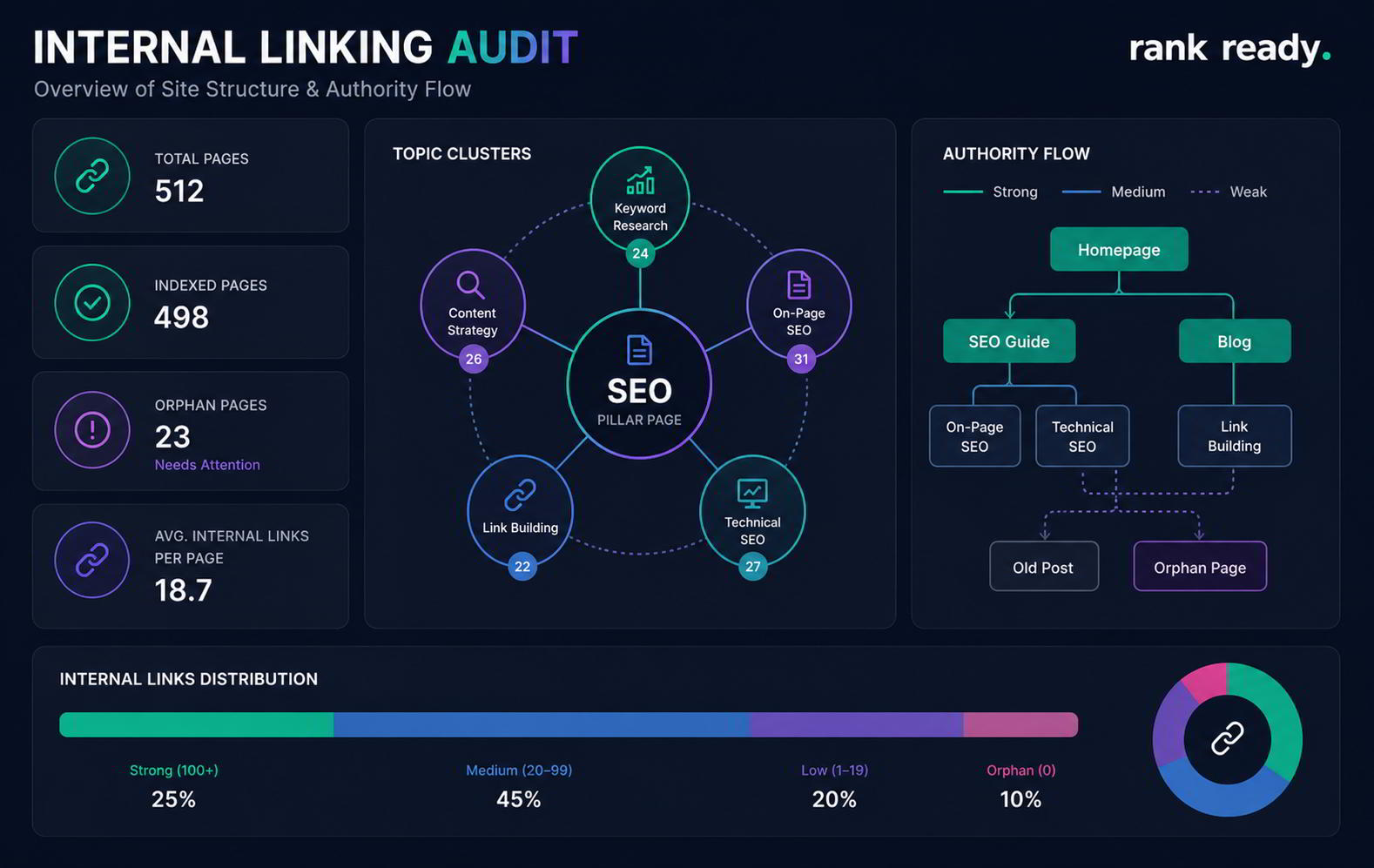
Pattern #1: Orphan pages (no inbound internal links)
Orphan pages are URLs with little or no internal links pointing to them.
Google can still discover them through sitemaps or external links. But orphan pages rarely accumulate meaningful authority because the rest of the site barely acknowledges they exist.
Why orphan pages hurt rankings
Most orphan pages fall into one of three categories:
- Old blog posts.
- Location pages.
- Service pages added later without integration.
These pages often sit 4-5 clicks deep with almost no contextual support.
Result:
- Weak crawl frequency.
- Poor rankings.
- Low engagement.
- Minimal authority flow.
One internal link from a strong hub page can outperform dozens of low-quality backlinks.
During audits, orphan pages are usually one of the fastest wins because the fix is structural, not content-heavy.
Fixing orphan pages is often the first major step in a successful internal linking audit because it reconnects forgotten authority back into the main topic cluster.
Pattern #2: Hub pages with no outbound links to spokes
This problem is common on agency websites.
The pillar page ranks well. The supporting pages exist. But the hub barely links outward to reinforce the cluster.
That breaks topical reinforcement.
Hub pages should distribute authority intentionally
If you have a strong pillar page about topical authority, it should naturally connect to:
- Entity SEO.
- Schema implementation.
- Internal linking.
- Content clusters.
- Semantic search.
Instead, many websites create pillar pages that behave like dead ends.
Good hub pages act as authority routers.
That is a major part of the strategy discussed in our guide on building topical authority in 90 days. Strong clusters reinforce themselves through intentional internal linking paths.
Strong internal linking SEO ensures that hub pages pass relevance naturally into deeper supporting content instead of trapping authority at the top layer.
Pattern #3: Random anchor text vs. intentional anchor text
Most anchor text is accidental.
“Read more.”
“This article.”
“Click here.”
None of those help Google understand context.
Anchor text should clarify topical relationships
Strong anchor text reinforces:
- Topic relevance.
- Entity relationships.
- Search intent.
- Page hierarchy.
For example:
- Weak: “Learn more here.”
- Strong: “our semantic SEO methodology.”
The second example passes contextual clarity immediately.
Intentional anchor text also improves user engagement because readers know exactly what they are clicking.
This is one of the easiest internal linking SEO improvements most sites can make in under a day.
Anchor text consistency also strengthens entity associations across topic clusters, especially for large informational websites.
Pattern #4: Authority leaking out via external links
External links matter. They build credibility, support claims, and strengthen trust.
But many sites unintentionally leak authority because they over-link outward while under-linking internally.
We regularly audit blog posts containing:
- 15 external links.
- 2 internal links.
That imbalance weakens topical reinforcement.
External links should support — not replace — internal authority flow
A healthier structure usually looks like:
- Relevant internal links throughout the article.
- 1-3 authoritative external references.
- Strategic contextual anchors.
Google’s Search Central documentation confirms that links help establish contextual understanding and content relationships. The goal is not avoiding external links. The goal is balancing authority flow properly.
Google’s crawlable links documentation explains how Google interprets and follows links within websites.
Strong internal links strategy ensures authority compounds inside the topic cluster before leaking outward.
Pattern #5: Unbalanced link distribution across topic clusters
This is where most large websites quietly fail.
One cluster gets dozens of internal links. Another cluster receives almost none. Usually because one topic has newer content or more editorial attention.
The result is uneven authority distribution.
Topic clusters should reinforce each other proportionally
A balanced cluster structure typically includes:
- Pillar pages.
- Supporting spoke articles.
- Cross-links between related subtopics.
- Service-page reinforcement.
For example, if a semantic SEO cluster links aggressively to entity SEO pages but ignores schema pages entirely, Google receives an incomplete topical map.
Strong link equity flow depends on balanced reinforcement across the cluster.Strong internal linking SEO depends on a deliberate internal links strategy that strengthens topical authority instead of scattering link equity flow randomly.
This becomes increasingly important as AI search systems rely more heavily on contextual relationships instead of isolated keyword signals.
Healthy internal linking audit workflows usually uncover these cluster imbalances quickly because weaker sections visibly receive fewer contextual references.
The 90-minute audit workflow
Most internal linking audits do not need weeks.
You can identify the highest-impact structural issues in roughly 90 minutes.
The workflow
- Run a full crawl in Screaming Frog.
- Export pages with low inlinks.
- Identify orphan pages.
- Map pillar pages and spoke relationships.
- Review anchor text patterns.
- Compare internal vs. external link ratios.
- Check crawl depth for important pages.
- Audit topic-cluster balance.
That process alone usually surfaces the majority of structural authority problems.
Most agencies overcomplicate internal linking because it sounds technical. In reality, the fundamentals are simple:
- Connect related pages.
- Pass authority intentionally.
- Reduce isolation.
- Clarify topic relationships.
Strong internal links strategy frameworks focus less on volume and more on strategic authority routing between high-value pages.
What to fix first (the 5 highest-leverage moves)
Not every issue deserves equal attention.
These are usually the fastest wins during an internal linking audit:
1. Fix orphan pages
Add contextual links from strong hub pages immediately.
2. Strengthen pillar-to-spoke connections
Ensure major topic hubs distribute authority across related articles and services.
3. Improve anchor text clarity
Replace vague anchors with descriptive topical anchors.
4. Reduce crawl depth
Important pages should rarely sit more than 3 clicks from the homepage.
5. Rebalance weak topic clusters
Support under-linked clusters with additional contextual links from stronger sections.
These five changes alone often improve rankings without publishing any new content.
How to measure improvement (rankings + engagement)
Internal linking improvements usually surface in stages.
First:
- Better crawl frequency.
- Faster indexing.
- Lower orphan-page counts.
Then:
- Ranking improvements.
- Longer session duration.
- Higher page depth.
- Improved assisted conversions.
Most importantly, topical clusters begin ranking more consistently together instead of randomly.
That clustering effect is usually the clearest sign that your internal links strategy is working.
Strong internal architecture also improves user experience because readers naturally discover deeper relevant content instead of bouncing after one page.
Successful internal linking SEO campaigns usually improve both rankings and engagement simultaneously because the content ecosystem becomes easier to navigate.
Most internal linking problems are structural, not complicated
The majority of websites already contain enough content authority to rank better. They just distribute it poorly.
Fix orphan pages. Strengthen hub-to-spoke relationships. Clean up anchor text. Balance topic clusters. Reduce unnecessary authority leakage.
That is how internal linking shifts from decorative SEO to actual ranking infrastructure.
Most agencies treat internal links like formatting. Strong SEO teams treat them like authority routing.
Internal linking audit work is often one of the fastest-return SEO improvements because it strengthens assets the site already owns instead of depending entirely on new content production.
Internal linking is one of the cheapest, fastest SEO levers — and one of the most consistently misused. We audit your structure, identify the highest-leverage fixes, and implement the changes fast. Our free SEO audit shows exactly where authority flow is breaking down and what to fix first.

0 Comments