
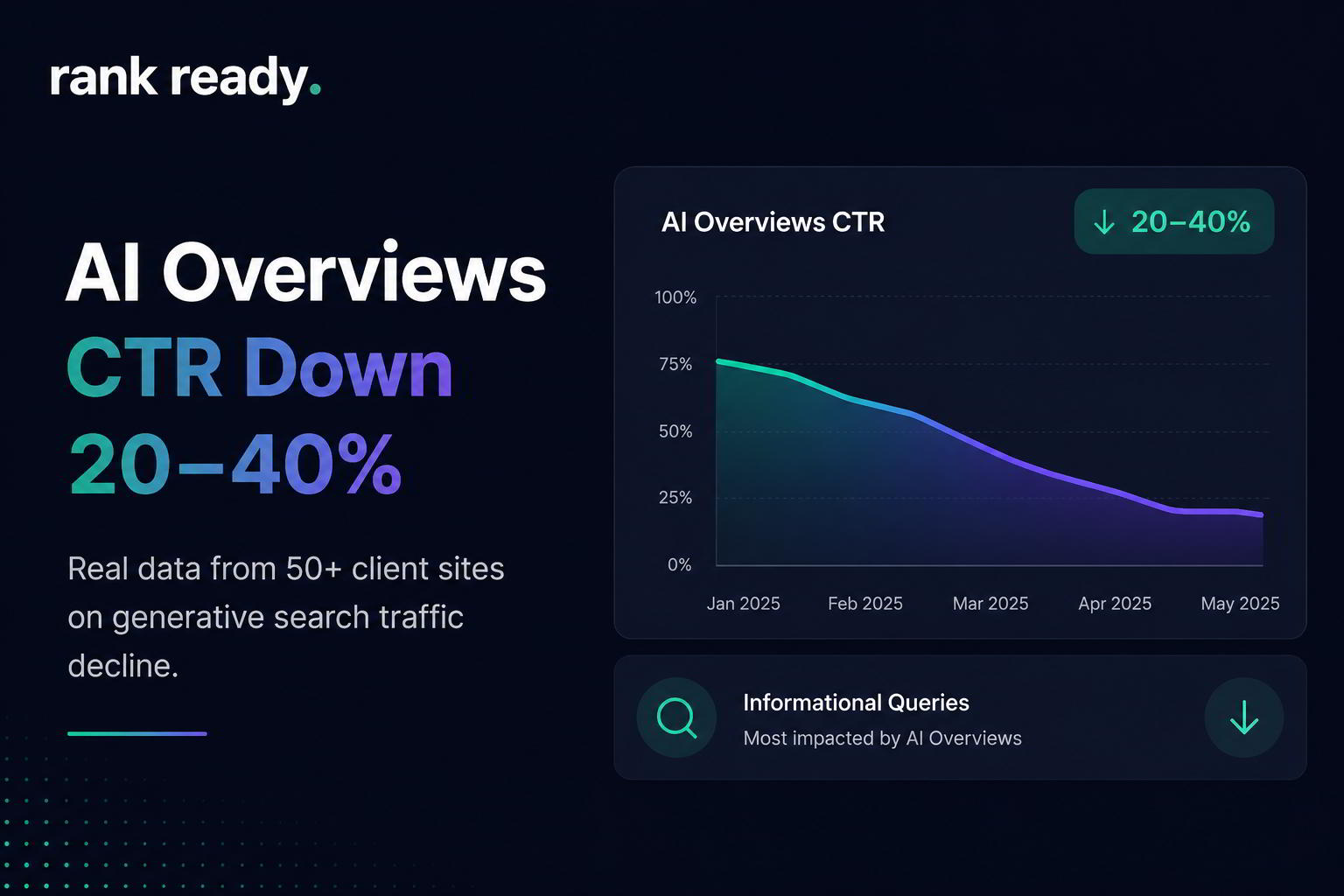
Across dozens of websites, we are watching pages maintain identical ranking positions while clicks decline steadily month after month.
That shift is not random.
It is the direct result of changing search behavior driven by AI-generated summaries occupying the top of the SERP.
The old SEO model assumed rankings controlled visibility.
That assumption is breaking.
AI Overviews CTR decline is now becoming one of the defining organic search challenges of 2026.
Especially for businesses heavily dependent on informational traffic.
This is not just an SEO problem anymore.
It is a visibility displacement problem.
The businesses adapting fastest are not obsessing over rankings alone. They are analyzing retrieval visibility, click behavior shifts, and how generative search SEO changes the economics of content entirely.
The CTR Data: What We’re Seeing Across 50+ Client Sites
The patterns are becoming extremely consistent.The biggest AI Overviews CTR losses are happening on broad informational queries where Google can summarize the answer directly inside the SERP.
Across more than 50 active client properties, we are seeing measurable AI search CTR drop trends on queries now triggering AI Overviews regularly.
The strongest declines usually appear on:
- Broad informational queries
- Simple definitions
- Beginner educational searches
- Basic comparison searches
- Low-complexity “how-to” searches
CTR reductions between 18% and 42% are now increasingly common on affected informational pages.
Some industries are getting hit harder than others.
Especially:
- SaaS
- Healthcare
- Marketing
- Legal
- Educational publishing
What surprised us most
Many affected pages still rank in positions 1–3.
That is the important shift.
The rankings often remain stable while clicks disappear.
This is exactly why many businesses misdiagnose the issue initially.
Traditional position tracking tools still report “healthy rankings.”
Meanwhile actual traffic declines steadily.
Being ranked #1 matters less when Google answers the question before users reach your page.
We are also seeing stronger AI Overviews impact patterns on mobile devices where AI-generated summaries consume substantially more viewport space.
That pushes traditional organic listings further down the screen and reduces click opportunity even more aggressively.
Which Queries Get AI Overviews Most — And Which Don’t
Not every query category triggers AI Overviews equally.
That distinction matters enormously for future SEO strategy.
Queries most likely to trigger AI Overviews
- “What is” searches
- Basic educational queries
- Simple troubleshooting queries
- Low-complexity comparisons
- Broad informational searches
- Top-of-funnel educational content
Google increasingly inserts AI-generated summaries where information can be synthesized quickly from multiple sources.
That is where AI Overviews CTR decline becomes most visible.
Queries less likely to trigger AI Overviews
- Transactional searches
- High-commercial-intent queries
- Local searches
- Branded searches
- Highly technical searches
- Urgent service searches
This is important because not all organic traffic carries equal risk exposure.
Many businesses are overexposed specifically because their content strategy depends too heavily on broad informational discovery traffic.
That model is becoming increasingly unstable.
Especially in industries where AI-generated summaries satisfy the majority of user intent directly inside search results.
The businesses adapting fastest are now prioritizing:
- Commercial-intent SEO
- Decision-stage content
- High-specificity content clusters
- Authority-building assets
instead of scaling lightweight informational publishing endlessly.
Why Traffic Drops Aren’t Always Ranking Drops
This is where many SEO teams still get confused.Many publishers are now tracking AI Overviews CTR decline separately from traditional ranking fluctuations because the click-loss pattern behaves differently.
Traffic falls.
Rankings remain stable.
Everyone assumes analytics or seasonality caused the issue.
Usually they are missing the real explanation.Businesses ignoring AI Overviews CTR trends often misinterpret traffic declines as technical SEO issues instead of visibility displacement.
The visibility layer changed completely
Traditional organic results used to dominate user attention.
Now AI-generated summaries increasingly intercept the click before users ever reach the organic listings.
That changes user behavior dramatically.
Even if your ranking position remains identical, your effective visibility shrinks when:
- AI Overviews occupy the top viewport
- Users receive immediate summarized answers
- Organic listings move further down the page
This is one reason AI Overviews impact analysis now matters just as much as ranking analysis.
Search Console increasingly reveals this pattern clearly:
- Impressions stable or increasing
- Average positions stable
- CTR steadily declining
That combination is now becoming one of the clearest indicators of AI Overview displacement.
Especially on informational content.
And the pattern is accelerating.
Strategy 1: Compete to Be Cited Inside the AI Overview
Ignoring AI Overviews entirely is not a viable strategy.
If they exist, your brand needs visibility inside them.
What increases citation probability
- Clear semantic structure
- Strong entity alignment
- FAQ formatting
- High-information-density writing
- Structured headings
- Authoritative sourcing
This is where Generative Engine Optimization services increasingly overlap with traditional SEO.
Pages structured for retrieval and citation perform better inside AI-generated answer systems.
Especially content that:
- Answers questions directly
- Uses semantic clarity
- Demonstrates topical authority
- Contains entity-rich context
Weak generic content rarely gets surfaced consistently.
Structured authoritative content does.
The goal is no longer just ranking visibility.
It is retrieval visibility.
That distinction is becoming central to modern generative search SEO.
Strategy 2: Target Queries That Don’t Trigger AI Overviews
Some search categories remain relatively protected.
That matters strategically.
The opportunity most businesses are missing
Many SEO teams still overproduce broad informational articles because historically they generated scalable traffic.
That model is becoming less efficient.Strong generative search SEO strategies increasingly focus on reducing dependency on vulnerable AI Overviews CTR query categories.
Smarter SEO strategies now increasingly prioritize:
- Commercial-intent searches
- Localized searches
- Decision-stage content
- Industry-specific searches
- High-specificity technical searches
Why?
Because users still require deeper evaluation before converting.
AI-generated summaries help less in those situations.
Especially when:
- Trust matters
- Money is involved
- Complexity is high
- Risk evaluation matters
This is why stronger commercial-intent content clusters are increasingly outperforming broad informational publishing strategies.
The intent quality is stronger.
And the AI search CTR drop risk is lower.
Strategy 3: Build for Branded Traffic
AI Overviews cannot replace brand preference.
That is becoming increasingly important.
Why branded search matters more now
Users searching directly for your company already moved beyond generic discovery.
That traffic remains substantially more protected from AI displacement.
Strong brands increasingly benefit from:
- Higher direct traffic
- More branded search demand
- Better repeat visitation
- Higher conversion efficiency
The businesses adapting best to AI Overviews impact are not relying entirely on anonymous informational traffic anymore.
They are building recognizable authority.
That includes:
- Founder visibility
- Podcast participation
- Original research
- Industry commentary
- Strong topical positioning
Brands users intentionally seek out are substantially harder for AI systems to displace.
Because the intent already includes the entity itself.
Strategy 4: Diversify Away From Informational Queries
Many SEO strategies became dangerously dependent on informational traffic.
That worked extremely well for years.
The economics are changing now.
What diversified SEO traffic looks like
- Commercial landing pages
- Case studies
- Product-led SEO
- Industry comparison pages
- Local landing pages
- Interactive tools
- Original data studies
These content categories generally retain stronger CTR because users still need deeper interaction beyond summarized answers.
Especially when:
- Evaluation requires nuance
- Purchases involve risk
- Decision-making complexity increases
- Trust becomes essential
This means future SEO success likely becomes less dependent on lightweight informational publishing at scale.
And more dependent on differentiated expertise ecosystems.
That shift is already visible across multiple industries.
Strategy 5: Use Search Console Data to Identify Exposure
Search Console is increasingly becoming one of the most important GEO analysis tools available.
Especially when interpreted correctly.
The patterns to monitor closely
- Stable rankings with falling CTR
- Impressions rising while clicks stagnate
- Traffic declines isolated to informational pages
- Mobile CTR dropping faster than desktop CTR
Understanding AI Overviews CTR patterns is now becoming essential for forecasting organic traffic performance accurately in 2026.
These patterns increasingly indicate AI Overview displacement.
The goal is not guessing.
The goal is segmentation.
You need to identify:
- Which query classes are vulnerable
- Which pages remain resilient
- Which topics deserve reinvestment
- Which traffic sources need diversification
This is also where structured GEO analysis becomes valuable because AI visibility issues increasingly overlap with traditional SEO reporting.
Our complete GEO playbook explains how retrieval visibility and AI citation patterns increasingly influence modern organic search performance.
Google’s helpful content guidance also reinforces many of the same principles AI systems increasingly reward — clarity, usefulness, semantic depth, and trustworthy expertise.
You should also compare informational query CTR trends against branded and transactional query groups separately.
The difference usually becomes extremely visible once segmented correctly.
What This Means for Content Investment in 2026
The old content economics are shifting rapidly.
Publishing massive volumes of low-differentiation informational content is becoming increasingly difficult to justify.
Especially if AI-generated summaries absorb most clicks before users ever reach the website itself.
The content categories still compounding
- Original research
- Strong opinion content
- Industry analysis
- Local authority content
- Commercial evaluation pages
- Brand-led educational ecosystems
Brands adapting fastest to AI Overviews CTR disruption are restructuring content around authority, retrieval visibility, and commercial intent.
The businesses winning now are building:
- Retrievable authority
- Citation-worthy expertise
- Recognizable brands
- High-trust ecosystems
Not just chasing informational rankings blindly.
AI Overviews changed the economics of generic content. The future belongs to differentiated authority.
This does not mean SEO is dying.
Far from it.
But it does mean SEO is evolving from pure ranking competition into visibility engineering across both traditional search and generative systems simultaneously.
The businesses adapting fastest already understand that shift.
And the gap between adaptive brands and traffic-dependent publishers is likely to widen substantially over the next 12–24 months.
Traffic dropping while rankings remain stable is increasingly the signature of an AI Overviews CTR problem. Our GEO audit process identifies exactly which high-impression queries are losing clicks, where AI-generated summaries are intercepting user attention, and which strategic changes recover the highest-value organic traffic opportunities first.

0 Comments