Why AI Visibility Matters (The Buyer-Research Data)
The traditional search funnel is changing.Instead of searching Google ten times, opening ten tabs, and comparing websites manually, buyers increasingly ask AI systems direct questions.Examples include:- Best SEO agencies for law firms
- Top local SEO companies
- Best CRM for small businesses
- Most trusted cybersecurity vendors
- Top GEO agencies
If buyers are researching through AI, visibility inside AI answers becomes a marketing channel.
Step 1: Build Your Prompt List (15–25 Prompts That Mirror Real Buyers)
The biggest mistake during an AI visibility audit is testing the wrong prompts.Most marketers use branded searches.Real buyers rarely do.Your prompt list should mirror actual research behavior.Focus on commercial and comparison intent
Build a list containing:- Best provider queries
- Top company queries
- Comparison queries
- Alternative queries
- Recommendation queries
- Best SEO agency for law firms
- Top GEO agencies in the United States
- Best local SEO company for dentists
- Alternatives to large SEO agencies
- Who are the best AI optimization firms?
Include industry-specific prompts
Generic prompts only tell part of the story.Add industry-specific searches based on your target audience.For example:- Best SEO agency for home services
- Best SaaS SEO consultant
- Top real estate SEO firms
- Best healthcare SEO companies
Step 2: Run Prompts Across ChatGPT, Perplexity, Claude, and Gemini
Once your prompt list is complete, run every prompt through the major AI platforms.At minimum, include:- ChatGPT
- Perplexity
- Claude
- Gemini
Use a consistent process
For every prompt:- Enter the exact prompt
- Record results
- Capture screenshots
- Document citations
- Track brand mentions
- Prompt
- Platform
- Brand Mentioned
- Cited Source
- Position
Look beyond rankings
Unlike traditional search, AI systems don’t always provide ranked lists.Instead, focus on:- Presence
- Frequency
- Citation quality
- Context
Step 3: Score Each Result — Cited, Mentioned, or Absent
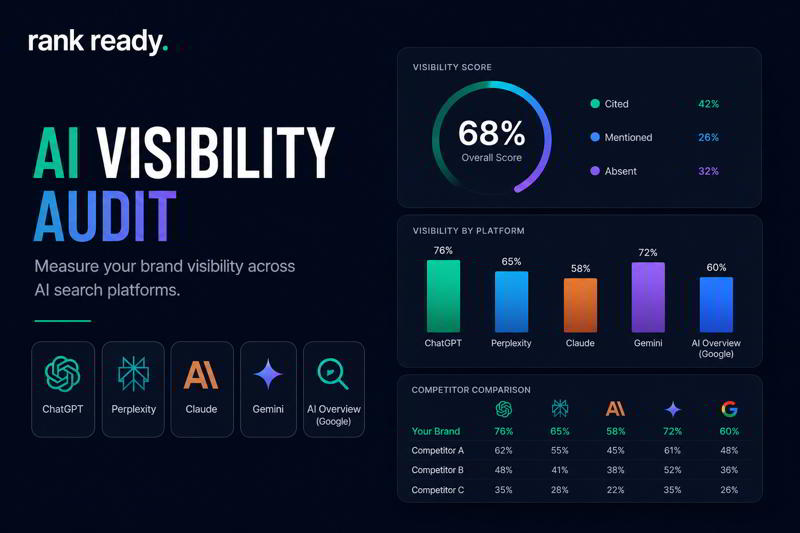
Now it’s time to turn observations into data.Every prompt should receive one of three scores.Cited
The strongest outcome.Your brand appears and is supported by a source reference.This indicates strong AI visibility.Mentioned
Your brand appears but receives no citation.This is still valuable visibility but generally less powerful than a direct citation.Absent
Your brand does not appear.This indicates an opportunity gap.Most businesses discover far more absent results than expected.Calculate your visibility score
Create a simple formula:- Cited = 2 points
- Mentioned = 1 point
- Absent = 0 points
Step 4: Identify Which Sources AI Engines Pull From
This is where the real insights begin.Most businesses focus on whether they appear.The smarter question is why they appear.Document every citation source
Common sources include:- Industry publications
- Review sites
- Directories
- Wikipedia
- Company websites
- News coverage
Look for entity signals
Many AI engines rely heavily on entity understanding.Businesses with stronger entity development frequently outperform competitors.If you’re missing key entity signals, our guide to Wikipedia and Wikidata entity establishment explains why those assets increasingly influence AI discovery.Step 5: Compare Your Visibility vs. Three Competitors
An AI visibility audit becomes significantly more valuable when viewed in context.That’s why competitor analysis matters.Select three direct competitors and repeat the same process.Track the same metrics
- Citations
- Mentions
- Visibility score
- Source frequency
Step 6: Build the Gap-Fill Action List
Every audit should end with actions.Not observations.Prioritize visibility gaps
Common opportunities include:- Missing industry mentions
- Weak entity profiles
- Insufficient topical coverage
- Limited brand citations
- Thin supporting content
Tools That Can Automate This
Manual audits work well.Software can accelerate the process.Popular options include:- Otterly
- Profound
- Peec.ai
What Good Results Look Like (The Benchmark)
Most businesses ask the same question:What’s a good score?There’s no universal benchmark.But a useful framework looks like this:- 0–20% visibility = weak
- 20–40% visibility = developing
- 40–60% visibility = competitive
- 60%+ visibility = strong
When to Stop DIY-ing and Hire Help
A DIY GEO audit DIY process works well for benchmarking.Eventually, most businesses need deeper analysis.Common triggers include:- Persistent AI visibility gaps
- Competitive industries
- Multi-location businesses
- Enterprise content libraries
- Rapid growth goals
Common Mistakes That Distort an AI Visibility Audit
Most businesses don’t struggle because they skip an AI visibility audit.
They struggle because they measure the wrong things.
The most common mistake is using branded prompts exclusively.
If you ask ChatGPT about your company by name, there’s a good chance you’ll appear in the answer.
That doesn’t tell you how visible you are during actual buyer research.
Real buyers ask category-level questions.
They search for recommendations, alternatives, comparisons, and best-of lists.
Those are the prompts that matter.
Other common audit mistakes
- Testing only one AI platform
- Using fewer than ten prompts
- Ignoring citation sources
- Comparing against the wrong competitors
- Tracking mentions but not citations
A strong AI visibility audit focuses on patterns rather than individual results.
One mention doesn’t matter much.
Consistent visibility across dozens of prompts does.
How Often Should You Run an AI Visibility Audit?
Unlike traditional rankings, AI visibility can change quickly.
New citations, fresh content, industry mentions, and entity signals can influence recommendations within weeks.
That’s why AI visibility should be monitored regularly.
A practical reporting schedule
- Monthly for competitive industries
- Quarterly for most businesses
- After major content campaigns
- After digital PR initiatives
- Following significant website changes
Google’s documentation on AI Overviews highlights how AI-generated search experiences continue evolving, making ongoing monitoring increasingly important.
The objective isn’t checking visibility every day.
The objective is identifying trends before competitors do.
Businesses that monitor AI visibility consistently tend to identify citation opportunities earlier and close visibility gaps faster.
That’s one reason the best-performing brands treat an AI visibility audit as an ongoing process rather than a one-time project.

0 Comments