
What Helpful Content Is (and Isn’t)
The Helpful Content System is not a penalty.It’s not a manual action.It’s not something that targets individual pages in isolation.Google describes it as a system designed to identify content primarily created for search engines rather than people.What the system is designed to reward
- Original insights
- Demonstrated expertise
- First-hand experience
- Clear answers to search intent
- Content that satisfies readers completely
What it isn’t designed to reward
- Mass-produced content
- Keyword-first publishing
- Thin affiliate pages
- AI-generated content with no added value
- Pages written solely to attract traffic
What Google Says Publicly + What We’ve Observed
Google’s public documentation provides a useful starting point.The company’s Helpful Content guidance repeatedly emphasizes people-first content.At the same time, real-world SEO audits reveal additional patterns.What Google says
Google encourages publishers to create content that:- Demonstrates expertise
- Satisfies search intent
- Provides substantial value
- Shows first-hand experience where relevant
What we’ve observed
Sites hit hardest by Helpful Content updates often share common characteristics:- Large volumes of thin content
- Minimal original insights
- Heavy template usage
- Weak topical authority
- Overreliance on outsourced content production
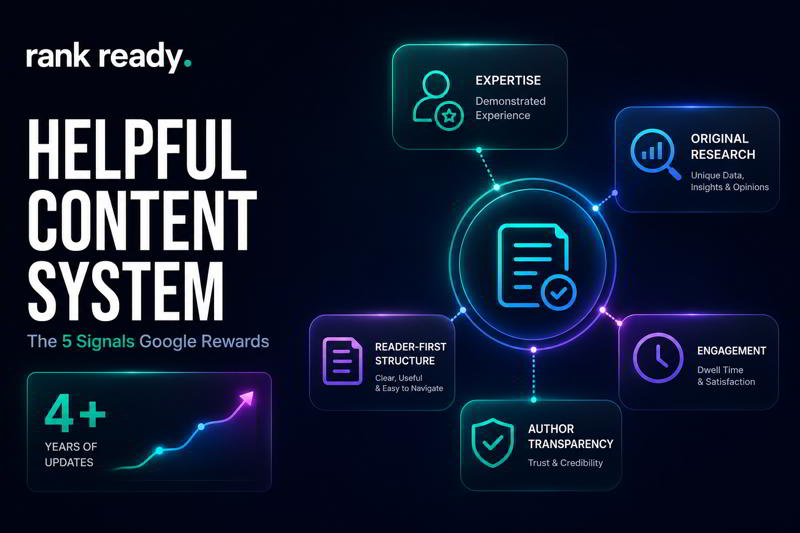
Signal 1: Demonstrated Expertise (E-E-A-T Evolution)
E-E-A-T remains one of the strongest frameworks for understanding the Helpful Content System.Experience, Expertise, Authoritativeness, and Trustworthiness continue shaping how Google evaluates quality.Experience changed everything
The addition of “Experience” created a major shift.Google increasingly rewards content written by people who have actually done the thing they’re describing.Examples include:- A lawyer discussing legal procedures
- A contractor reviewing roofing materials
- A marketer sharing campaign results
- A founder explaining operational lessons
Expertise must be visible
Expertise isn’t enough.Readers and search engines need evidence of it.That evidence often appears through:- Case studies
- Examples
- Data
- Unique insights
- Author credentials
Signal 2: Original Research, Data, Opinions
One of the clearest indicators of content quality is originality.If your article could have been generated by summarizing the first ten search results, it’s unlikely to become a long-term winner.Original data creates defensibility
Google consistently rewards content that contributes something new.Examples include:- Survey results
- Industry research
- Internal datasets
- Case studies
- Performance benchmarks
Opinions matter when they’re informed
Many publishers avoid opinions because they fear appearing subjective.The opposite is often true.Strong, informed opinions help differentiate content from generic summaries.The key is supporting those opinions with evidence.Signal 3: Engagement + Dwell Signals
Google rarely confirms specific user-behavior signals.But ignoring engagement entirely would be a mistake.Users reveal quality
When readers:- Stay longer
- Read multiple pages
- Return later
- Engage with content
Engagement follows usefulness
Trying to manipulate engagement rarely works.Improving usefulness does.Readers stay when content answers questions better than alternatives.That’s the foundation of every successful Helpful Content System strategy.Signal 4: Reader-First Structure
Good content isn’t just about information.It’s about accessibility.Readers scan before they read
Most visitors don’t consume content linearly.They scan headings first.They evaluate structure.They decide whether the article deserves their attention.Strong content structures typically include:- Clear H2s
- Useful H3s
- Short paragraphs
- Bullets where appropriate
- Logical flow
Organization supports quality
The best information in the world becomes ineffective if readers can’t find it quickly.Reader-first formatting improves usability and supports stronger content quality signals.Signal 5: Author Transparency
Anonymous content became significantly riskier after repeated Helpful Content updates.Who wrote this?
Google increasingly values transparency.Readers do too.Strong content typically includes:- Author information
- Business information
- Editorial standards
- Contact details
Authority should be visible
Sites that hide expertise often struggle to benefit from it.If your team has relevant experience, showcase it.Transparency strengthens trust.What HCU-Affected Sites Had in Common
Across hundreds of SEO audits, the patterns are surprisingly consistent.Sites impacted by a Helpful Content update often shared:- Thin content at scale
- Weak topical authority
- Minimal original insights
- High publishing volume
- Little evidence of expertise
What Recovered Sites Had in Common
Recovery rarely happened through small tweaks.It usually required structural changes.Common recovery patterns
- Removing low-quality content
- Consolidating overlapping pages
- Adding expertise signals
- Improving topical depth
- Strengthening internal linking
How to Write for HCU in 2026 (Practical Guide)
If you’re creating content in 2026, assume Google will evaluate it through the lens of usefulness.That changes the writing process.A practical publishing framework
- Start with real audience questions.
- Add first-hand experience wherever possible.
- Include original examples or data.
- Cover the topic comprehensively.
- Structure content for scanning.
- Demonstrate expertise visibly.
- Link related topics together.
- Update content regularly.
Common Helpful Content System Mistakes That Still Hurt Rankings
One of the biggest misconceptions about the Helpful Content System is that it only targets obviously low-quality content.
In reality, many affected sites contain technically accurate content. The problem is that accuracy alone is no longer enough.
Google increasingly evaluates whether a page contributes something useful beyond what’s already available elsewhere.
The patterns we see repeatedly
- Publishing dozens of near-identical articles targeting keyword variations
- Rewriting competitor content without adding new insights
- Using AI-generated drafts with little human expertise added
- Creating content outside the site’s actual area of authority
- Prioritizing publishing volume over usefulness
Many of these tactics worked for years.
They work far less effectively today.
The strongest sites focus on depth rather than volume. Instead of producing ten shallow articles, they publish one comprehensive resource that genuinely answers the reader’s questions.
That’s the direction the Helpful Content System continues pushing the web — fewer pages, better information, and clearer demonstrations of expertise.
Why Content Quality Has Become a Site-Wide Evaluation
One important shift many publishers still underestimate is that Google increasingly evaluates content quality at the site level rather than the page level alone.
A single excellent article can struggle if it’s surrounded by hundreds of weak pages.
That’s why content audits have become more important than ever.
Quality patterns matter
When Google reviews a site, it can identify broader publishing patterns.
Questions the system appears to evaluate include:
- Does the site consistently demonstrate expertise?
- Are articles adding original value?
- Do authors have relevant experience?
- Is the content helping readers accomplish goals?
- Does the site show topical authority?
Sites that perform well under the Helpful Content System rarely rely on a handful of standout pages.
Instead, they create a consistent pattern of useful, trustworthy content across the entire domain.
That’s often the difference between short-term rankings and long-term visibility growth.

0 Comments